
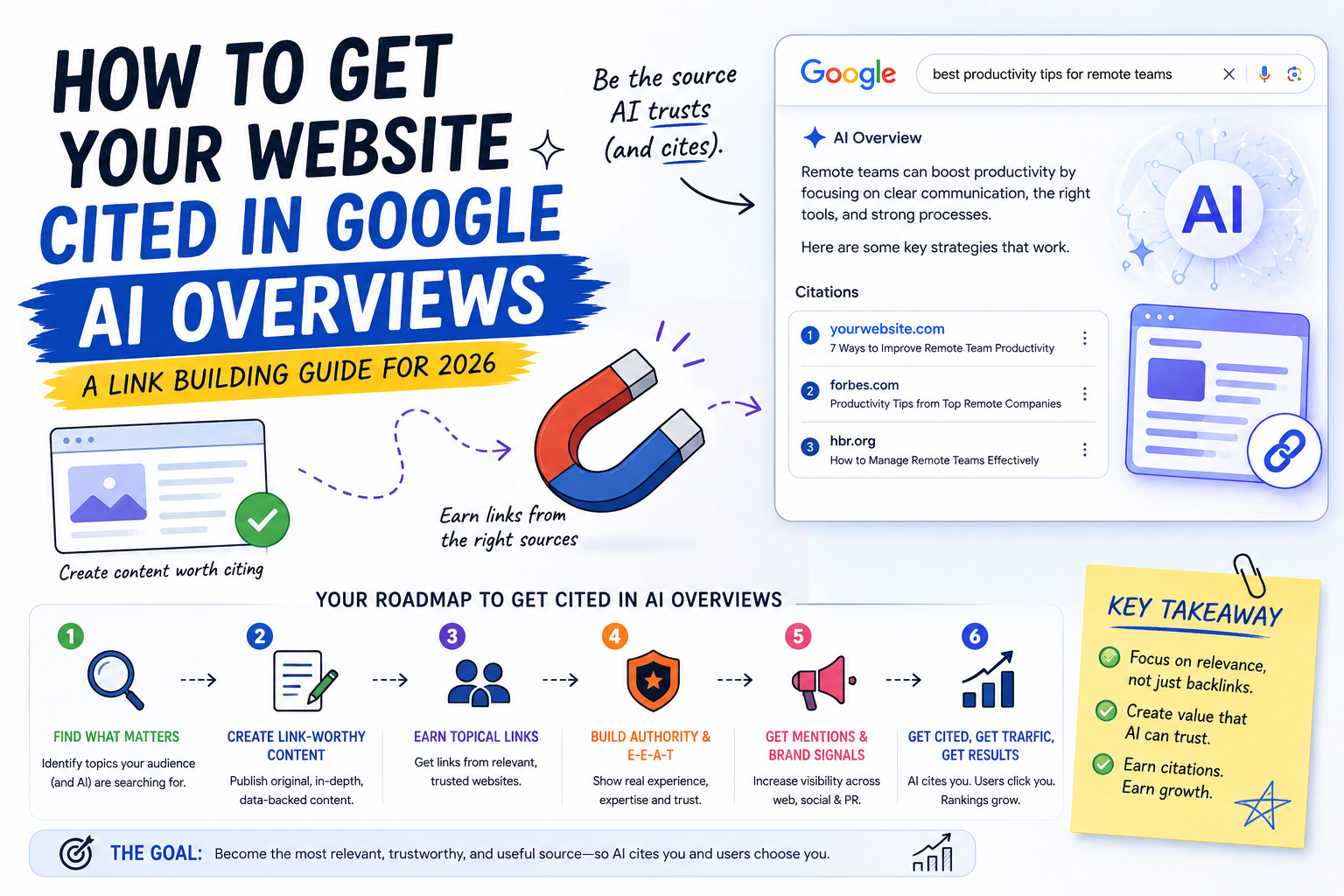
Google’s AI Overviews have changed the search results page more fundamentally than any update since the introduction of featured snippets. They now appear on more than 50 percent of all US searches, they sit above every organic result, and they give users a direct answer before a single blue link is visible. For any site trying to build organic visibility in 2026, ignoring AI overviews is no longer an option.
The good news: the same link building investment that improves your organic rankings also directly improves your chances of being cited in Google AI Overviews. Backlinks are not the only signal — but they are the foundation of the authority Google’s AI uses to select which sources it trusts enough to cite. This guide breaks down exactly how that works, what the data shows, and the specific steps to take to appear in AI Overviews for your target queries.
What makes this guide different from every other article on this topic: it is written specifically for SEOs and link building campaigns — not for general content teams. Every recommendation connects directly to actions you can take in your AI Overview link building strategy right now.
What Are Google AI Overviews and Why Do They Matter for Link Building?
A Google AI Overview (AIO) is an AI-generated answer block that appears at the top of search results for informational and commercial queries. Google’s Gemini model synthesizes information from multiple indexed sources and presents a direct answer — with clickable citation links to the pages it drew from.
The numbers from the 2026 research make the stakes clear:
- 50 to 60 percent of US searches now trigger an AI Overview — up from just 6.49 percent in January 2025
- Organic CTR drops 34 to 61 percent for queries where an AI Overview appears above the results
- Pages cited inside an AI Overview earn 35 percent more clicks than pages ranking in standard organic positions below
- AI Overview traffic converts at 14.2 percent versus traditional organic traffic at 2.8 percent — a 5x quality premium
- 76 percent of AI Overview citations come from pages already ranking in the top 10 — but 46.5 percent of cited URLs rank outside the top 50, meaning structure and authority can overcome lower rankings
The key insight for link building: being cited in an AI Overview is not an accident. Google’s AI selects sources based on four criteria — relevance, extractability, trust, and proof. Backlink authority is the single most controllable trust signal you can build. It is also the signal most directly in MonkeyGoals’ wheelhouse.
How Backlinks Directly Influence AI Overview Citations
COMPETITOR GAP: Every competitor article explains content formatting and schema. None explains specifically how your backlink profile determines whether Google’s AI trusts you enough to cite you. This is the section no other article has.
The relationship between link building for AI Overviews and citation selection is direct but often misunderstood. Google’s AI does not independently evaluate every page on the web from scratch when generating an AI Overview. It draws heavily from existing search authority signals, and backlinks are the most powerful of those signals.
Backlinks build the domain authority that gets you into the citation pool
Google’s AI retrieval system pulls candidates for AI Overview citations from pages that are already indexed, crawled regularly, and considered authoritative. A page with strong backlinks from topically relevant, high-traffic sites is crawled more frequently, assigned more authority, and therefore more likely to be in the pool of pages Google’s AI evaluates for citation.
Research from Ahrefs in 2026 found that 76.1 percent of URLs cited in AI Overviews also rank in the top 10 for that query in standard organic search. Ranking in the top 10 requires, above all, else, backlinks. This means AIO link building and traditional SEO link building are not separate activities. They are the same activity, with AI citations as an additional output of a strong backlink profile.
Editorial backlinks signal the trustworthiness that Google’s AI requires
Google’s AI is specifically designed to avoid citing unreliable sources. It weighs sources that are cited by other authoritative sites, which is exactly what a quality backlink from an editorial publication represents. A guest post on a genuine niche publication with real editorial standards sends a signal to Google: this source has been evaluated and endorsed by another trusted voice in the industry. That endorsement carries directly into Google AI Overview SEO citation probability.
Topical backlinks reinforce the entity authority that AI systems rely on
Google’s AI evaluates content through an entity lens — it needs to understand what your site is definitely about before it will cite you as an authority in that topic area. Backlinks from topically related sites strengthen this entity association. A link insertion in a relevant article signals to Google: this domain is a recognized entity within this subject area. Build enough of these signals, and Google’s AI begins treating your site as a default citation candidate for queries in your niche.
What Google’s AI Actually Looks for When Selecting Citations
Based on the 2026 research data from studies of AI Overview citation patterns, here are the confirmed signals that determine whether a page is cited. This is what “how to rank in Google AI Overviews” actually means in practice.
Citation signal | What it means | How link building helps | Priority |
|---|---|---|---|
Domain authority | How strong is the site’s overall backlink profile? | Quality backlinks from DR 30+ sites directly increase domain authority and citation eligibility | Critical |
Topical authority | Is this site recognized as an expert in the query’s subject area? | Niche-relevant backlinks from themed publications build topical-entity signals | Critical |
E-E-A-T signals | Does the site demonstrate real experience, expertise, authority, and trust? | Editorial links from reputable publishers are one of the strongest E-E-A-T signals. Google uses | Critical |
Page-level authority | How many quality links point to the specific page being evaluated? | Link insertions and guest posts pointing to target pages directly boost page authority | High |
Content extractability | Can Google’s AI easily pull a clean, direct answer from the page? | Link building does not affect this — page structure and formatting do. | High |
Brand mentions across the web | Is the brand consistently referenced by other trusted sources? | Every quality backlink is a brand mention signal — the two compound together | Medium |
Crawl frequency | How often does Google visit and re-evaluate the page? | High-authority backlinks increase crawl frequency — Google checks trusted pages more often | Medium |
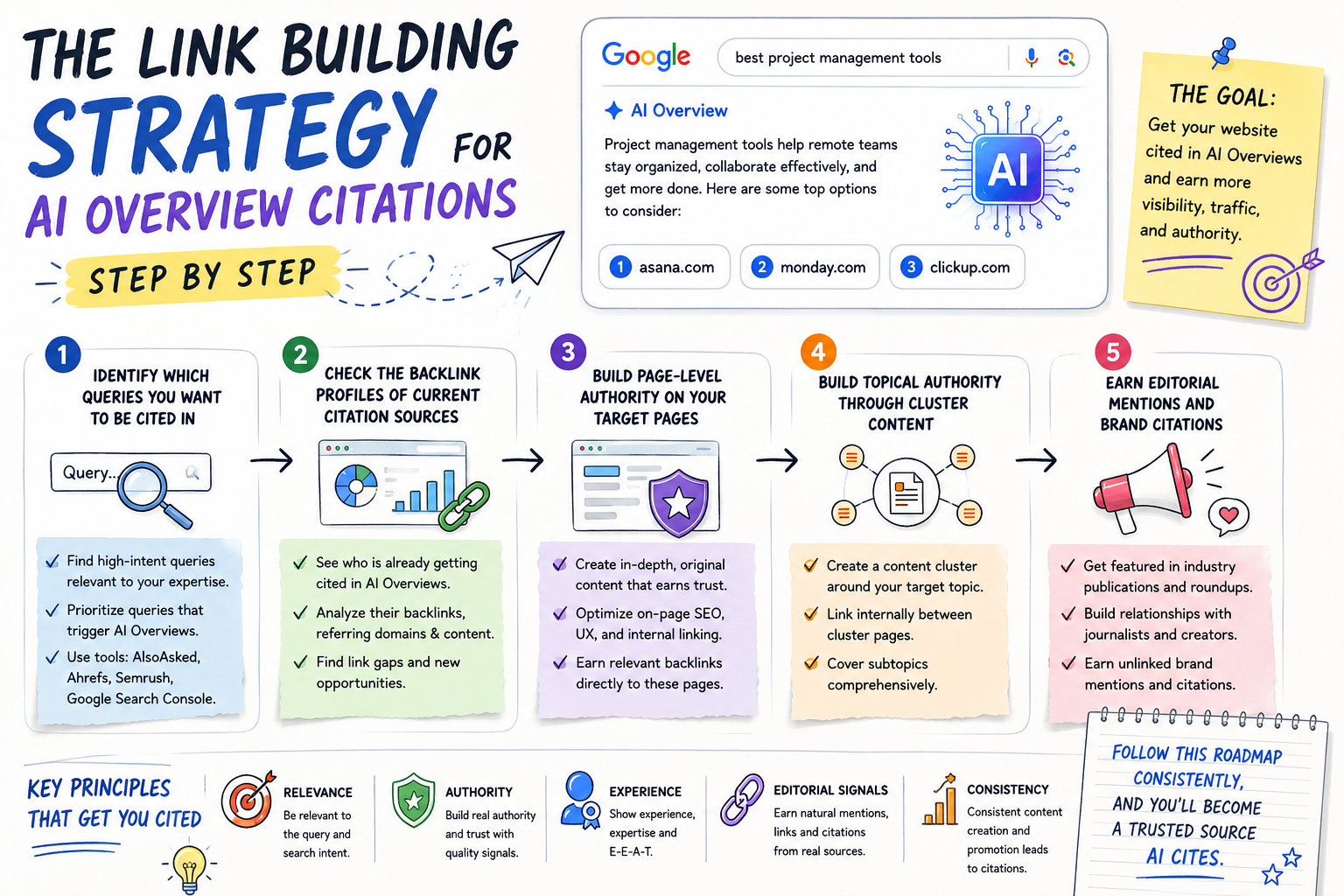
The Link Building Strategy for AI Overview Citations: Step by Step
Here is the specific AI Overview link building strategy to implement for each target query you want to be cited in. These steps work both for new campaigns and for sites that already have an organic presence but are not yet appearing in AI Overviews.
Step 1 — Identify which queries you want to be cited in
Open Google and search your 10 most important target keywords. Note which ones trigger an AI Overview. These are your primary citation targets. For each one, check which sources Google is currently citing — these are your direct competitors for citation authority. Use Semrush’s AI Toolkit or Otterly. AI to track AI Overview appearances at scale.
Step 2 — Check the backlink profiles of current citation sources
For each page currently being cited in an AI Overview for your target query, run it through Ahrefs and check its referring domain count and DR. This gives you the authority benchmark you need to compete. If current citation sources have 15 to 40 referring domains, that is your target. Build to match or exceed that count with quality, topically relevant backlinks pointing directly to your target page.
Step 3 — Build page-level authority on your target pages
Most link building campaigns build authority at the domain level. For the AI Overview citation specifically, you need authority at the page level — links pointing directly to the page that answers the target query. A link insertion in an existing, ranking article that links directly to your target page is the fastest way to build page-level authority. Use anchor text that matches the topic closely — not exact match keyword stuffing, but clear topical anchoring.
Step 4 — Build topical authority through cluster content
Research published in 2026 found that pages ranking for both the main query and at least one related sub-query were 161 percent more likely to be cited in AI Overviews. This means a narrow article targeting one keyword is significantly less likely to earn a citation than a page that is part of a wider content cluster.
Build your link building campaign to support the entire cluster — not just the primary page. Guest posts linking to related cluster articles, with internal links back to the pillar, signal to Google that your site is the comprehensive authority on the topic area, not just a single-page answer.
Your existing blog already covers several interconnected topics: AI and SEO, link building timelines, domain rating, guest posting, and link insertion services. Link building that connects these pages builds the topical cluster signals that Google’s AI rewards.
Step 5 — Earn editorial mentions and brand citations
Research from Profound in March 2026 found that LinkedIn is the most cited domain for professional queries in AI Overviews. Reddit appears in 37 percent of Google SERPs and is consistently one of the most cited sources. Third-party mentions of your brand — in guest posts, industry publications, and authoritative directories — contribute to how Google’s AI perceives your entity authority.
Every quality manual blogger outreach placement is simultaneously a backlink and a brand mention. These compound over time: as more authoritative sites reference your content, your site becomes a more recognizable entity to Google’s AI system — making each subsequent citation more likely, not less.
What Your Page Must Look Like to Be Extractable by Google’s AI
COMPETITOR GAP: Competitors cover content structure but not how to combine it with link building for maximum AI Overview impact. This section bridges both — the only article to do so.
Building the right backlink profile gets your page into Google’s AI citation pool. But once you are in that pool, the page’s structure determines whether Google can extract a clean answer. Both elements are required — authority gets you considered, and extractability gets you cited.
Structure your target pages using this format for maximum AI citation probability:
- Lead with a direct answer in the first 60 words after the H2 heading. Google’s AI citation data shows answers appearing in the first 20 percent of a page are cited most frequently. Write as if Google might quote your opening paragraph directly — because it might.
- Use H2 and H3 headings that mirror the exact questions searchers ask. AI Overviews often trigger on multi-part queries. Each H2 that directly matches a related sub-question gives Google an additional extraction point — and increases your citation probability for multiple related queries.
- Include specific, verifiable statistics with named sources. A claim with a cited source is more citable than a general statement. Write: ‘According to Ahrefs 2026 data, 76.1 percent of AI Overview citations come from top 10 ranking pages’ — not ‘most cited pages rank well. AI systems are trained to weight sourced, specific claims.
- Build dedicated FAQ sections at the bottom of every article. FAQ-formatted content is the structure most consistently cited from deep-page positions. Each question-answer pair is a discrete citation target. The FAQ section in this article is itself optimized for AI Overview extraction.
- Use schema markup — Article and FAQPage minimum. Schema does not guarantee citations, but it reduces ambiguity and improves machine understanding. Google’s AI can process structured data faster than free-form prose — particularly for definitions, steps, and FAQs.
MonkeyGoals builds links. You structure the content. Every article in this blog is already built with an AI-extractable structure — direct answers, FAQ sections, clear H2 headings, and Article + FAQPage schema. Combine that structure with quality backlinks from topically relevant, editorial sites, and you have both ingredients Google’s AI needs to start citing your content.
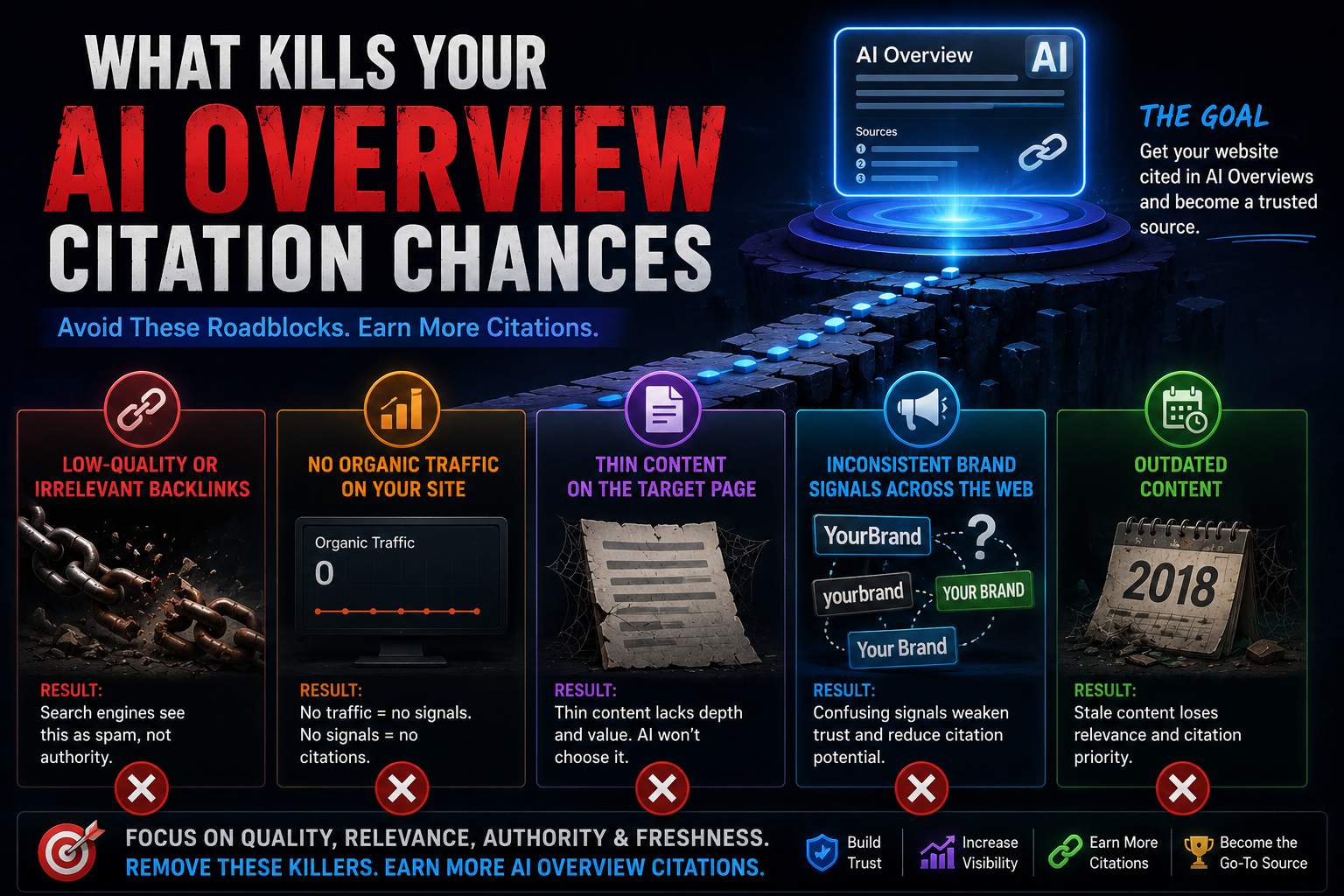
What Kills Your AI Overview Citation Chances
Just as important as what to do is what to avoid. These mistakes actively reduce your probability of being cited in Google AI Overviews — even if your content is well-structured.
- Low-quality or irrelevant backlinks: Links from PBNs, link farms, or off-topic sites do not build authority. Google’s AI uses it for citation decisions. They can actively harm your domain’s trust signals. Every link in your profile is evaluated — not just the ones pointing to your target page.
- No organic traffic on your site: Google’s AI draws citations from pages it sends users to. A site with zero organic traffic is a site Google does not yet trust as a destination. Build organic traffic alongside link building — they are mutually reinforcing.
- Thin content on the target page: Google’s AI will not cite a page that cannot provide a complete, extractable answer. Even with strong backlinks, a 300-word page covering a complex topic will be passed over in favour of a comprehensive, structured answer from a slightly less authoritative source.
- Inconsistent brand signals across the web: Google’s AI evaluates entity consistency — your brand name, contact information, and topic associations should be identical across your website, LinkedIn, Google Business Profile, and any other platform. Inconsistency confuses the entity recognition system.
- Outdated content: Content published in 2023 is significantly less likely to be cited in 2026 than content updated in Q1 2026. Refresh your highest-priority pages quarterly with new data, updated statistics, and current examples. Add a ‘Last updated’ date visibly to each page.
How to Measure Whether You Are Being Cited in AI Overviews
COMPETITOR GAP: No competitor gives a practical measurement framework. Agency owners need to know how to prove AI Overview performance to clients. This section solves that.
Tracking AI Overview optimisation 2026 performance is less straightforward than tracking standard rankings — but it is measurable. Use this framework to monitor your citation presence and prove performance to clients.
Measurement method | What it tracks | Tool | Frequency |
|---|---|---|---|
AI Overview impressions in GSC | Pages appearing in AI Overviews via Web search type | Google Search Console (as of June 2025) | Weekly |
Manual query sampling | Which queries trigger AIOs, and whether your site is cited | Manual Google search, incognito | Monthly — track your top 20 target queries |
AI visibility tracker | Systematic citation tracking across hundreds of queries | Otterly.AI or Semrush AI Toolkit | Monthly |
Ahrefs traffic tracking | Organic traffic to pages optimised for AI citation | Ahrefs Site Explorer | Monthly |
DR and referring domain growth | Whether backlink authority is increasing on target pages | Ahrefs or Semrush | Monthly |
Brand mention tracking | Whether your site is being referenced in new publications | Google Alerts or Mention.com | Weekly |
For agency clients, build a monthly AI Overview report that shows which target queries now trigger an AIO, whether your client’s site is cited, which pages are cited, and the trend over time. This reframes the conversation from ‘Why has nothing happened yet? ‘to ‘Here is the citation authority we are building month by month’ — the same communication framework we recommend in our link building timeline guide.
Final Thoughts
Google AI Overviews have permanently changed what it means to rank in 2026. Being on page one is no longer enough if an AI Overview appears above the results and answers the query before anyone scrolls. The sites that thrive will be the ones cited inside those AI Overviews — and citation is earned through the same investment that has always driven SEO results: quality backlinks from authoritative, topically relevant sources.
The strategy is clear: build page-level authority on your highest-priority target pages through quality guest posts and link insertions. Structure each page with direct answers, clear headings, cited statistics, and FAQ sections. Support the entire content cluster — not just the primary page. And measure citation presence monthly so you can demonstrate progress before rankings fully materialize.
The window to establish citation authority in your niche is open right now. Research suggests that AI systems reinforce existing citation choices over time — the brands that become default citation sources in 2026 will have compounding advantages that later entrants cannot easily overcome. The time to build that profile is now, not after your competitors have already claimed the citation positions in your category.
Want to build the backlink profile that gets you cited in Google AI Overviews?
MonkeyGoals builds high-quality, editorially placed links on topically relevant, traffic-verified sites — exactly the link profile Google’s AI uses it as a trust signal when selecting citation sources. Guest posts and link insertions cost $79 per placement.