
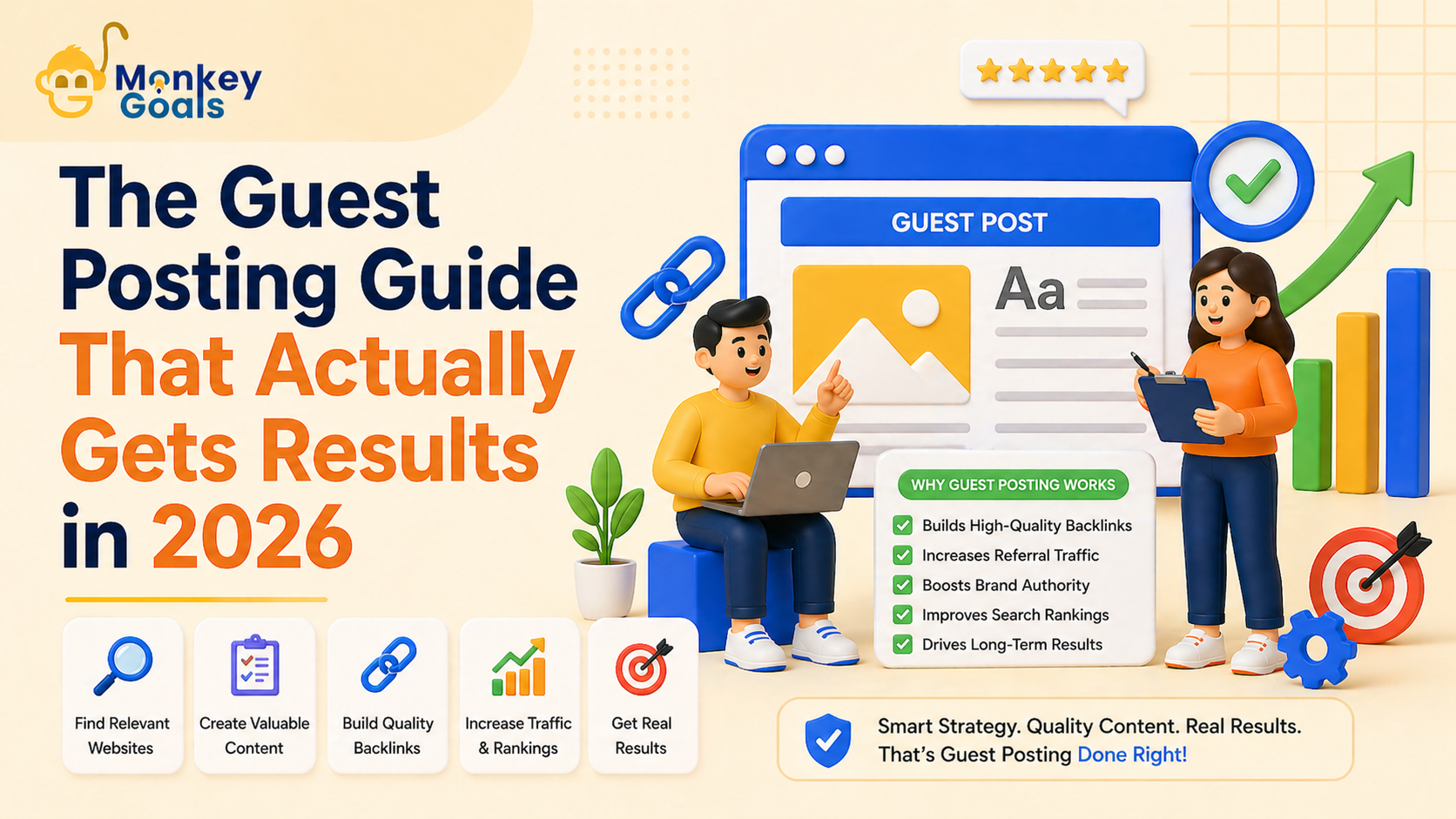
Let’s be honest — if you’ve been running the same guest posting playbook from 2022, you’re probably not seeing the results you used to.
That’s not because guest posting stopped working. It’s because the bar moved. And most agencies, tools, and guides haven’t caught up.
This is the real-deal guest posting guide for 2026: what’s driving rankings, what’s quietly tanking sites, the verified data behind it all, and how Monkey Goals helps brands build authority the right way — without shortcuts that come back to bite you.
Table of Contents
ToggleWhat Guest Posting Actually Means in 2026
Guest posting — also called guest blogging — is the practice of publishing original content on a third-party website in your niche. In return, you earn a contextual backlink to your own site.
Simple concept. Wildly different results depending on how you execute it.
In 2026, guest posting has evolved from a numbers game into a credibility game. Google’s algorithm has gotten much better at evaluating the quality of link relationships — not just their quantity. A single well-placed guest post on a relevant, high-traffic site in your niche can outperform dozens of mediocre placements on general-interest blogs.
The shift can be summarized like this:
| Old Guest Posting (Pre-2023) | Guest Posting in 2026 |
|---|---|
| Volume-first — pitch as many sites as possible | Quality-first — target sites your audience actually reads |
| DA/DR as the primary vetting metric | Real traffic + topical relevance as primary metrics |
| Exact-match anchor text | Natural, branded, and partial-match anchors |
| Generic content written around a link | Expert-level content that earns the link |
| Mass email outreach | Personalized, relationship-based pitching |
Why Guest Posting Still Matters — The Data
Before getting into strategy, let’s address the elephant in the room: is guest posting actually still worth it in 2026?
Yes. Here’s why the data backs that up.
Guest posting is the most widely used link-building strategy, favored by 64.9% of marketers according to DemandSage’s 2026 link building research. That number doesn’t reflect a dying tactic — it reflects one that has matured.
More importantly, 73.2% of marketers believe backlinks influence a brand’s chance of appearing in AI search results like ChatGPT and other LLMs. That’s a massive shift in why guest posting matters. It’s not just about Google rankings anymore — it’s about getting cited in AI-generated answers on Perplexity, ChatGPT, Gemini, and Google’s AI Overviews.
Research from Position.digital (April 2026) found that distributing content across multiple publications can increase AI citations by up to 325% compared to publishing only on your own site. Guest posts, when placed on authoritative niche sites, are exactly the kind of distributed content that feeds AI citation engines.
And if you’re worried about diminishing returns: 68% of link builders believe link building will become more important in the next two years — specifically because of AI, not in spite of it. As AI Overviews and LLMs crowd out traditional SERP real estate, brands with stronger backlink profiles and broader editorial presence will dominate what’s left.
Want to understand how AI is reshaping SEO right now? Read our guide: AI and SEO: Why Smart Businesses Are Changing Their Strategy in 2026
The Hard Truth About Most Guest Posting Sites
Here’s the stat that should stop you before you buy your next link package:
86% of guest posting sites on the market are low quality — meaning they have fewer than 10,000 monthly visitors and a Domain Rating below 40, according to BuzzStream’s study of over 26,000 guest post sites.
Even worse: nearly 1 in 5 of those sites had between 0 and 100 monthly visits — making them essentially invisible to both Google and real humans.
A real-world example from January 2026 shows exactly what this looks like in practice: a financial services company discovered over 500 backlinks from low-quality Eastern European directories using exact-match commercial anchor text. The result was a 40% drop in organic visibility in just two weeks.
This is what happens when you buy links from low-quality networks — regardless of how convincing the DA numbers look in the pitch deck.
The average quality guest post costs around $609, according to DemandSage’s research. Top-tier links from authoritative sites, when sourced through vendors, can run $2,500–$3,000. Anyone selling you $30 guest posts is selling you risk, not results.
What No Longer Works in 2026 (Stop Doing These)
Mass Email Blasts
Sending 500 identical pitches with the same subject line and topic list isn’t outreach — it’s spam. Open rates are lower, editors are more frustrated, and even when you land a placement this way, the editorial standards of the site are usually poor enough that the link doesn’t help you.
Personalized pitches that reference specific content on the target site, demonstrate genuine familiarity with their audience, and offer a concrete relevant topic idea perform dramatically better. One well-researched pitch to the right editor beats 100 template emails.
This is exactly why Monkey Goals operates exclusively with manual blogger outreach — no bulk emails, no automation, no templated spray-and-pray.
Exact-Match Anchor Text Overuse
If your backlink profile is full of “best SEO agency London” and “affordable link building services” as anchor text across dozens of guest posts, you’ve built an unnatural pattern that Google flags.
Natural anchor text in 2026 looks like: your brand name, your URL, partial-match phrases, and contextually descriptive language that serves the reader. Branded and natural anchors are safer and perform just as well — or better.
Paying for Link Farms and PBNs
Private Blog Networks and link farms still get sold. They look attractive on paper — high DA, quick turnaround, affordable pricing. And they still carry serious algorithmic risk.
Google’s AI-powered detection has become significantly better at identifying link schemes — evaluating content authenticity, topical relevance, and user engagement signals at scale. Sites that accept any content from any source for a fee are increasingly being discounted or penalized outright.
AI-Spun or Generic Content
Editors in 2026 can spot AI-generated, lightly edited content immediately. Many quality publications have added explicit policies against it. Even where it slips through, it underperforms — generic content doesn’t earn engagement, shares, or secondary links.
Google’s E-E-A-T framework (Experience, Expertise, Authoritativeness, Trustworthiness) rewards content that demonstrates genuine knowledge: first-person experience, original perspectives, specific data, and a real point of view. A 500-word generic “what is” article isn’t going to make the cut.
That’s why every piece Monkey Goals places goes through our content creation process — written by in-house writers who understand SEO and editorial standards, not outsourced generalist content.
Ignoring Topical Relevance
A guest post on a cooking blog with a link to a cybersecurity company doesn’t help the cybersecurity company. Google evaluates the semantic relationship between linking and receiving domains — relevance is foundational, not optional.
A study of 5,000+ tech guest posts (GISuser.com, 2026) found that sites with strong topical alignment to the linking domain delivered measurably better ranking outcomes than high-DR sites with no topical connection.
What Actually Works — The 2026 Guest Posting Playbook
1. Prioritize Real Traffic Over Vanity Metrics
Domain Rating and Domain Authority are useful rough proxies, but they’re not the whole picture. A DR 45 niche blog with 40,000 monthly visitors from your target audience is far more valuable than a DR 70 general news site whose readers will never become your customers.
Before pitching any site, check:
- Organic traffic (Ahrefs, Semrush) — aim for at least 5,000–10,000 genuine monthly visits
- Audience alignment — are their readers the same people you’re trying to reach?
- Editorial standards — does the site publish well-researched, original content?
- Engagement signals — comments, social shares, active community
2. Build Real Relationships Before You Pitch
The best guest posts in 2026 don’t start with a pitch email — they start with a relationship. Follow editors and contributors on LinkedIn. Comment on their content meaningfully. Share their work. When you eventually reach out, you’re not a cold stranger — you’re a peer.
For most high-authority placements, the relationship IS the pitch. Practitioners who approach editors as collaborators and provide value upfront see dramatically higher acceptance rates at premium publications than those using cold outreach templates.
3. Write Expert-Level Content, Not Filler
The bar for what gets published on quality sites has risen significantly. Editors are rejecting generic listicles and basic how-to posts in favor of content that offers:
- Original data or research
- Lived experience and first-hand examples
- Nuanced takes on industry debates
- Actionable frameworks backed by evidence
If your guest post could have been written by anyone with a basic Google search, it probably won’t get accepted — and if it does, it won’t perform. Guest posting authority comes from being an expert contributor, not a generic writer.
Content length matters too. The 5,000+ tech guest post study (GISuser.com, 2026) found short-form posts consistently underperformed. The most effective guest posts delivered real depth without unnecessary padding — for most niches, that lands between 1,200 and 2,500 words.
4. Get Your Anchor Text Strategy Right
Your anchor text distribution across your entire backlink profile matters. Before your next guest post, look at your existing anchors and ask: does this look natural?
A healthy anchor text breakdown in 2026:
| Anchor Type | Recommended Share |
|---|---|
| Branded (your company name) | 40–50% |
| Partial-match and contextual | 25–35% |
| Naked URLs | 10–15% |
| Exact-match commercial keywords | 5% or less |
Anything heavily skewed toward exact-match commercial terms is a red flag — and a penalty risk. If you’re unsure where your current profile stands, a proper SEO audit will surface these issues before they cause real damage.
5. Think Beyond the Link — AI Visibility Is Now Part of the Goal
This is the angle most guest posting guides are still missing in 2026.
Getting a backlink used to be the primary goal. In 2026, getting cited by AI systems is an equally important outcome. Research shows that 44.2% of all LLM citations come from the first 30% of a piece of text (Growth Memo, February 2026) — meaning your introduction needs to be citable, authoritative, and packed with real insight.
Brands mentioned consistently across multiple reputable publications — not just their own site — are far more likely to show up in ChatGPT answers, Perplexity summaries, and Google AI Overviews. Guest posting is one of the most effective ways to build that kind of distributed editorial presence.
When Monkey Goals places a guest post for a client, we think about AI citation architecture from the start: leading with clear, direct claims backed by data, structuring content for featured snippets, and ensuring every post passes the “would an AI cite this?” test.
How to Find Guest Posting Sites That Are Actually Worth It
Most people start with a “write for us” Google search. That works to a point — but those lists get spammed heavily, and sites openly advertising guest posts tend to have lower editorial standards than sites you approach directly.
Here’s a more effective approach:
Reverse-engineer your competitors. Use Ahrefs or Semrush to see where competing brands in your niche have earned placements. If a site published content from your competitor, it’s likely open to quality contributions from you too.
Search for bylines in your niche. Search “[your industry] + ‘guest author'” or “[topic] + ‘written by'”. This surfaces sites that actively publish external contributors even if they don’t advertise it.
Look at who’s linking to your best content. Sites that already link to content like yours are pre-qualified as topically relevant. Reach out with a specific pitch tied to a content gap you’ve spotted on their site.
Vet every site before you pitch. Check real organic traffic, topical focus, content quality, publication recency, and whether their own backlink profile looks clean.
How to Write a Guest Post Pitch That Gets Replied To
Most pitch emails fail within the first two sentences. Here’s what a pitch that actually works looks like:
Subject line: Specific, not clever. Reference their site or a recent piece. “Quick idea for [Site Name] — [Topic]” beats “Guest post inquiry” every time.
Opening: One sentence showing you actually know their content. Not “I love your site” — something specific.
The pitch: A clear, original topic idea with a one-line rationale for why it fits their audience. Not three vague headlines — one strong, specific angle.
Your credentials: Two sentences max. What makes you qualified to write this specific piece.
The close: Simple. “Happy to send a full outline if this sounds like a fit.”
No attachments. No portfolio links unless they asked. No “I’ll write anything you need.” Editors want confident contributors with specific ideas, not flexible generalists.
How to Measure Guest Posting Success (Beyond Backlinks)
Most brands track link count. The brands that actually win track outcomes.
| Metric | What It Tells You | How to Measure |
|---|---|---|
| Referral Traffic | Whether the placement reaches real readers | Google Analytics (source/medium) |
| Keyword Ranking Changes | Whether links are passing SEO equity | Ahrefs, Semrush ranking tracker |
| Domain Rating Growth | Whether your overall authority is building | Monthly Ahrefs DR checks |
| Brand Search Volume | Whether placements are increasing brand awareness | Google Search Console branded queries |
| AI Citation Frequency | Whether you’re appearing in AI-generated answers | Manual checks on ChatGPT, Perplexity, Gemini |
| Engagement on the Post | Whether editors will work with you again | Comments, social shares, time on page |
A single high-quality guest post can trigger a chain of secondary links — content that references it, publications that cite it, journalists who quote it. That compounding effect is what makes quality placements worth every penny.
How Guest Posting Fits Into a Bigger Link Building Strategy
Guest posting works best when it’s not running in isolation. The brands seeing the strongest results in 2026 are combining it with:
Link Insertion Services — Placing your links inside existing, already-ranking content on relevant sites. Faster to secure, and often pointing from high-authority pages that are already getting Google traffic.
Manual Blogger Outreach — Building brand mentions and relationship equity alongside your backlinks. This amplifies the trust signals Google reads from your brand entity over time.
White Label Link Building — If you’re an agency managing multiple client campaigns, a white label partner handles the full outreach and placement workflow under your brand. Fully scalable without sacrificing quality.
Content Creation — Guest posts need somewhere strong to point. A link landing on a thin service page underperforms compared to one pointing to a detailed, well-structured resource that keeps visitors engaged.
Together, these create a link profile that looks natural to algorithms and is genuinely valuable to humans — which is exactly what Google’s helpful content guidelines are designed to reward.
For SaaS brands specifically, the link building dynamics look a bit different. Read our full breakdown: Link Building for SaaS Companies: Proven Strategies to Drive Organic Growth
How Monkey Goals Approaches Guest Posting Differently
At Monkey Goals, we don’t run link mills. We build editorial relationships.
Every guest posting campaign starts with two questions: Who is your customer? and What do they actually read? The answers drive everything — which sites we target, what topics we pitch, how we frame your expertise.
Here’s what our process looks like in practice:
Manual site vetting — Every site we pitch is evaluated for real traffic, audience alignment, editorial standards, and topical relevance. We don’t work from pre-approved lists of sites that have already been spammed into mediocrity.
Custom content creation — Every piece is written specifically for the publication it’s placed on, in a voice that fits their editorial standards. We don’t recycle one generic draft across five different sites.
Natural link placement — Anchor text, placement within content, and surrounding context are all considered. Links feel native, not bolted on.
AI-visibility optimization — We structure content so key claims appear in the first third of each piece, use schema-friendly formatting, and maximize the chance of AI citation alongside traditional search rankings.
Full campaign transparency — You get clear, readable monthly reports on referral traffic, ranking changes, and domain authority growth — not just a list of URLs and a spreadsheet you have to interpret yourself.
The result is guest posts that work on multiple levels: traditional SEO authority, referral traffic, brand credibility, and AI visibility — all from placements that don’t put your domain at risk.
👉 See our Guest Posting Services and pricing
Common Myths About Guest Posting in 2026
| Myth | Reality |
|---|---|
| “Guest posting is dead” | It’s the most widely used link-building strategy among professional SEOs (DemandSage, 2026) |
| “You need DA 70+ sites to see results” | Real traffic and topical relevance outperform raw authority scores |
| “More posts = more results” | One quality placement beats ten irrelevant ones every time |
| “All dofollow links help SEO” | Only contextually placed, editorially earned links pass meaningful value |
| “AI killed the need for backlinks” | 73.2% of marketers say backlinks now influence AI search visibility — more important than ever |
| “A big budget is required” | Smart targeting beats spray-and-pray volume regardless of budget size |
Final Word
This guest posting guide comes down to one shift in mindset: stop thinking about links and start thinking about credibility.
The brands winning at guest posting right now are building real editorial relationships, creating content that’s genuinely worth reading, and thinking beyond the backlink — does this placement make my brand more visible, more trusted, and more citable across every platform that matters?
That’s Google. That’s ChatGPT. That’s Perplexity. That’s Gemini. All of them.
That’s the standard Monkey Goals holds every placement to. No link farms. No AI-spun filler. No shortcuts that put your site at risk. Just strategic, relationship-driven guest posting that builds real authority — and keeps building it.
Frequently Asked Questions
Is guest posting still good for SEO in 2026?
Yes — when done right. Guest posting builds topical authority, earns contextual backlinks, drives referral traffic, and increasingly supports visibility in AI-generated search answers. The tactic works; only the low-quality version of it has been devalued.
How many guest posts should I publish per month?
Quality over quantity is the only answer that matters. For most businesses, two to four genuinely high-quality placements per month on relevant, authoritative sites will outperform ten posts on mediocre sites. B2B brands with longer sales cycles often see strong returns from just one or two premium placements per quarter.
What makes a guest posting site high quality in 2026?
Real organic traffic (5,000+ monthly visits as a baseline), topical relevance to your niche, genuine editorial standards with a human review process, engaged readership, and a clean backlink profile of its own.
Should I only pursue dofollow links?
Not necessarily. A contextual link from a highly relevant, authoritative site — even marked nofollow — can drive valuable referral traffic and brand exposure. The site’s audience and relevance matter more than the link attribute alone.
How do I know if my current link profile is healthy?
The fastest way is a proper SEO audit. It will surface over-optimized anchor text patterns, low-quality link sources, and any red flags before they cause ranking problems.
What's the difference between guest posting and link insertion?
Guest posting means publishing a new article on a third-party site with a link back to you. Link insertion means placing your link inside an article that already exists and already has traffic. Both work — the right choice depends on your goals, timeline, and the sites available in your niche.

Hayden Grace Lee is a content strategist and SEO writer at Monkey Goals, a white-hat guest posting and editorial outreach agency. He specialises in crafting long-form, search-optimised content that ranks, converts, and supports link building campaigns for businesses and agencies worldwide. Follow his work at monkeygoals.com.