
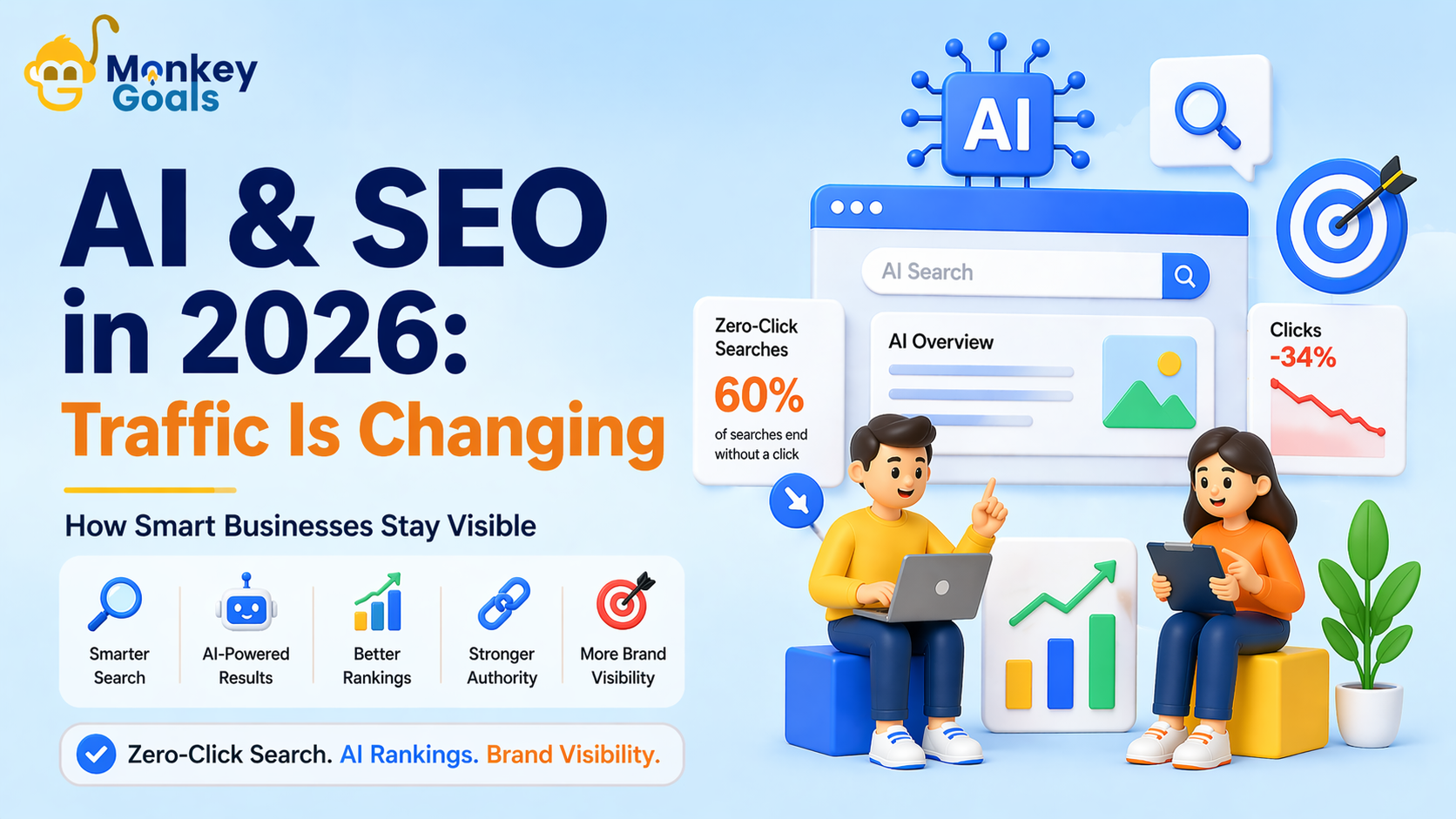
Search has changed more in the last three years than in the previous ten. Businesses that understand how AI and SEO work together will win visibility, authority, and traffic. The ones that don’t may quietly disappear from search results.
Key Statistics
- 60% of searches end with zero website clicks
- 61% of marketers use AI to improve SEO strategy
- 34%+ drop in clicks caused by AI summaries
- 49% ranking improvement with AI-assisted SEO
Imagine this: someone searches for what you offer on Google. Multiple articles appear covering your topic in detail. Sounds great, right?
Now imagine none of those articles are yours — and the answers come directly from an AI summary that never sends a visitor to any website.
That is the reality many businesses are facing right now. And it raises one urgent question: how do you win in an AI-powered search world?
The answer lies in understanding how AI and SEO work together — and acting on that understanding before your competitors do.
What Is AI and SEO?
Many people think AI will replace SEO. That idea is wrong.
AI and SEO refers to the intersection of artificial intelligence with search engine optimization. SEO focuses on helping search engines understand your content. AI helps machines interpret that content in a smarter, faster, and more context-aware way.
Together, they improve the overall quality of search — for both users and businesses.
Instead of only matching keywords, modern search engines now try to understand meaning. They analyze context, read full sentences, and study user intent. This means high-quality content matters more than ever. Pages that directly answer real questions are far more likely to appear in AI-generated results.
Key Insight: More than 65% of marketers report better SEO results when AI tools assist their work. AI is not replacing search optimization — it is becoming a core part of the process.
The Shift That Changed Search Forever
Search engines have always tried to give fast answers. AI simply made that process dramatically faster and smarter.
Instead of showing ten blue links, search engines can now generate a complete, structured answer that appears instantly on screen. This means users often get what they need without opening a single website.
Research shows that around 60% of internet searches now end without a website click, because AI answers the query directly on the results page. For years, traffic depended on rankings. Rank number one and you received clicks. Now ranking alone is not enough — your content must also become part of the AI-generated answer itself.
Why Clicks Are Declining — and What to Do About It
Many websites have noticed a significant drop in organic traffic. The main cause is zero-click searches — when a user finds the answer directly on the search page without clicking through to any website at all.
Reports suggest AI summaries can reduce website clicks by more than 34%. This does not mean SEO is dying. It simply means the goal is changing.
Instead of chasing clicks alone, businesses now need to focus on visibility and authority. If your brand becomes a trusted source, AI systems will reference it more often. That visibility still brings customers — even without a direct click.
Warning: Businesses that focus only on traditional click-based rankings — without adapting to AI search — risk losing visibility to competitors who appear directly in AI-generated answers.
AI Search vs Traditional SEO: Key Differences
Understanding how AI-powered search differs from traditional SEO helps you build the right strategy.
Aspect | Traditional SEO | AI and SEO (2026) |
How results are ranked | Keyword matching + backlinks | Meaning, intent + authority signals |
What users see first | 10 blue links | AI summary, then organic links |
Primary goal | Rank #1 to get clicks | Become a trusted cited source |
Content strategy | Keyword density + volume | Intent matching + complete answers |
Authority signals | Backlinks only | Backlinks + brand mentions + trust |
Search query style | Short keywords (2–3 words) | Full questions (long-tail queries) |
Best content format | Keyword-focused articles | Structured, question-answering content |
How AI Is Improving SEO Work
The good news: AI is not just changing how search works — it is also making SEO faster and more efficient. Many tasks that used to take hours can now be completed in minutes.
Some research shows AI can reduce keyword research time by up to 80%. This allows SEO professionals to spend more time on strategy, content, and creative decisions.
Common SEO Tasks AI Can Accelerate:
- Keyword research — Analyze thousands of keyword variations and search intent signals in seconds
- Content topic discovery — Identify content gaps and trending topics your audience is searching for
- Competitor gap analysis — Find topics and keywords competitors rank for that you don’t yet cover
- Search intent mapping — Group large keyword sets by user intent (informational, navigational, transactional)
- Content scoring — Evaluate existing content quality and identify specific improvement opportunities
Pro Tip: Use AI tools for research and analysis, but keep human expertise for strategy, creative direction, and brand voice. The businesses winning at AI and SEO combine both — they don’t replace one with the other.
Why Content Quality Matters More Than Ever
In the early days of SEO, repeating keywords was enough. Many websites stuffed phrases into every paragraph. That strategy no longer works.
Modern search systems — powered by AI — analyze meaning, not just words. They evaluate whether a page truly solves the user’s problem and whether it can be trusted as an authoritative source.
Studies show websites using AI-assisted SEO strategies have seen ranking improvements of close to 49% in some cases. However, those improvements come from better content — not from automation alone. Quality always wins in the long run.
What Makes Content High-Quality in 2026:
- Answers the full question — Not just the keyword, but the complete intent behind it
- Written for humans first — Clear language, logical structure, no unnecessary filler
- Structured for machines — Proper H2/H3 headings, clean HTML, and schema markup
- Backed by expertise or data — Original insights, research, or real-world experience
- Regularly updated — Fresh, accurate information consistently outranks outdated pages
The Role of Search Intent in Modern SEO
One of the biggest shifts in AI and SEO is how search engines now interpret user intent. Earlier, a keyword like “SEO tools” would produce basic lists. Now, search engines try to understand the actual goal behind the search.
The Four Types of Search Intent:
- Informational — User wants to learn something. Example: “What is AI SEO?”
- Navigational — User wants a specific page. Example: “Google Search Console login”
- Transactional — User wants to buy or act. Example: “Best SEO tool free trial”
- Commercial — User is comparing options. Example: “Semrush vs Ahrefs 2026”
Content that clearly matches one of these intent types has a significantly higher chance of appearing in AI-generated results. This is why modern AI and SEO strategies focus on complete, intent-matched answers — not single keywords.
Long-Tail Questions Are Growing Fast
Another major trend reshaping AI and SEO is the rise of long, detailed search queries. People now type full questions instead of two or three words.
Research indicates that long-tail searches are around 60% more likely to trigger AI-generated results — making them prime targets for content strategy.
Examples: Short Keywords vs Long-Tail Questions
Old Keyword Approach | Long-Tail Question Approach (Better for AI) |
link building | How does link building improve search rankings in 2026? |
SEO tools | What are the best free SEO tools for small businesses? |
content marketing | How does content marketing increase organic traffic? |
AI SEO | How can businesses use AI to improve their SEO strategy? |
Including question-based H2 and H3 headings in your content is one of the fastest ways to improve visibility in both traditional search and AI-generated answers.
Building Authority in an AI-Driven World
Authority has always mattered in SEO. In the age of AI-powered search, it matters even more. AI systems often rely on trusted sources when generating answers — they tend to reference websites that already carry strong, verifiable credibility.
How to Build Authority That AI Systems Recognize:
- Earn quality backlinks from respected, relevant websites in your niche
- Publish consistently — Regular, expert content signals active authority to search engines
- Build brand mentions — Get your brand cited across trusted websites, even without a direct link
- Collect and showcase reviews — Third-party validation strengthens trust signals
- Establish author authority — Bylined, expert-written content ranks higher in AI-era search
AI-Era Insight: Brand mentions — even without a direct backlink — help AI systems like Google AI Overviews, ChatGPT, and Perplexity recognize and surface your brand more often. Consistent visibility across trusted websites is now a real ranking signal.
Practical AI and SEO Strategies to Start Using Today
Understanding AI and SEO is useful. But action matters more. Here are the most effective steps businesses can implement right now.
- Write Genuinely Helpful Content Focus on solving real problems in plain language. Every article should leave the reader better informed. Avoid filler, vague statements, and keyword stuffing. Write for your reader first — the algorithm rewards this approach.
- Structure Content for Both Humans and AI Use clear H2 and H3 headings, short paragraphs, and logical content flow. Add schema markup to help AI systems understand your page type, FAQs, and article structure. This is one of the highest-ROI technical SEO improvements you can make.
- Target Question-Based Keywords Include FAQ sections and question-based subheadings throughout your content. Use long-tail queries your audience actually types. This format is ideal for appearing in AI-generated responses and featured snippets.
- Build Quality Backlinks Consistently Links from trusted, authoritative sites remain one of the strongest ranking signals. Focus on earning links from relevant, well-regarded sources in your industry — not on volume. One link from a high-authority site outweighs dozens from low-quality ones.
- Monitor and Update Existing Content Regularly Fresh, accurate information consistently outperforms outdated pages. Audit your existing content every 6–12 months. Update statistics, improve structure, and expand answers where search intent has evolved.
- Build Brand Mentions Across Trusted Websites Being mentioned — even without a direct backlink — helps AI systems recognize and surface your brand. Contribute expert insights to industry publications, seek features in roundups, and track where your brand is being discussed online.
When NOT to Rely Solely on AI for SEO
AI tools are powerful, but they have real limitations. Here are situations where human expertise must lead:
- Brand voice and tone — AI-generated content often lacks the distinct personality that builds audience loyalty
- Strategic content planning — Only humans can align content with real business goals, customer journeys, and market positioning
- Original research and data — AI cannot create genuinely new insights; original studies and surveys are more valuable than ever
- Relationship-based link building — Earning links from real editors and publishers requires genuine manual outreach
- Crisis or reputation management — Sensitive brand situations always need human judgment, not automated responses
The Future of AI and SEO
Search will continue evolving. AI will become more powerful and results will become increasingly personalized. However, one thing will remain constant: people will always seek trustworthy, accurate information.
Websites that provide real value will continue to attract visitors regardless of how the technology changes. The core principle of SEO has never changed — help people, provide answers, build trust. When those elements are present, both users and algorithms reward your content.
The future of search is not about choosing between AI or SEO. The future belongs to businesses that understand how AI and SEO work together — and act on that understanding early.
Conclusion
The conversation around AI and SEO often sounds dramatic. Some say AI will replace websites. Others claim SEO is finished. Neither is true.
Search is simply entering a new phase. AI is changing how information is delivered — but it still relies on high-quality sources across the web. Businesses that adapt early will create better content, build stronger authority, and appear more often in both search results and AI-generated answers.
If you want to grow your online presence and build lasting brand recognition in an AI-powered search world, the strategies in this guide are your starting point.
What is AI and SEO?
Is AI replacing SEO?
How does AI affect search rankings?
Can AI help with SEO tasks?
What type of content works best for AI-powered search?
Why is search intent important in modern SEO?
How can businesses prepare for AI-powered search?
Businesses should focus on producing genuinely helpful content and building strong domain authority. Publishing useful, well-structured articles builds trust with search engines over time. Quality backlinks and consistent brand mentions also improve credibility. When a website becomes a recognized trusted source, it is far more likely to appear in AI-generated search answers.
Do brand mentions without backlinks still help SEO?
Is long-tail SEO still relevant in 2026?