
Most agencies say ‘it depends.’ That answer is useless when you have a client waiting for results or a budget decision to make. This article gives you specific, honest timelines based on your starting DR, keyword difficulty, and link type — plus exactly what to say to clients in month one when nothing has moved yet.
If you have ever invested in link building and then spent three months staring at Google Search Console, wondering if anything is happening, you are not alone. Link building results timeline is one of the most misunderstood topics in SEO, and most of the content written about it is frustratingly vague.
The honest answer is that there is no single number. But there are specific, predictable ranges based on your domain’s current authority, the competitiveness of your target keywords, how many links you are building, and what type of links you are using. This article breaks all of that down so you know exactly what to expect — and when to be concerned.
We also cover two things no competitor article addresses: the early signals that tell you a campaign is working before rankings visibly move, and the exact client communication scripts for managing expectations in the critical first 90 days.
The Direct Answer: What to Realistically Expect
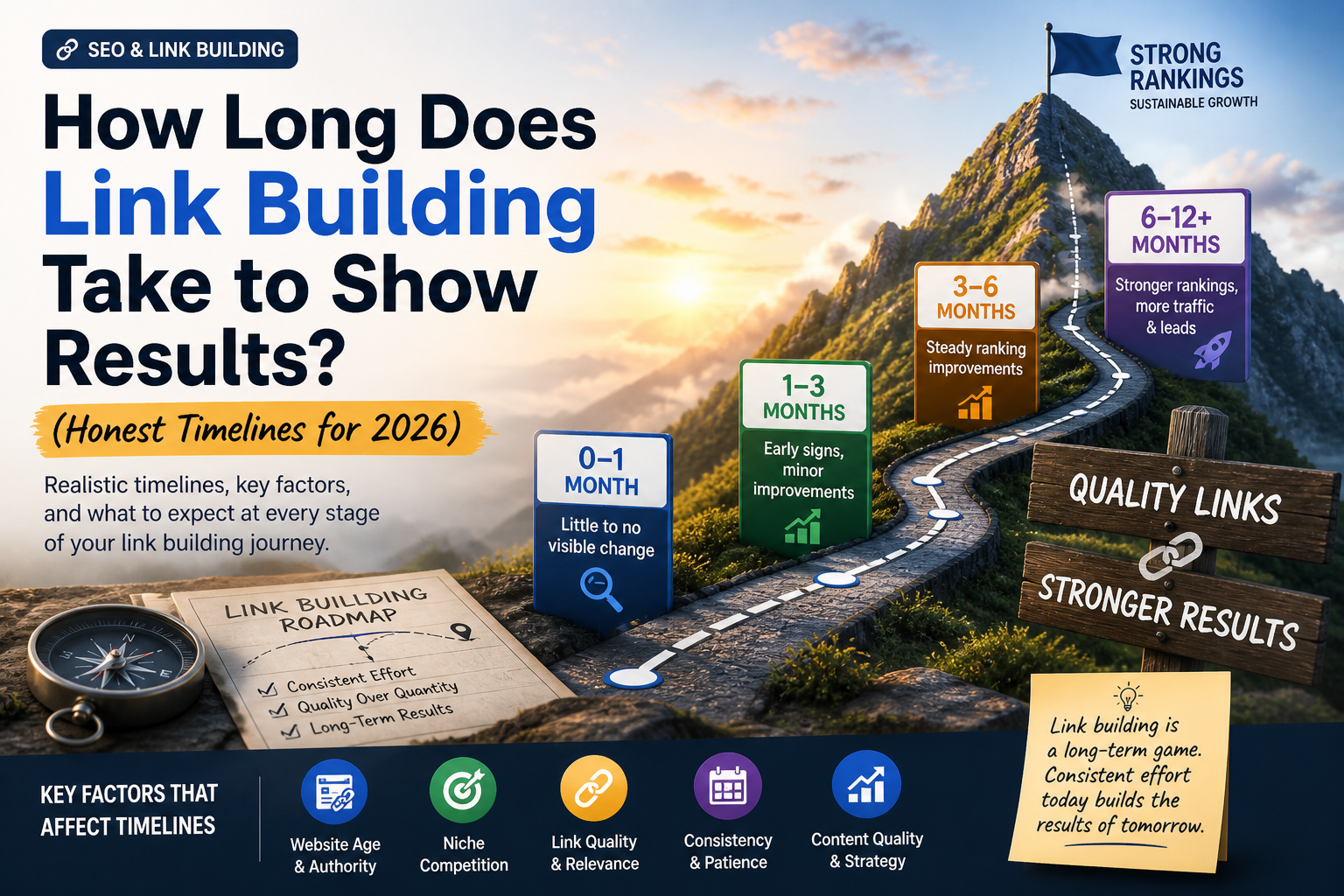
For most campaigns, how long link building takes to show results breaks down into three distinct phases. Here is the honest version:
Phase | Timeline | What actually happens |
|---|---|---|
First placements go live | Week 1–4 | Links are published on host sites. Google has not found most of them yet. |
Crawling and indexing | Week 2–6 | Google discovers and indexes the linking pages. No ranking movement yet — this is normal. |
Early ranking signals | Week 4–10 | Long-tail keywords begin shifting. Impressions in GSC start rising before clicks do. |
Measurable traffic growth | Month 3–6 | Primary target keywords move to pages 1–2. Referring domain count visibly climbs. |
Compounding growth | Month 6–12 | High-competition keywords reach page one. DR begins rising. New content ranks faster. |
Full authority established | Month 12+ | Domain earns passive links. Rankings stabilize and resist algorithm updates. |
The most common mistake: stopping at month three. The compounding effect of link building accelerates in months four to six. Cutting a campaign at 90 days means you paid for the foundation and never built the house.
Timeline by Domain Rating and Keyword Difficulty
COMPETITOR GAP: No competitor has built this matrix. This is the specific answer every buyer is actually looking for.
Your starting domain rating and your target keyword’s difficulty are the two biggest variables that determine how long for backlinks to affect ranking. Here is a realistic breakdown:
Your DR | Target KD | Links/month | Expected page 1 timeline |
|---|---|---|---|
DR 0–15 | KD 0–20 | 3–5 DR 30+ links | 60–90 days |
DR 0–15 | KD 21–40 | 5–8 DR 35+ links | 4–6 months |
DR 0–15 | KD 41–60 | 8–12 DR 40+ links | 8–12 months |
DR 16–30 | KD 0–20 | 3–5 DR 30+ links | 30–60 days |
DR 16–30 | KD 21–40 | 5–8 DR 35+ links | 3–5 months |
DR 16–30 | KD 41–60 | 8–12 DR 40+ links | 6–9 months |
DR 31–50 | KD 0–30 | 3–5 DR 30+ links | 2–4 weeks |
DR 31–50 | KD 31–50 | 5–8 DR 40+ links | 2–4 months |
DR 31–50 | KD 51–70 | 10–15 DR 45+ links | 5–8 months |
DR 50+ | KD 50–70 | 8–12 DR 50+ links | 2–4 months |
DR 50+ | KD 71–85 | 12–20 DR 55+ links | 6–10 months |
Important: These timelines assume consistent monthly link building with quality placements on topically relevant, traffic-verified sites. Sporadic campaigns or low-quality links produce significantly slower — or zero — results.
Guest Posts vs Niche Edits: Which Shows Results Faster?
COMPETITOR GAP: Every competitor treats all link types the same. Nobody compares the speed difference between guest posts and niche edits — and this directly affects how you should structure your campaign.
Not all links activate at the same speed. The type of link you build has a direct impact on link building timeframe SEO, and understanding this helps you structure campaigns for faster, early results.
Factor | Guest Posts | Niche Edits (Link Insertions) |
|---|---|---|
Host page status | Brand new URL — needs indexing | Already indexed — Google knows this page |
Time to index | 2–8 weeks, depending on host crawl rate | Usually re-crawled within 3–10 days |
Time to first signal | 4–10 weeks after placement | 2–5 weeks after placement |
Best use case | Building foundational authority | Accelerating pages already near page one |
Authority transfer | Builds over time as the new page ages | Faster — established page already has link equity |
Ranking speed | Slower — 2 to 3 months typical | Faster — 4 to 6 weeks typical |
Long-term value | Higher — new indexed asset + referral traffic | Medium — depends on the host page staying live |
Strategy recommendation: Use niche edits for pages already ranking between positions 4 and 20 — they need an authority push, not a slow build. Use guest posts for new pages or domains, building authority from scratch. Combining both in the same campaign produces the fastest overall results.
For a deeper comparison of these two strategies, read our article on guest posts vs niche edits.
Why Your Link Building Is Taking Longer Than Expected
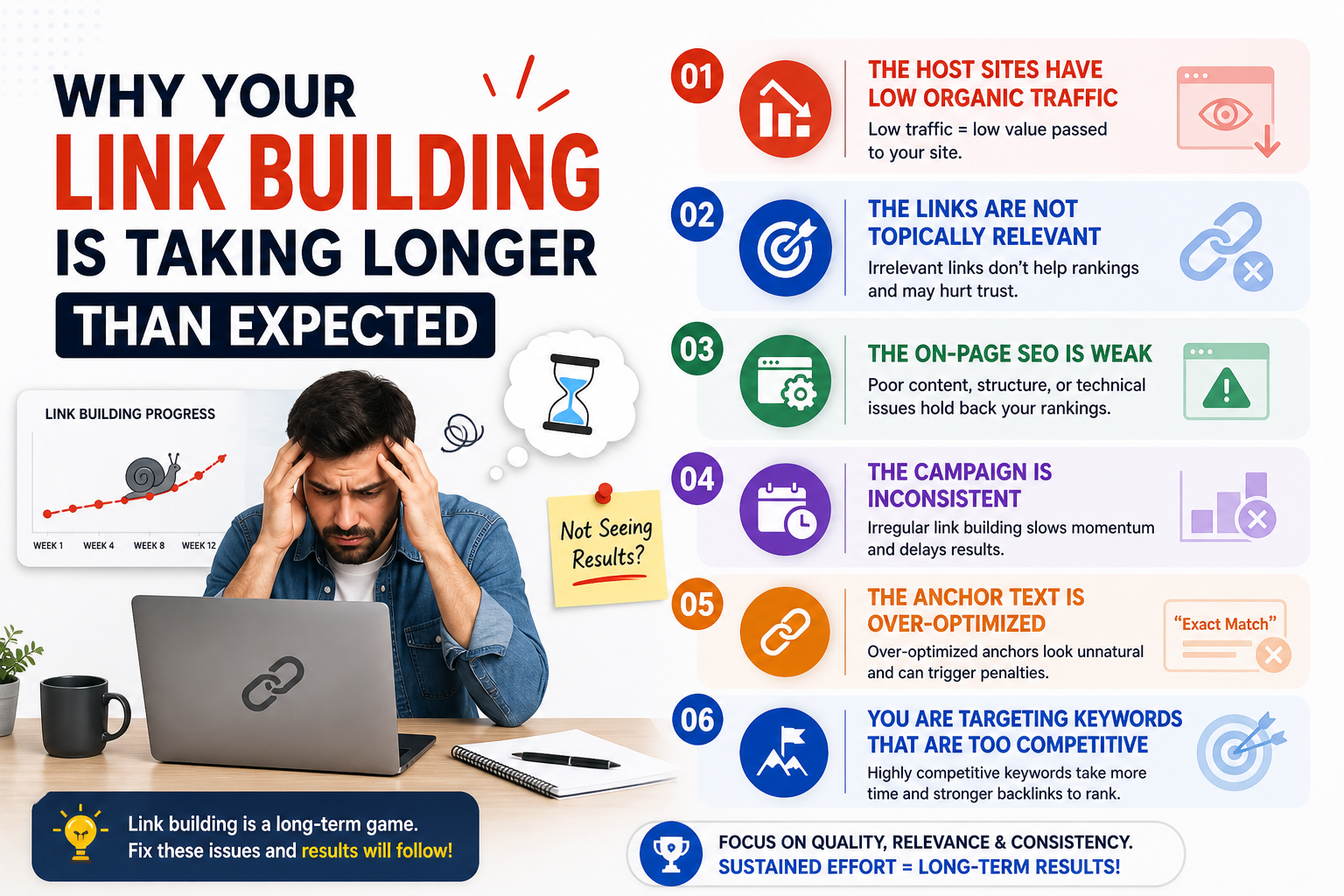
If your link building results timeline is dragging beyond what the matrix above suggests, one of these factors is almost certainly responsible.
1. The host sites have low organic traffic
DR is not the only quality signal that matters. A site with DR 45 and 50 monthly organic visitors is far less valuable than a DR 35 site with 5,000 monthly visitors. Google weighs actual traffic as a trust signal. Always verify the host site traffic in Ahrefs or Semrush before accepting any placement. MonkeyGoals requires a minimum of 500 monthly organic visitors on every host site we use.
2. The links are not topically relevant
A backlink from a gardening blog to a B2B SaaS company passes very little authority. In 2026, topical relevance is as important as DR for determining how quickly backlinks start working. The closer the host site’s niche is to your target page’s topic, the faster and stronger the ranking impact.
3. The on-page SEO is weak
Links amplify what is already there — they cannot compensate for a poorly structured page. If your target page has a weak title tag, thin content, mismatched search intent, or slow load speed, links will have limited impact. Fix on-page fundamentals before investing heavily in link building.
4. The campaign is inconsistent
Buying 10 links in month one and then nothing for three months does produce consistent results. Google’s algorithm responds better to steady, ongoing link acquisition than to spikes followed by silence. A campaign of 3 to 5 quality links per month every month outperforms a one-time burst of 20 links followed by inactivity.
5. The anchor text is over-optimized.
Using your exact target keyword as the anchor text on every link is an unnatural signal that triggers Google’s spam filters. A healthy anchor text profile is roughly 40% branded anchors, 30% partial matches, 20% natural phrases, and 10% exact matches. Over-optimized anchor text is one of the fastest ways to slow down — or reverse — your link building ROI timeline.
6. You are targeting keywords that are too competitive
This is the most common mistake. A new or low-DR domain targeting KD 70+ keywords will not see results regardless of link quality. Start with keywords your domain can realistically rank for today — typically KD under 35 for DR under 30 — and build up. The matrix in the previous section gives you the right starting point.
How to Tell Your Links Are Working Before Rankings Move
COMPETITOR GAP: No competitor explains early success signals. This is the section agency owners and clients desperately need in the first 60 days of a campaign.
Rankings are a lagging indicator. By the time you see a ranking move, your links have already been doing work for weeks. Here are the early signals that confirm a campaign is on track — even when the ranking dashboard still looks flat.
- GSC impressions rising before clicks: Log in to Google Search Console and check the performance report. If impressions for your target keywords are increasing even while clicks stay flat, Google is starting to show your page in results — the clicks follow the impressions within 2 to 4 weeks.
- Target page appearing for new keyword variations: Check GSC for new queries your page is appearing for. If you see related terms appearing that were not there before, your page’s topical authority is growing — a direct result of link acquisition.
- DR increase in Ahrefs: Your domain’s DR rising is a direct confirmation that the links have been indexed and are contributing to your domain’s authority. Even a 2- to 3-point DR increase in the first 60 days confirms the campaign is working.
- Referring domain count increasing: In Ahrefs or Semrush, check your referring domains count. Each new domain added confirms a link is live and indexed. This is the most direct confirmation that placements have been successfully acquired and recognized.
- Target page impressions spiking in Search Console: A sudden increase in impressions for the target page — even without a ranking jump — means Google is re-evaluating the page’s authority. This typically precedes a ranking movement by 2 to 4 weeks.
Rule of thumb: If you see at least three of the five signals above within 60 days of starting a campaign, the links are working. Rankings will follow.
What to Tell Your Clients When Nothing Has Moved Yet
COMPETITOR GAP: Every competitor ignores this completely. This is the section that separates agencies that retain clients from those that lose them at month two.
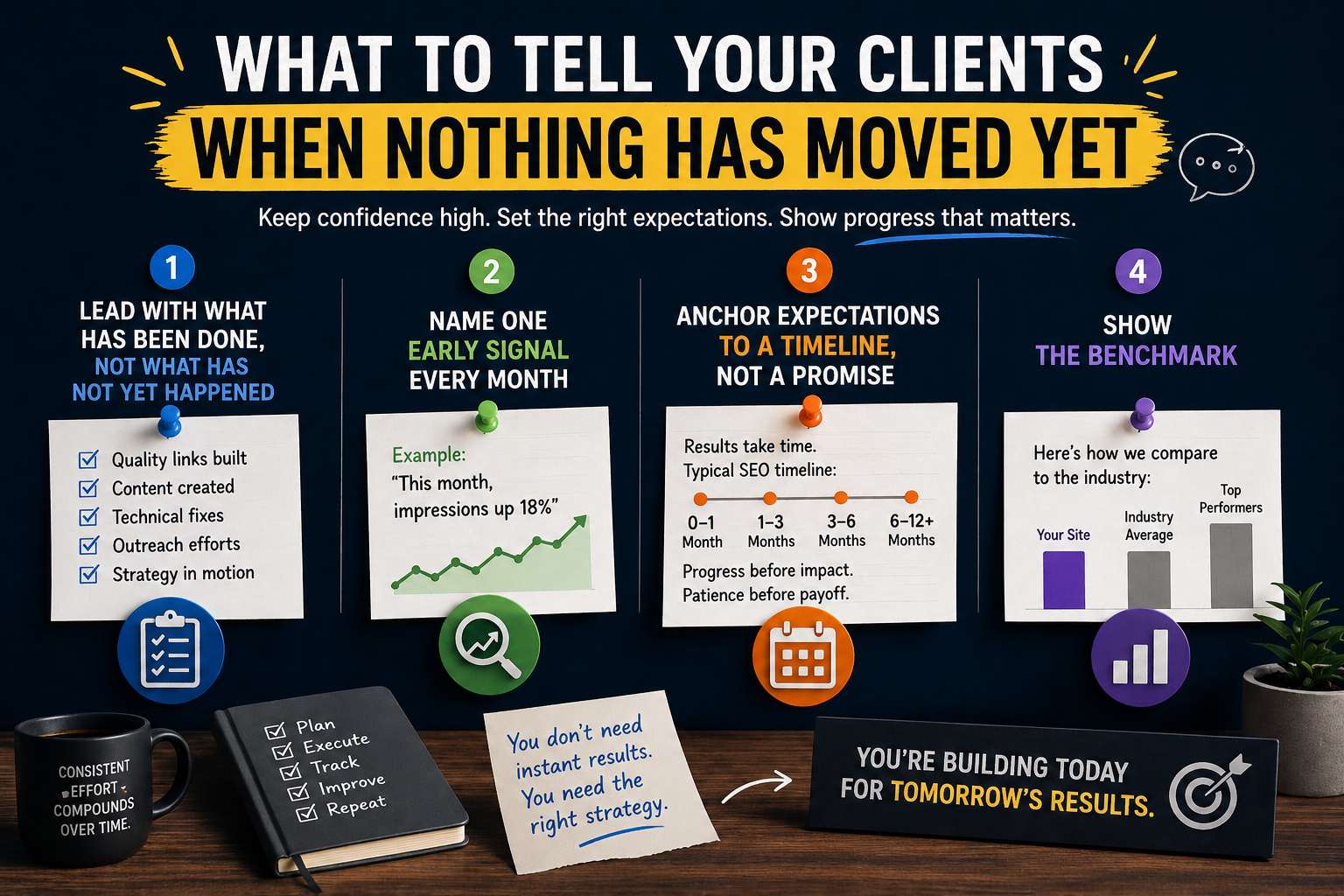
Months one or two of a link building campaign is the most dangerous period for client relationships — not because results are not coming, but because clients do not understand why they cannot see them yet. Here is exactly how to handle the conversation.
The month one check-in script
“I want to give you a quick update on the link building campaign. We have secured [X] placements this month on sites with an average DR of [Y]. Here is what to expect over the next 60 days: Google has now indexed most of these links and is beginning to re-evaluate your pages. You will not see ranking jumps yet — that is completely normal at this stage. What you will start to see first is impressions rising in Google Search Console, followed by clicks, then ranking improvements. I am already seeing [mention one early signal — e.g., impressions up 18% on the target page]. We are on track. I will send a full performance update at the 90-day mark with before-and-after comparison data.”
Key principles for client communication during the waiting period:
- Lead with what has been done, not what has not yet happened: Number of placements, average DR, host site names — concrete deliverables that confirm activity
- Name one early signal every month: Even a 5% impressions increase is worth mentioning — it shows the campaign is alive and measurable
- Anchor expectations to a timeline, not a promise: Say ‘expect visible movement by month three,’ not ‘you will rank by month three.’
- Show the benchmark: Share a screenshot of current rankings at campaign start so the before-and-after comparison is unambiguous when results do arrive
How Budget Affects Your Link Building Timeline
COMPETITOR GAP: Nobody connects the budget directly to the timeline. This is the real question behind the timeline question.
The speed at which you see link building results by month is directly proportional to how many quality links you are acquiring per month. Here is a realistic budget-to-timeline breakdown for a DR 20 site targeting KD 30 to 40 keywords:
Monthly budget | Links/month (DR 30–40) | Expected timeline to page one | Best for |
|---|---|---|---|
$237–$297 | 3 links | 5–7 months | New sites, low-competition niches |
$396–$495 | 5 links | 3–5 months | Most small business campaigns |
$693–$891 | 7–9 links | 2–4 months | Competitive niches, faster results needed |
$990–$1,485 | 10–15 links | 6–10 weeks | Agency campaigns, multiple target pages |
$1,485+ | 15+ links | 4–8 weeks | Highly competitive, aggressive campaigns |
Note: Prices above are based on MonkeyGoals DR 30–40 guest post pricing at $99 per placement. Timelines assume topically relevant placements on traffic-verified sites. Niche edit campaigns at the same budget produce results 3 to 4 weeks faster than guest post-only campaigns.
MonkeyGoals bulk pricing: Agencies and clients ordering 10+ links per month qualify for volume pricing — reducing the per-link cost and improving margins on every campaign. Contact us to discuss bulk rates.
Link Building Timelines for Specific Niches
Industry vertical matters. Google applies different levels of scrutiny to different niches, which directly affects how quickly link building results become visible.
- SaaS and tech: Medium competition, relatively fast results. A DR 20 SaaS site with good content typically sees page-one movement for long-tail keywords within 3 to 4 months of consistent link building.
- Ecommerce: Competitive, but category and product pages respond well to niche edits from relevant industry blogs. Expect 4 to 6 months for main category keywords, faster for long-tail product terms.
- Legal: YMYL niche — Google holds legal content to higher E-E-A-T standards. Links from authoritative legal publications carry more weight but are harder to acquire. Add 2 to 3 months to standard timelines.
- Health and wellness: YMYL — same logic as legal. Author credentials on your target pages matter as much as links. A combined E-E-A-T and link building approach is required. Expect 6 to 12 months for competitive health keywords.
- Real estate: Local real estate moves faster than national. City-specific long-tail keywords with local backlinks can reach page one in 60 to 90 days for a DR 20+ site.
- Green energy and tech startups: Emerging niches with relatively low competition. Good opportunity for fast ranking wins with 3 to 5 quality placements per month. Expect 2 to 4 months for low-competition terms.
Final Thoughts
The question “How long does link building take to show results does not have one answer, but it does have specific answers once you know your starting DR, target keyword difficulty, budget, and link type. Use the matrices in this article to set accurate expectations for yourself and your clients.
The most important insight from years of running link building campaigns: the agencies and businesses that see the best results are not the ones who build the most links fastest. They are the ones who build consistently, stay patient through the first 60 to 90 days, and do not stop when the dashboard looks flat. The compounding effect of link building results by month is real — but only if you stay in the game long enough to see it.
Start with keywords you can realistically rank for today. Build 3 to 5 quality links per month on topically relevant, traffic-verified sites. Monitor the early signals in Google Search Console. And give the campaign at least 90 days before drawing any conclusions.
Ready to start a link building campaign and see results in 60 to 90 days?
MonkeyGoals builds manual, outreach-based backlinks starting from $79 per placement — guest posts, link insertions, and manual blogger outreach on traffic-verified sites. Bulk pricing for agencies.