
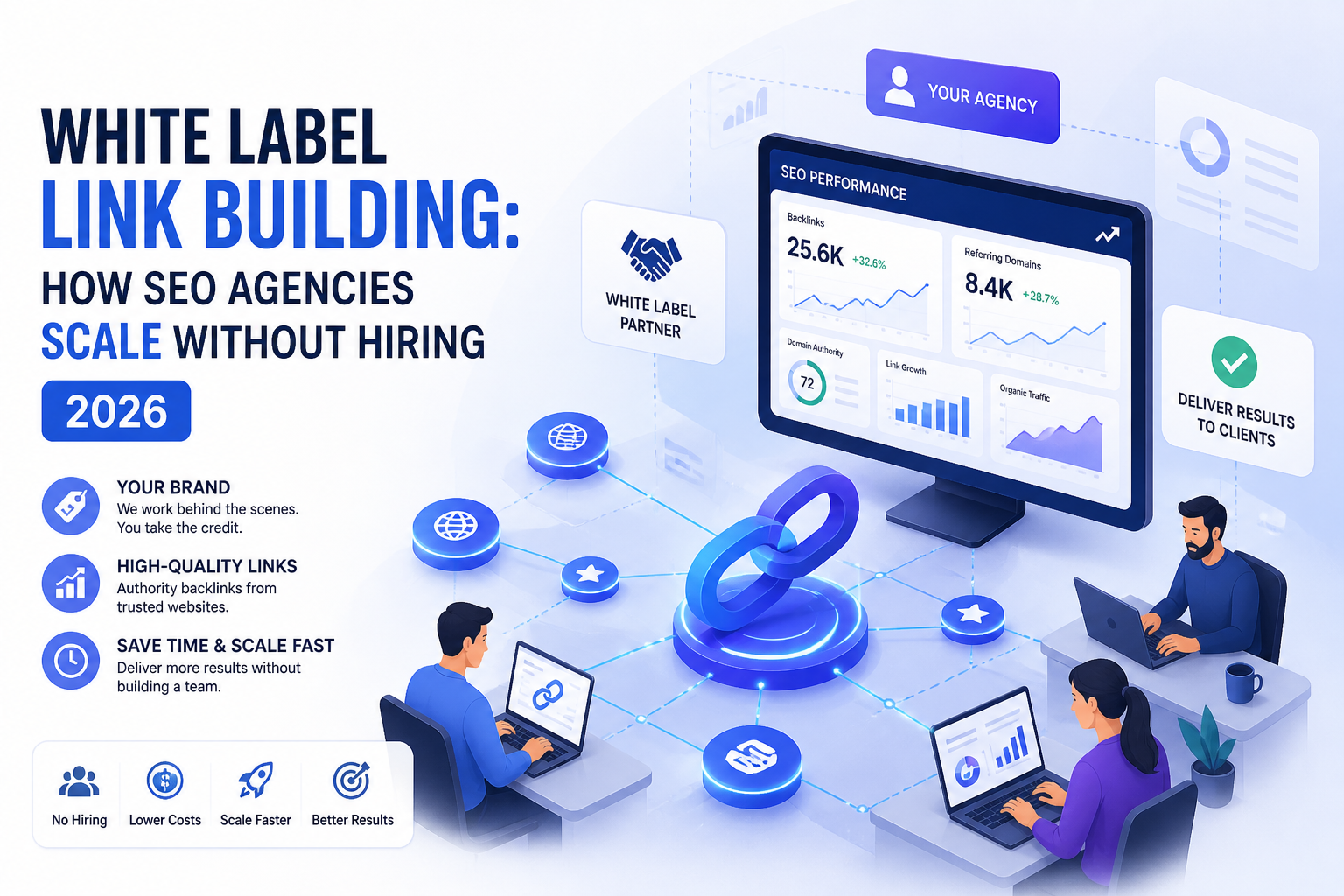
If every new link building client means recruiting, training, and managing another outreach specialist, you are not scaling; you are just getting busier. This guide shows you exactly how white label link building solves that problem.
Hiring a competent link building specialist costs between $3,500 and $6,000 per month in salary alone. Add onboarding time, management overhead, tools, and the months it takes before they are producing results independently, and the true cost of building link building in-house is far higher than most agencies’ budgets.
There is a better model. White label link building lets your agency deliver professional, fully branded link building results to clients without adding a single headcount. You focus on strategy, client relationships, and business growth. A specialist provider handles all the outreach, content, and placements behind the scenes.
This guide covers everything you need to know — how the model works, how to calculate your margins, how to present results to clients, what to look for in a white label link building agency, and the red flags that should make you walk away immediately.
What Is White Label Link Building?
White label link building is a fulfillment model where a specialist agency builds backlinks on behalf of your agency, and you deliver those links to your clients under your own brand. The end client never knows a third party was involved.
The workflow in practice looks like this:
- Your agency wins a client who needs link building as part of their SEO campaign
- You brief the white label provider with target pages, anchor text guidelines, DR requirements, and niche details
- The provider handles everything — prospect research, outreach, content creation, editorial approval, and placement
- You receive an unbranded report, which you rebrand with your agency logo and deliver to the client as your own work
The client sees seamless results. You maintain the relationship. The provider works invisibly in the background. This is exactly how outsource link building for agencies is structured at every professional level — from solo consultants to 50-person agencies.
Pro Tip: White labelling is not a shortcut — it is a specialization model. Just as your clients hire your agency instead of doing their own SEO, your agency uses a white label provider instead of running a full outreach operation in-house.
Why Scaling With Hires Breaks Most Agencies
Most agencies try to scale agency link building by hiring. It rarely goes as planned. Here is what actually happens:
- Hiring takes 4 to 12 weeks — job posts, interviews, offers, and notice periods all delay your ability to fulfil new client work
- Training takes 3 to 6 months — a new outreach specialist needs time to understand your processes, build publisher relationships, and produce consistent quality
- Output drops before it rises — senior time gets consumed managing new hires during exactly the period you need capacity most
- Fixed cost is unforgiving — if a client churns after month two, you still pay the salary. White label is a variable cost that matches revenue
- Quality is inconsistent — building internal quality control for link building is a separate discipline that takes years to develop
The white label link building model flips all of these. Capacity is available immediately. Cost is variable. Quality is handled by a team that does nothing else. And you can take on three new clients on Monday without changing your headcount.
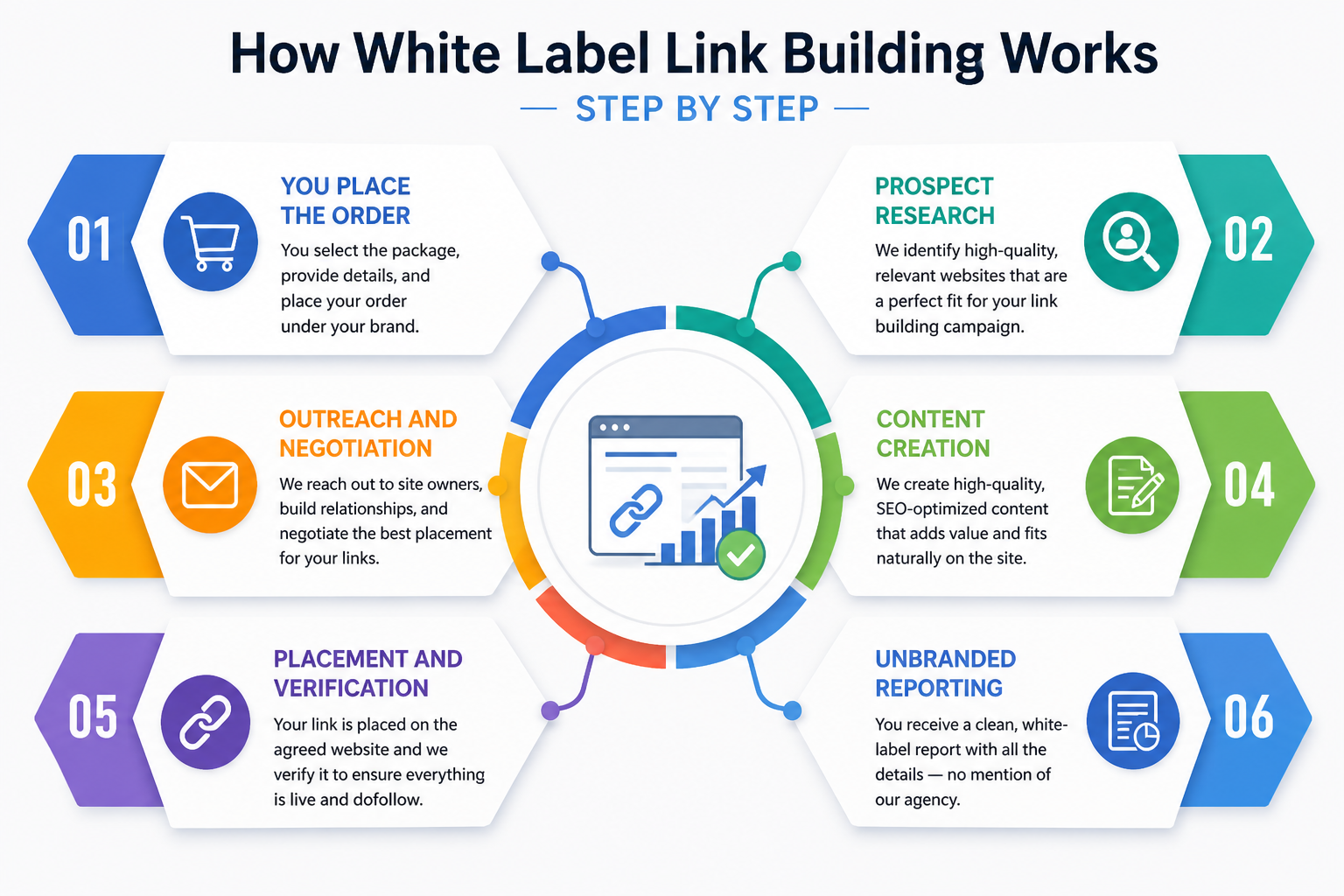
How White Label Link Building Works Step by Step
Understanding the full process helps you manage client expectations accurately and brief your white label link building agency effectively.
Step 1 — You place the order
You specify the target URL, preferred anchor text, DR range, niche category, and quantity. A good link building reseller program gives you a dashboard or order form to do this cleanly — no lengthy email chains.
Step 2 — Prospect research
The provider identifies suitable host sites — real websites with genuine organic traffic, editorial content, and topical relevance to your client’s niche. Every site should be manually vetted, not pulled from a pre-sold list.
Step 3 — Outreach and negotiation
The outreach team contacts site owners or editors. For white label guest posts, this means pitching and getting a topic approved. For link insertions, it means negotiating placement in an existing article. Timelines vary — expect 2 to 4 weeks for standard placements.
Step 4 — Content creation
For guest posts, the provider writes the article — typically 800 to 1,200 words — tailored to the host site’s editorial standards. You or your client should review the content before it goes live if brand voice matters.
Step 5 — Placement and verification
The link goes live. The provider verifies indexing, confirms the anchor text matches the brief, and checks the surrounding content for relevance. A quality provider rejects placements that do not meet the agreed metrics.
Step 6 — Unbranded reporting
You receive a report — typically as a spreadsheet or PDF — showing the live URL, the linking domain, DR, organic traffic, anchor text used, and target page. You remove any provider branding and deliver it to your client as your own work. This is the core of the white label backlink service model.
How to Calculate Your Agency’s Profit Margin
COMPETITOR GAP: No competitor covers this. This is what agency owners actually need to know before choosing a white label provider.
The fundamental business case for white label link building is margin. Here is how to calculate yours and set pricing that keeps both you and your clients satisfied.
DR Range | You pay (MonkeyGoals) | Suggested client price | Your margin | Margin % |
|---|---|---|---|---|
DR 20+ | $79 | $149 – $180 | $70 – $101 | 89% – 128% |
DR 30+ | $99 | $180 – $220 | $81 – $121 | 82% – 122% |
DR 40+ | $179 | $299 – $360 | $120 – $181 | 67% – 101% |
DR 50+ | $249 | $399 – $480 | $150 – $231 | 60% – 93% |
DR 60+ | $319 | $499 – $600 | $180 – $281 | 56% – 88% |
DR 70+ | $399 | $599 – $750 | $200 – $351 | 50% – 88% |
Bulk orders increase your margin further. Ordering 10 or more placements per month typically unlocks volume pricing from your provider — the per-link cost drops while your client-facing price stays the same. This is why scale agency link building through white label consistently delivers better margins than in-house fulfillment.
Rule of thumb: Charge clients at least 80–100% above your provider cost. This covers your account management time, reporting work, strategy input, and reasonable profit. Never price at cost-plus-20% — you will resent the client by month three.
How to Present White Label Links to Your Clients
COMPETITOR GAP: Every competitor mentions unbranded reports, but none explain what to actually say to your client. This section fills that gap.
Presenting white label link building results professionally is a skill. Done well, it reinforces your agency’s value. Done poorly, it raises questions you do not want to answer. Here is exactly how to handle it.
What to include in the client report
- Live URL of the host page — the page the link appears on, verified as live and indexed
- Domain Rating (DR) of the host site — confirms you delivered the agreed quality tier
- Organic traffic of the host site — proves it is a real site with a real audience, not a placeholder
- Anchor text used — shows alignment with the target keyword strategy
- Target page — confirms the link points to the agreed URL
- Date placed — for tracking and timeline reference
What to say on the client call
Never say ‘we outsource this.’ Instead, present your process:
“We manually identify relevant, high-authority sites in your niche; conduct editorial outreach; and secure placements that meet strict quality criteria — minimum DR 30, verified organic traffic, and topical relevance. Every link in this report has been individually vetted before we present it to you.”
This is accurate. You do set the criteria. You do verify the output. You do manage the relationship. The fact that a specialist team handles execution does not change the truth of that statement.
Reporting cadence
- Monthly reporting: Standard for retainer clients — one report per month showing all live placements that month
- Campaign summary: At the end of a fixed campaign, a full report showing all links placed, DR breakdown, and ranking movement
- Real-time access: Some agencies give clients access to a shared dashboard (Google Sheets or Notion) updated as links go live — this reduces ‘what is happening’ emails significantly
Red Flags: How to Vet a White Label Link Building Agency
COMPETITOR GAP: All competitors warn about scams in general terms. None gives a specific, actionable checklist. Use this before signing with any provider.
Choosing the wrong white label link building agency can damage your clients’ sites, destroy your reputation, and leave you unable to get refunds. Here is exactly what to check.
Check this | Green flag | Red flag — walk away |
|---|---|---|
Site quality standard | Minimum 500 organic visitors verified in Ahrefs or Semrush | They only mention DR — no traffic verification |
Link placement method | 100% manual outreach to real editorial sites | Mentions a ‘network,’ ‘inventory,’ or pre-approved site list |
Content creation | Original article written per placement, reviewed by editor | Spun content, AI-only content, or generic filler articles |
Turnaround transparency | Clear timeline (10–20 days) with status updates | Vague promises like ‘within 45 days’ with no milestones |
Sample reports | Real URLs you can verify in Ahrefs yourself | Screenshots only, or refusal to share live examples |
Niche relevance | Links placed on topically matched sites | Links from generic lifestyle blogs for a B2B SaaS client |
Refund policy | Clear replacement or refund if the link drops within 12 months | No guarantee, or ‘all sales final’ terms |
Communication | Named account manager, respond within 24 hours | Support ticket system only; no direct contact |
Pricing transparency | Clear per-link pricing by DR tier | Bundle-only pricing with no breakdown |
When White Label Link Building Is NOT the Right Choice
COMPETITOR GAP: No competitor is honest about this. Building trust means telling agencies when outsourcing does not make sense.
White label link building is the right model for most growing agencies — but not all situations. Be honest with yourself about these scenarios before committing:
- You have a single client in an ultra-niche industry: If the niche is so specific that finding relevant host sites is extremely difficult (e.g., regulated financial derivatives), discuss this with your provider upfront. Some niches genuinely require deeper specialist relationships than a standard white label workflow provides.
- Your client expects weekly deliverables on a very short timeline:
Quality outreach takes time. If a client expects 10 guest posts placed in two weeks every month, the pressure will lead to quality compromise. This is especially true with manual blogger outreach, where building real relationships and securing high-quality placements cannot be rushed. Set realistic expectations or negotiate a longer timeline. - You want to build a proprietary publisher network: If your long-term agency strategy involves owning a list of exclusive publisher relationships as a competitive moat, in-house outreach is the right investment. White label is for scale, not for building a unique asset.
- Your client is in an extremely sensitive YMYL niche: For medical, legal, or financial clients with strict E-E-A-T requirements, vet your white label provider’s YMYL experience specifically — not all providers have equal depth in regulated industries.
White Label Link Building in 2026: What the AI Era Changes
COMPETITOR GAP: Zero competitors address how AI Overviews and Google’s 2024–25 updates affect white label link quality. This is the most forward-looking section in any article on this topic.
Google’s landscape in 2026 is different enough from 2022 that the question of which links your white label link building agency builds matters more than it did three years ago. Two changes are most relevant for agencies.
AI Overviews and editorial authority
Google’s AI-generated answer boxes at the top of the SERP increasingly cite sources that demonstrate genuine expertise and editorial credibility. A guest post on a real, active niche publication — even one with a moderate DR — can contribute to your client’s site being cited in AI Overviews. A link from a low-traffic, generic content site cannot.
This shift reflects how AI and SEO are becoming deeply interconnected, where authority signals like high-quality backlinks and real editorial placements influence both search rankings and AI-generated visibility.
This means the quality threshold for valuable white label link building has risen. Traffic on the host site is now just as important as DR.
Ask any provider: “What is the minimum monthly organic traffic you accept on a host site?” If they do not have a clear answer, that’s a red flag.
E-E-A-T and topical authority
Google’s E-E-A-T framework (Experience, Expertise, Authoritativeness, Trustworthiness) has made topical relevance a stronger signal than ever. A link from a site in your client’s exact industry is worth significantly more than a link from a tangentially related site with a higher DR.
When briefing your white label SEO link building provider, specify the sub-niche, not just the broad category. ‘SaaS’ is not enough — ‘B2B SaaS project management tools’ give the outreach team the specificity needed to find genuinely relevant placements that pass E-E-A-T signals to your client’s pages.
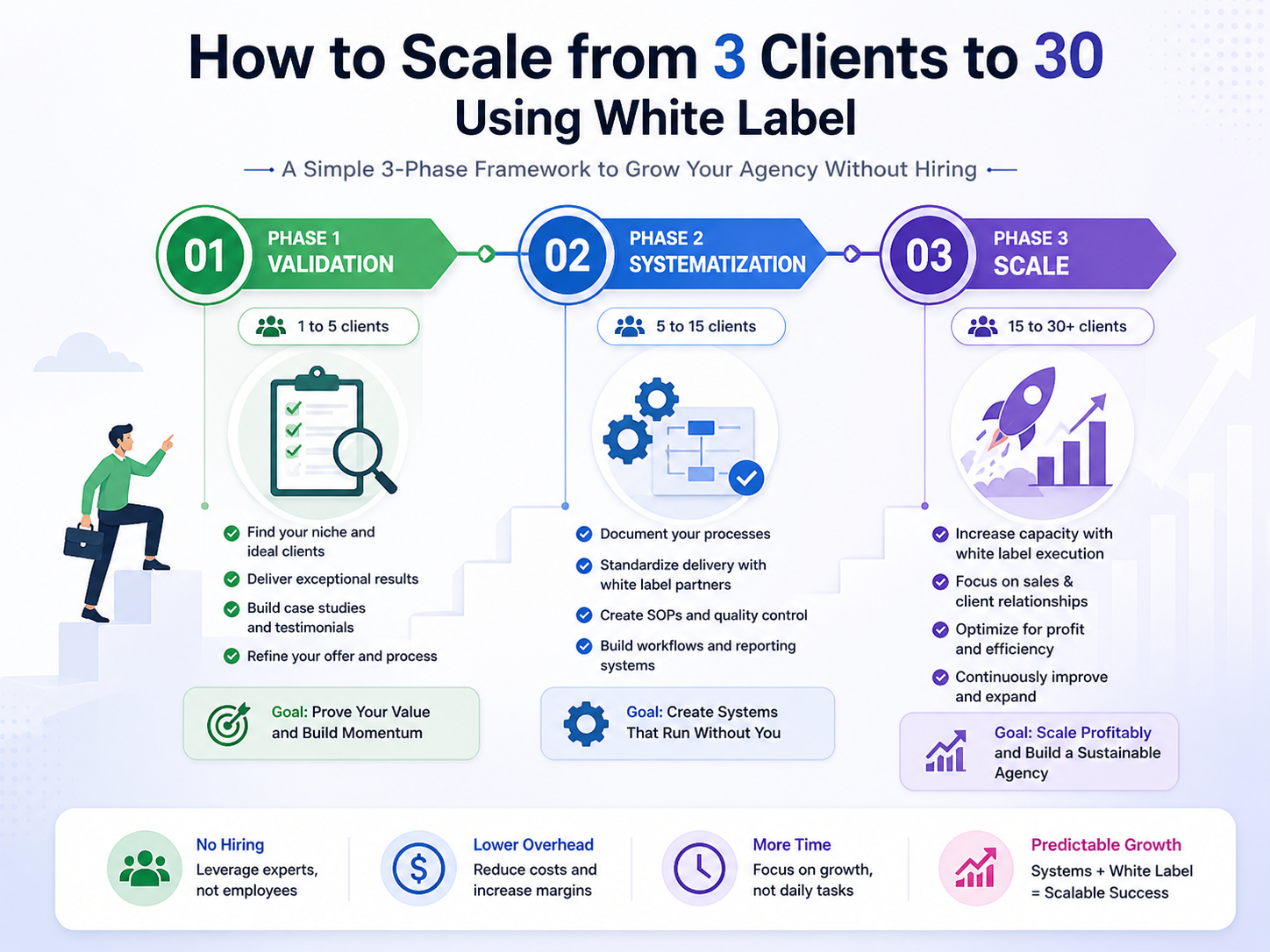
How to Scale from 3 Clients to 30 Using White Label
The link building reseller model becomes more powerful as you grow. Here is the scaling playbook most agencies follow.
Phase 1 — Validation (1 to 5 clients)
- Start with one provider on a small test order — 3 to 5 links across 2 clients
- Verify every placement manually in Ahrefs before presenting to clients
- Measure ranking movement over 60 to 90 days to confirm the provider’s link quality is real
- Build your reporting template — the document you will use every month as you scale
Phase 2 — Systematization (5 to 15 clients)
- Create a brief template — a standard order form your team fills out for every new client, covering niche, DR range, anchor text, and target pages
- Set a monthly ordering cadence — order all links for the month in one batch on a fixed date to simplify billing and delivery tracking
- Automate reporting — build a Google Sheets template that pulls data from the provider’s report and formats it in your agency branding automatically
- Negotiate volume pricing — at 10+ links per month, you should be discussing bulk rates with your provider
Phase 3 — Scale (15 to 30+ clients)
- Assign a dedicated account manager internally — one person owns the provider relationship and quality control
- Diversify providers if needed — different providers have different niche strengths. Use a specialist for SaaS and another for ecommerce if your client mix requires it
- Build link strategy into onboarding — every new client gets a link audit and 6-month link plan in their first week. This sets expectations and simplifies the briefing
- Review provider performance quarterly — track link retention rates, average DR delivered vs promised, and response times. Replace underperforming providers before they become client problems
MonkeyGoals offers bulk pricing for agencies managing ongoing campaigns. Starting at $79 per placement, with volume discounts available for 10+ links per month. All placements are manually outreached on traffic-verified sites — no pre-sold networks, no PBNs.
Final Thoughts
Scaling an agency is not about doing more of the same thing faster. It is about building a delivery model that grows without breaking. White label link building gives you exactly that — immediate capacity, consistent quality, and a margin that improves at volume.
The agencies growing fastest in 2026 are not the ones with the biggest in-house teams. They are the ones who have systemized their delivery, partnered with the right specialists, and focused their own energy on the client relationships and strategy that only they can provide.
Choose a white label link building agency that is transparent about its process, verifies host site quality beyond DR, provides unbranded reporting, and has clear guarantees. Use the pricing model in this guide to set healthy margins. Build the scaling playbook before you need it. And deliver results your clients will never question.
Ready to scale your agency without hiring a single outreach specialist?
MonkeyGoals handles all the outreach, content creation, and placement — you deliver branded reports and take the credit. From guest posts to link insertion services, placements start at $79 each, with bulk pricing available for agencies.