
If you talk to any experienced SEO agency today, one thing becomes clear very quickly: guest posting still works.
But only when it is done properly.
A strong guest posting strategy is what separates successful campaigns from failed ones. Many businesses try guest posting and see no results. They buy a few cheap placements, publish thin articles, and expect rankings to magically improve. When nothing happens, they assume guest posting is outdated. The truth is very different.
Guest posting still remains one of the most reliable white-hat link building strategies available today. In fact, editorial backlinks remain one of the top three ranking signals Google uses — and their value only compounds over time. The difference between success and failure comes down to strategy.
Most businesses simply buy guest posts. Smart agencies build systems.
Instead of chasing random backlinks, professional agencies follow a structured process — identifying relevant websites, creating high-quality content, and placing editorial backlinks that strengthen a site’s authority over time.
At Monkey Goals, we see this difference every day. Clients who follow a strategic guest posting framework consistently see stronger rankings, more organic traffic, and long-term SEO growth.
In this guide, we will explain:
- Why guest posting still works in 2026
- The biggest mistakes businesses make
- The exact system agencies use to rank clients faster
- How to evaluate guest posting opportunities the right way
By the end, you will understand why the best SEO agencies treat guest posting as a long-term authority-building strategy — not just a quick backlink.
Why Guest Posting Is Still the Most Reliable SEO Strategy Agencies Use
Despite constant changes in search algorithms, backlinks remain one of the strongest ranking signals in search engines.
Search engines rely on backlinks to understand which websites are trusted sources of information. When a reputable site links to your content, it acts like a vote of confidence.
A strong guest posting strategy works because it earns editorial backlinks— links placed naturally within valuable content on another website. These links carry far more weight than links placed through spammy methods or automated tools.
Another reason guest posting works is that its value compounds over time. A strong backlink placed today can continue passing authority and sending referral traffic for years. That long-term compounding effect is what makes it the strategy agencies keep coming back to.
Agencies prefer this guest posting strategy because it is:
- Scalable — campaigns can grow steadily over time without triggering algorithmic red flags
- White hat — fully compliant with Google’s search guidelines, zero penalty risk when done correctly
- Reportable — clients can see exactly where every link is placed, on which site, and with what metrics
- Consistent — results improve naturally with steady execution month after month
Compared with other link-building methods, guest posting offers a balance of quality, transparency, and control that is hard to match. For agencies managing multiple clients, that reliability makes it one of the most dependable SEO strategies available.
| Key Stat: Agencies that maintain a consistent guest posting cadence of 4 to 8 high-quality placements per month see measurable ranking improvements within 6 to 12 weeks of links being indexed. |
Why Most Guest Posts Do Not Move Rankings
If guest posting works so well, why do so many businesses fail with it?
The answer is simple: they focus on the wrong metrics.
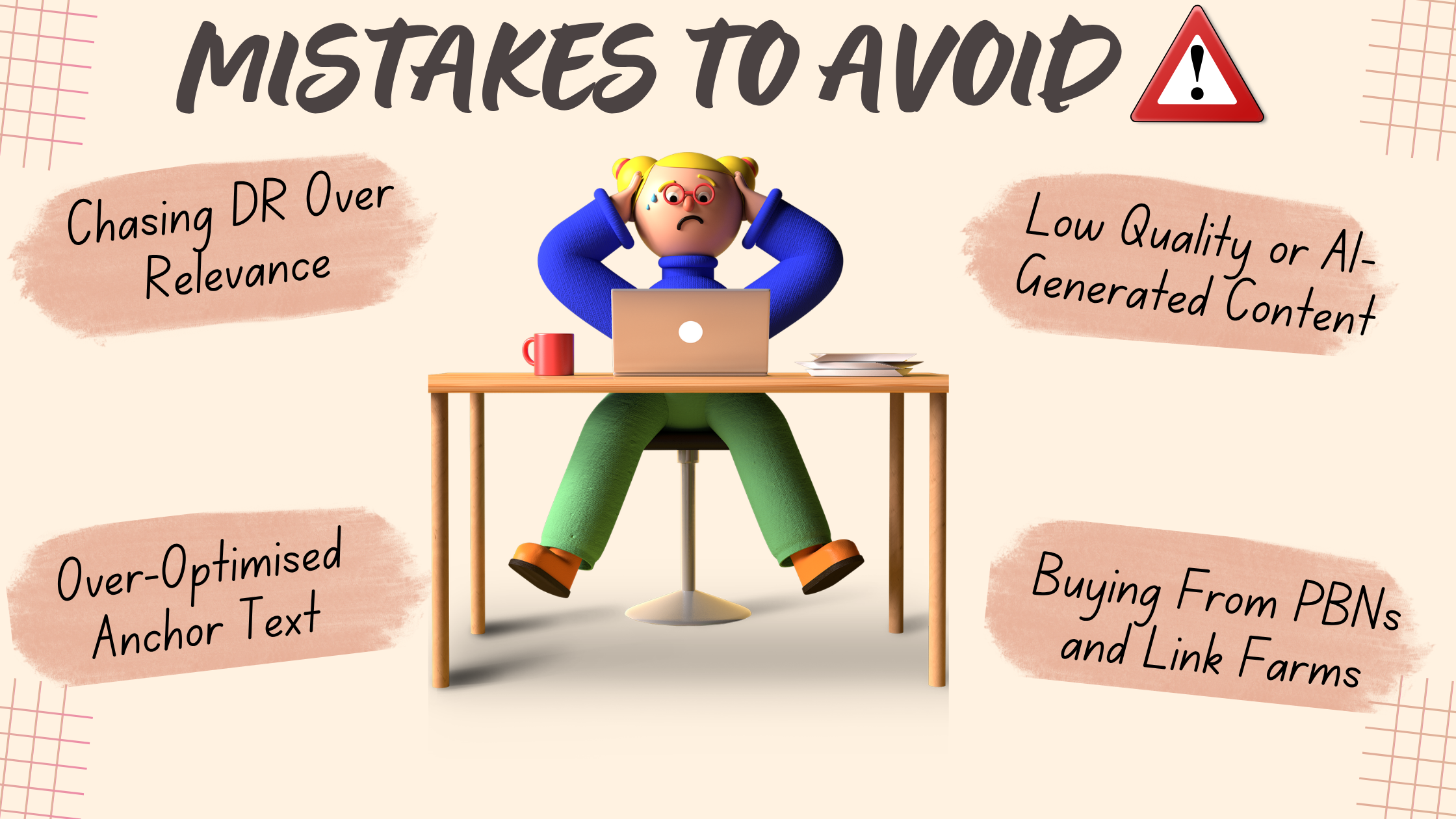
Mistake 1: Chasing DR Over Relevance
The most common mistake is chasing Domain Rating instead of relevance. A DR 70 website might look impressive on paper. But if that website has nothing to do with your industry, the link provides very little value.
Search engines evaluate the contextual relationship between websites. A relevant backlink from a niche blog with real traffic often carries more weight than a random link from a high-authority site. Relevance always beats raw authority.
Real World Example: Wrong Sites — Zero Relevance A well-known SaaS company in the project management space spent over $4,000 on 20 guest posts from a popular, cheap service. Every site had DR 50 or above — impressive on paper. But not one site covered project management, productivity, or B2B software. Three months later, zero ranking movement. The links looked great in a spreadsheet. In Google’s eyes, they were nearly worthless. |
Mistake 2: Low Quality or AI-Generated Content
Another major issue is low-quality content. Many cheap guest posting services publish thin articles that add little value for readers. These articles are often AI-generated or poorly written, making them unlikely to attract engagement or earn long-term authority.
Google’s Helpful Content updates have made one thing very clear — low quality content gets devalued, and the links inside it get devalued too. Every guest post should be written by a human who understands the niche and creates something the blog’s audience actually wants to read.
Mistake 3: Over-Optimised Anchor Text
Using the same match keyword as your anchor text on every single guest post is one of the fastest ways to trigger an algorithmic flag. Natural link profiles have variety — branded anchors, partial match, generic, and exact match in the right balance. Agencies that plan anchor text diversity before starting a campaign protect their clients from unnecessary risk.
Mistake 4: Buying From PBNs and Link Farms
Businesses also fall into the trap of buying links from private blog networks or link farms. These networks exist only to sell backlinks and have no real audience, no real editorial standards, and no real authority.
Real World Example: The Real Cost of PBN Links A legal services firm bought 50 guest posts at $15 each from a popular link marketplace. Six months later, their domain authority had actually dropped. Why? Over 60% of the sites were inactive, had no organic traffic, and were flagged as part of link networks. Compare this to a competitor who placed just 8 targeted guest posts on real legal and business blogs with genuine audiences. That competitor ranked on page 1 for three high-value local keywords within four months. |
In other words, both campaigns focused on the wrong things. Volume instead of strategy. Cheap instead of relevant. Quick instead of consistent.
The 5-Step Guest Posting Strategy Agencies Use
Professional agencies rarely rely on guesswork. Instead, they follow a repeatable process that ensures every guest post contributes to long-term SEO growth. Here is the framework most agencies use.
Step 1: Niche Mapping Before Prospecting
Before reaching out to any website, agencies first map the client’s topical clusters. This means identifying the core subjects related to the business and understanding which topics need stronger backlink support.
Instead of targeting random blogs, agencies look for sites covering specific subtopics that align directly with the client’s niche. For example, a client selling accounting software does not just need links from general finance blogs. They need links from blogs about small business accounting, payroll management, tax software, and bookkeeping tools. That level of specificity is what makes a guest posting strategy actually move rankings.
Real World Example: Niche Mapping That Changed Everything An e-commerce brand selling eco-friendly packaging came to a link-building agency after their previous team placed links on generic business and marketing blogs. None of those blogs covered sustainability, packaging, or retail supply chain topics. The new agency remapped the entire strategy around topical clusters — green business, sustainable retail, eco packaging, and circular economy. Their target keywords moved from page 4 to page 2 within just 10 weeks of the new placements going live. |
Step 2: Prospecting for Traffic — Not Just DR
Experienced agencies know that organic traffic is often a better signal than authority metrics alone. When evaluating guest posting opportunities, they focus on:
- Organic traffic levels — minimum 3,000 to 5,000 visits per month.
- Keyword overlap with the client’s niche — at least 30% topical alignment.
- Quality of published content — written for humans, not just search engines.
- Natural outbound link patterns — does the site link out regularly to real sources?
- Site age — minimum 2 years old for established trust signals.
Traffic indicates that a website is trusted by search engines and has a real audience. A DR 35 site with 20,000 monthly visitors will almost always deliver more link value than a DR 60 site with 800 monthly visitors and no real readership.
Step 3: Creating Content That Earns the Link
A guest post should never feel like an advertisement. The goal is to publish valuable content that naturally deserves a backlink. Strong guest posts usually include:
- In-depth explanations with original insight — not recycled information
- Real examples or case studies that illustrate the point
- Data, statistics, and facts that add credibility
- Visual elements such as charts, tables, or infographics where relevant
The backlink is placed contextually within the content — not forced into an unrelated paragraph. The anchor text is planned before the article is written, so it fits naturally into the surrounding sentence.
| Monkey Goals Standard: Every article we produce is written by experienced, niche-specific human writers. No AI content. No spinning. No shortcuts. The content has to be good enough that the blog editor is genuinely proud to publish it. |
Want to see how professional guest post content is planned and placed in practice? This tutorial breaks it down step by step:
Step 4: Maintaining a Consistent Publishing Cadence
One of the biggest differences between successful campaigns and failed ones is consistency. Agencies typically publish four to eight guest posts per month for each client. This steady pace builds authority gradually while avoiding suspicious spikes in backlink activity.
Search engines reward websites that show consistent, natural growth patterns. A campaign that places 5 quality links per month for 6 months will always outperform a campaign that places 30 links in one month and stops. Consistency compounds — just like interest in a savings account.
Step 5: Tracking Performance and Reporting ROI
Professional agencies always track results. They monitor live URLs and indexing status, organic traffic of linking sites, keyword ranking changes for target terms, and domain authority growth over the campaign period.
Regular reporting demonstrates exactly how each backlink contributes to SEO progress. For agencies managing client relationships, white-label reporting is essential — clean, branded reports that clients can review and trust.
Real World Example: 6 Links — Page 4 to Page 1 One of our clients — a SaaS company in the project management space — moved from page 4 to page 1 for a competitive keyword within 14 weeks. The campaign included only 6 carefully targeted guest posts, each placed on relevant industry blogs with real organic traffic. No PBNs. No bulk links. No shortcuts. The key factor was topical relevance — not link quantity. |
Cheap Guest Posts vs Authority Placements — What Actually Moves Rankings?
Not all guest posts are created equal. Many low-cost services focus on selling as many placements as possible. These links often come from websites that exist purely to sell backlinks and have no real editorial standards.
Here is how cheap guest posts compare with authority placements:
| Cheap Guest Posts ($10 – $30) | Authority Guest Posts ($70 – $499+) |
| Often, PBN or low traffic sites | Real, vetted sites with organic traffic |
| AI-generated or thin content | Human-written, 850+ words, niche-specific |
| Minimal to zero link value | High value — compounds over time |
| Higher risk of penalties | White hat — Google safe long term |
| Temporary or no ranking impact | Sustainable long-term ranking growth |
| No quality control or vetting | Manual prospecting and editorial review |
| No reporting or transparency | Full reporting with live URLs and metrics |
Cheap links might look attractive because of the low price. But they often provide little SEO benefit and can sometimes actively damage a website’s credibility and domain score.
Investing in fewer, higher-quality placements almost always produces stronger results. One relevant, editorially placed guest post on a real blog with 10,000 monthly readers will outperform ten cheap placements every single time.
Real World Example: Same Budget — Completely Different Results A B2B software startup bought 40 links at an average of $20 each — a total spend of $800. After six months, not one target keyword had moved, and their domain spam score had increased by 12 points. They then reinvested the same $800 into 4 authority guest posts on niche-relevant tech and business blogs. Within 10 weeks, two of their primary keywords had moved from page 3 to page 1. Same budget. Completely different strategy. Completely different results. |
The 6-Point Site Vetting Checklist Agencies Use
Before securing any guest post placement, agencies carefully evaluate every website. Not every blog that accepts guest posts is worth pitching. Here is the checklist professional agencies use — and that you should use too.
Guest Post Site Vetting Checklist ✓ Organic traffic minimum 3,000 to 5,000 monthly visitors — verified in Ahrefs or SEMrush ✓ Topically relevant — the site covers your client’s niche directly, not just broadly ✓ Real editorial content — the blog publishes original articles, not only guest posts ✓ No PBN signals — natural link profile, real social presence, no footprint patterns ✓ Site age minimum 2 years — newer sites have not built real algorithmic trust yet ✓ Dofollow links confirmed — check existing guest posts to verify link treatment |
If a site fails even one of these six checks, move on. There are thousands of quality blogs in every niche. Never compromise on standards just to hit a volume target. Quality always wins.
Does Guest Posting Work the Same for Every Industry?
Guest posting strategies often vary depending on the industry. The core principles stay the same — relevance, quality, consistency. But the execution changes significantly depending on your niche.
| Industry | Best Site Types | Key Focus |
| SaaS | Tech, software, productivity blogs | Product keywords, feature comparisons |
| eCommerce | Lifestyle, product review, niche blogs | Buyer intent, product categories |
| Health | Medical, wellness, fitness blogs | E-E-A-T critical — credentials required |
| Legal | Legal advice, business, and finance blogs | Very niche specific, high DR required |
| Local Business | Local news, regional, community sites | Location-based anchor text strategy |
| Green Energy | Sustainability, eco, environment blogs | Topical authority in niche clusters |
One industry that deserves special attention is health. Google applies its strictest E-E-A-T standards to health-related content — Experience, Expertise, Authoritativeness, and Trustworthiness. Guest posts in the health niche need credentialed authors, established medical or wellness blogs, and thoroughly fact-checked content. A poor-quality health backlink can damage a site far more than it helps.
Understanding these differences helps tailor every guest posting campaign to the specific demands of each industry — rather than applying a one-size-fits-all approach that rarely delivers the best results.
Why Agencies Outsource Guest Posting — And How It Works
Running a successful guest posting campaign takes time. It involves researching websites, building relationships with publishers, creating high-quality content, managing outreach and follow-ups, tracking placements, and reporting results.
For many agencies, outsourcing guest posting allows them to scale their services while maintaining quality. Instead of spending dozens of hours per client on manual blogger outreach, agencies partner with specialist providers and focus their own team on strategy and client relationships.
White-label guest posting services provide fully managed outreach campaigns, high-quality niche-specific content, and detailed reports that agencies can present under their own brand.
| At Monkey Goals, we provide fully white-label guest posting services designed for agencies. Manual outreach, human-written content, real niche-relevant sites, and clean white-label reports with live URLs and verified metrics. No AI content, no PBNs, no shortcuts. Your clients see your brand — not ours. |
How Long Does Guest Posting Take to Show Results?
Guest posting is a long-term strategy, not an overnight fix. Here is an honest, realistic timeline based on what we see from actual campaigns:
| Timeframe | What to Expect |
| Weeks 1 to 2 | Links placed and submitted for indexing |
| Weeks 3 to 6 | Google indexes most links — crawling begins |
| Weeks 6 to 12 | Initial ranking improvements start appearing |
| Months 3 to 6 | Meaningful domain authority growth becomes visible |
| Months 6 to 12 | Significant results for competitive keywords |
| 12 months+ | Compounding authority — rankings continue to strengthen |
The key lesson is consistency. A steady stream of high-quality backlinks will almost always outperform short bursts of aggressive link building. For highly competitive keywords, results may take six to twelve months — but the authority built is far more durable than anything achieved through shortcuts.
Conclusion
A successful guest posting strategy is built on systems, not shortcuts.
Relevance matters more than raw authority. Consistency matters more than volume. And long-term strategy always beats quick wins.
The agencies that achieve the best results focus on building relationships, publishing valuable content, and securing editorial placements on websites that genuinely matter to their audience.
Over time, these backlinks compound — strengthening a website’s authority, improving its search visibility, and delivering organic traffic that grows month after month.
If you want to build a guest posting strategy that actually moves rankings, Monkey Goals can help. Our team handles the entire process — prospecting, outreach, content creation, and reporting — so you can focus on growing your business while your authority grows with it.