
- May 9, 2026
- Camila Morgan
- 8:38 pm
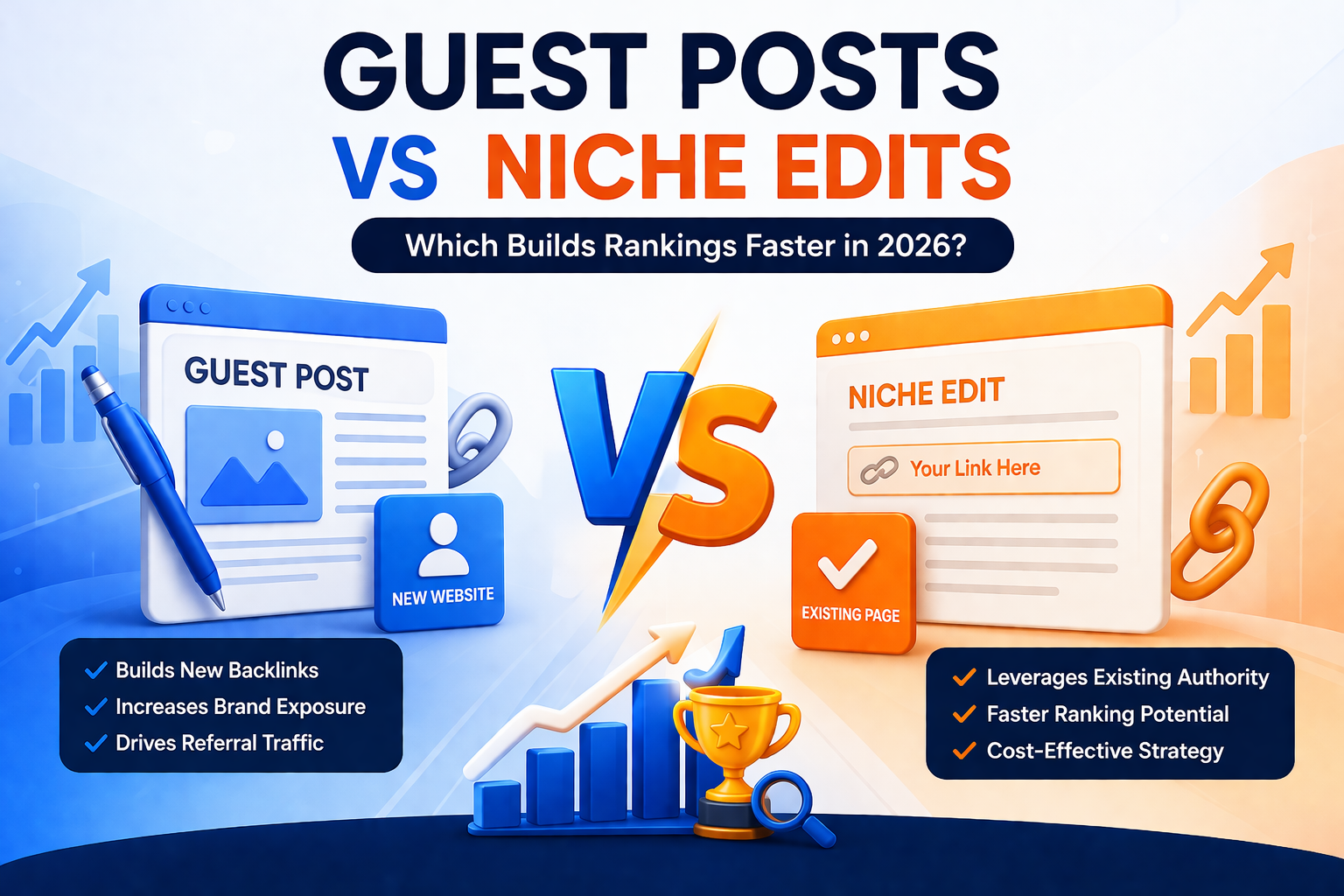
Guest Posts vs Niche Edits: Which Builds Rankings Faster in 2026?
You have two of the most effective link building strategies in front of you — guest posts and niche edits. Both build authority. Both earn backlinks. But they work very differently, and choosing the wrong one for the wrong situation can cost you months of SEO progress.
This article breaks down exactly how each strategy works, how fast each one moves rankings, what they cost, and when to use one over the other. No theory. No filler. Just a practical comparison built for SEOs and business owners who need results in 2026.
Table of Contents
ToggleWhat Are Guest Posts?
A guest post is a brand-new article written specifically for publication on a third-party website. The article is relevant to the host site’s niche, provides genuine value to its readers, and includes a contextual backlink to your target page.
The process typically works like this:
- Identify a niche-relevant website with real organic traffic
- Pitch a topic and get approval from the site’s editor
- Write and submit an original article
- The article is published with your backlink embedded contextually
Guest posts give you full control over the surrounding content, the anchor text, and the context in which your link appears. They are considered one of the cleanest white-hat link building methods when done through genuine manual outreach on sites with editorial standards and real audiences.
What Are Niche Edits?
A niche edit — also called a link insertion or curated link — is a backlink placed inside an article that already exists and is already indexed on a third-party website.
Rather than creating new content, the process involves reaching out to a site owner or editor and arranging for your link to be inserted into a relevant paragraph within a live, ranking article.
The process typically works like this:
- A niche-relevant, already-published article is identified
- Outreach is conducted to the site owner
- Your link is inserted contextually into the existing content
- The page is re-crawled by Google and begins passing link equity to your site
Because the host page already has age, authority, and backlinks pointing to it, niche edits tend to activate faster than guest posts on brand-new pages.
Guest Posts vs Niche Edits: Key Differences at a Glance
Factor | Guest Posts | Niche Edits |
|---|---|---|
Content | New article created | Existing article updated |
Indexing time | 1 to 3 weeks (new URL) | Already indexed |
Ranking impact | 2 to 3 months | 4 to 6 weeks |
Cost range | $150 to $600+ per link | $80 to $360 per link |
Context control | High | Medium |
Link naturalness | High (editorial) | High (contextual) |
Non-indexing risk | Present | Very low |
Best use case | Building topical authority | Quick ranking lifts |
Which One Builds Rankings Faster?
When Google crawls a niche edit, it is re-evaluating a page it already knows, trusts, and has assigned authority to. The link equity flows to your site almost immediately after the next crawl. Most SEOs observe measurable ranking movement within four to six weeks of a quality niche edit going live.
Guest posts work on a slower timeline. The new article needs to be discovered, crawled, indexed, and then evaluated by Google for authority — a process that can take anywhere from two to twelve weeks, depending on the host site’s crawl frequency. After indexing, it may take another two to three months before the ranking impact becomes clearly visible.
That said, faster is not always better. The right answer depends on what you are trying to achieve.
When to Use Niche Edits
Niche edits are the better choice when speed and efficiency matter more than content control. Use them when:
- Pushing into the top 3: Your page is already ranking between positions 4 and 15 and needs an authority boost to break through
- Running a time-sensitive campaign: You have a defined timeline and need visible movement within 4 to 8 weeks
- Working with a tighter budget: You need more placements per dollar spent
- Topically strong niches: Strong existing content can naturally accommodate your link without forced context
- Reinforcing authority without new content: You want to build link equity without creating additional content assets
A well-placed niche edit in an article that already ranks for related keywords can compound your authority signals faster than any other tactic at this price point.
When to Use Guest Posts
Guest posts are the better choice when you are building for the long term or entering a competitive niche from scratch. Use them when:
- Starting from a new domain: Your site needs foundational link equity and topical authority signals
- Targeting YMYL niches: In health, finance, or legal, E-E-A-T signals matter more than speed — editorial links carry more weight
- Requiring full context control: You need to control the exact topic, tone, and anchor text surrounding your backlink
- Building topical authority: You want links from articles closely themed to your target page’s subject matter
- Competing for high-volume keywords: The top-ranking pages have editorial links from high-authority publishers — you need to match that profile
Guest posts also create a new indexed page on a third-party site. Over time, that page may rank in its own right and send referral traffic directly to your site — an asset that compounds in value.
Speed Breakdown: A Realistic Timeline Comparison
Understanding the realistic timeline for each strategy helps you set expectations and plan your campaigns properly.
Niche Edit Timeline
- Day 1–7: Outreach, negotiation, link placed in existing article
- Day 7–14: Google re-crawls the updated page
- Week 3–6: Link equity begins flowing to your target page
- Week 4–8: Measurable ranking movement typically observed for mid-competition keywords
Guest Post Timeline
- Day 1–7: Outreach and topic approval
- Day 7–21: Article written, reviewed, and submitted
- Day 21–42: Article published on host site
- Week 4–8: New page crawled and indexed by Google
- Week 8–16: Ranking impact becomes visible for mid-competition keywords
The gap is roughly 4 to 8 weeks in favour of niche edits when measuring time from campaign start to visible ranking movement.
Cost Comparison: What You Actually Pay Per Link
Pricing in link building varies based on domain authority, organic traffic, and the niche of the host site. Here is a realistic market overview for 2026.
DR Range | Guest Post (per link) | Niche Edit (per link) |
|---|---|---|
DR 20–29 | $150 to $220 | $80 to $120 |
DR 30–39 | $220 to $320 | $120 to $180 |
DR 40–49 | $320 to $450 | $180 to $260 |
DR 50–59 | $450 to $650 | $260 to $360 |
DR 60+ | $650 to $1,500+ | $360 to $600+ |
The price difference exists because guest posts include content creation. Writing a quality 1,000- to 1,500-word article, managing editorial approval, and handling placement logistics costs more than inserting a link into existing content. For agencies managing multiple clients, niche edits offer a better margin at scale.
Most SEO professionals running ongoing campaigns order in bulk — typically 5 to 10 links per month — which brings the per-link cost down further. If you are managing multiple client campaigns or targeting several pages at once, bulk ordering is the most cost-efficient way to scale without compromising on placement quality.
At MonkeyGoals, every placement — whether a guest post or link insertion — is manually outreached on real, traffic-verified sites starting at just $79. No PBNs, no link farms, no bulk automation.
What Factors Actually Determine How Fast Links Move Rankings
Speed is not just about the link type. Several other factors determine how quickly either strategy produces visible results.
- Domain Authority of the host site: A niche edit on a DR 50 site will move rankings faster than a guest post on a DR 20 site. Host authority is the most important speed variable.
- Topical relevance: A link from a page closely themed to your target page passes more authority. Topical relevance has become significantly more important as Google has reinforced entity-based ranking systems.
- Organic traffic on the host page: For niche edits specifically, the target page should have real organic traffic. A page Google already values is a much stronger endorsement.
- Your target page’s existing authority: If your target page has zero backlinks, even one strong placement can produce a significant jump. If it already has 50 quality backlinks, incremental gains require more placements.
- Anchor text distribution: A healthy mix of branded, partial match, and exact match anchors produces the fastest long-term gains. Over-optimised anchors create unnatural signals.
The Smartest Strategy: Use Both Together
The most effective link building campaigns in 2026 do not choose between guest posts and niche edits. They use both in combination, with each type serving a specific role.
Phase 1 — Foundation (Months 1 to 2)
Use guest posts on niche-relevant sites with genuine editorial standards to build topical authority and contextual backlink profiles. Focus on DR 30 to 50 placements.
Phase 2 — Acceleration (Months 2 to 4)
Layer in niche edits on already-ranking pages to push target keywords from page two into the top five. Prioritise pages with existing traffic and strong topical alignment.
Phase 3 — Maintenance (Ongoing)
Continue a steady mix — roughly 60% niche edits for speed and efficiency, 40% guest posts for long-term authority building and referral traffic.
This combined approach delivers both the speed of niche edits and the durability of guest posts — which is why it remains the standard for agencies managing competitive SEO campaigns.
How to Evaluate Quality for Both Link Types
Not all guest posts and niche edits are equal. The link building market in 2026 is flooded with providers selling placements on link farms and low-traffic blogs that carry almost no SEO value. Before accepting any placement, verify the following.
For any host site:
- Real organic traffic: At least 500 monthly visitors verified in Ahrefs or Semrush
- Domain Rating: At least DR 25 for foundational links, DR 40+ for competitive campaigns
- Topical relevance: Not a generic lifestyle blog — the site must be themed to your niche
- Clean outbound link profile: No links to gambling, casino, adult, or spam-adjacent industries
- Genuine audience: Look for social shares, comments, or engagement signals
For niche edits specifically:
- Host page must rank: The page should rank for at least one keyword with real search volume
- Natural link context: Existing content must be relevant enough for your link to read naturally
- No link overload: More than 5 to 8 outbound links in a single article is a warning sign
For guest posts specifically:
- Real editorial guidelines: The site should not accept every article submitted
- Closely aligned topic: The article topic must match your target page’s subject matter
- Original content only: The content must be original — not spun or AI-generated without quality human editing
What 2026 Changes About This Decision
The SEO landscape in 2026 has added two important dimensions to this debate: AI Overviews and E-E-A-T enforcement.
AI Overviews: Google’s AI-generated answer boxes increasingly cite sources based on authority and topical relevance, not just keyword rankings. Links from editorially respected publications — more common in quality guest post placements — can contribute to your site being cited in AI Overviews. Niche edits on lower-authority pages are less likely to carry this benefit.
E-E-A-T enforcement: Google has made it clearer than ever that links from sites demonstrating real expertise, experience, authority, and trustworthiness carry more weight. For YMYL niches especially, the editorial quality of your guest post placements matters as much as the DR of the host site.
The practical implication: volume-based niche edit campaigns on mediocre sites produce weaker results in 2026 than they did in 2022. Quality has become non-negotiable for both strategies.
The Bottom Line
If speed is your priority and your pages are already in range of page one, niche edits are the faster path. If you are building authority from the ground up or competing in a trust-sensitive niche, guest posts are the stronger foundation.
The strongest campaigns in 2026 use both — with niche edits providing the acceleration and guest posts providing the durability. Choose your mix based on where your site is today, how competitive your target keywords are, and how quickly you need to see results.
Both strategies work. The question is which one works for your situation right now.
Not sure which strategy fits your site? Get a free SEO audit from MonkeyGoals — we’ll review your backlink profile and tell you exactly which approach will move the needle fastest.
Frequently Asked Questions
Are niche edits safe for SEO in 2026?
Yes — when placed on real, editorially governed websites with genuine organic traffic and a clean backlink profile. Niche edits only become risky when sourced from link farms, private blog networks, or providers that insert links en masse without genuine editorial oversight. Always verify the host site quality before accepting any placement.
How many niche edits or guest posts do I need to rank?
It depends on your keyword’s competition and your current domain authority. For low-competition keywords, three to five quality placements on relevant DR 30 to 50 sites can produce first-page rankings within 60 to 90 days. For competitive keywords, you may need 10 to 20 placements over six months. A consistent ongoing approach always outperforms bulk one-off campaigns.
Can I use niche edits and guest posts at the same time?
Yes — and this is the recommended approach for most campaigns. Use guest posts to build foundational topical authority and niche edits to accelerate movement on specific target pages. Running both simultaneously produces better results than relying on either strategy alone.
Which strategy is better for a brand new website?
Guest posts are generally better for new sites. A new domain needs foundational link equity and topical authority signals before niche edits can maximize their impact. Building a base of 10 to 15 quality guest post links in the first three to four months gives your domain the authority profile needed for niche edits to work most effectively.
How do I know if a niche edit provider is legitimate?
Ask for sample placements and verify them independently using Ahrefs or Semrush. Check that host pages have real organic traffic — not just DR. Confirm the sites are topically relevant to your niche, not generic content farms. Legitimate providers welcome this scrutiny. Anyone who resists verification is a red flag.
Do guest posts or niche edits work better for local SEO?
Both can support local SEO, but local citation building and links from locally relevant publications often matter more for purely local rankings. For local businesses trying to rank nationally or in broader regional searches, a mix of guest posts and niche edits on industry-relevant sites follows the same logic as any other campaign.
Will these strategies still work with Google's AI-driven updates?
Yes. Backlinks remain one of Google’s core ranking signals in 2026 and are also a factor in AI Overview citations. The key shift is that quality and relevance matter more than volume. Ten high-quality links from topically relevant, high-traffic sites will consistently outperform fifty cheap links from low-quality sources — and this gap has widened with each algorithm update since 2023.

Camila Morgan is an SEO and content strategist with years of experience helping businesses grow their organic presence through ethical link building. She regularly writes about guest posting, digital PR, and search strategy for marketing publications and industry blogs. When she is not building outreach campaigns, she shares practical SEO insights that help businesses rank smarter — not harder.