
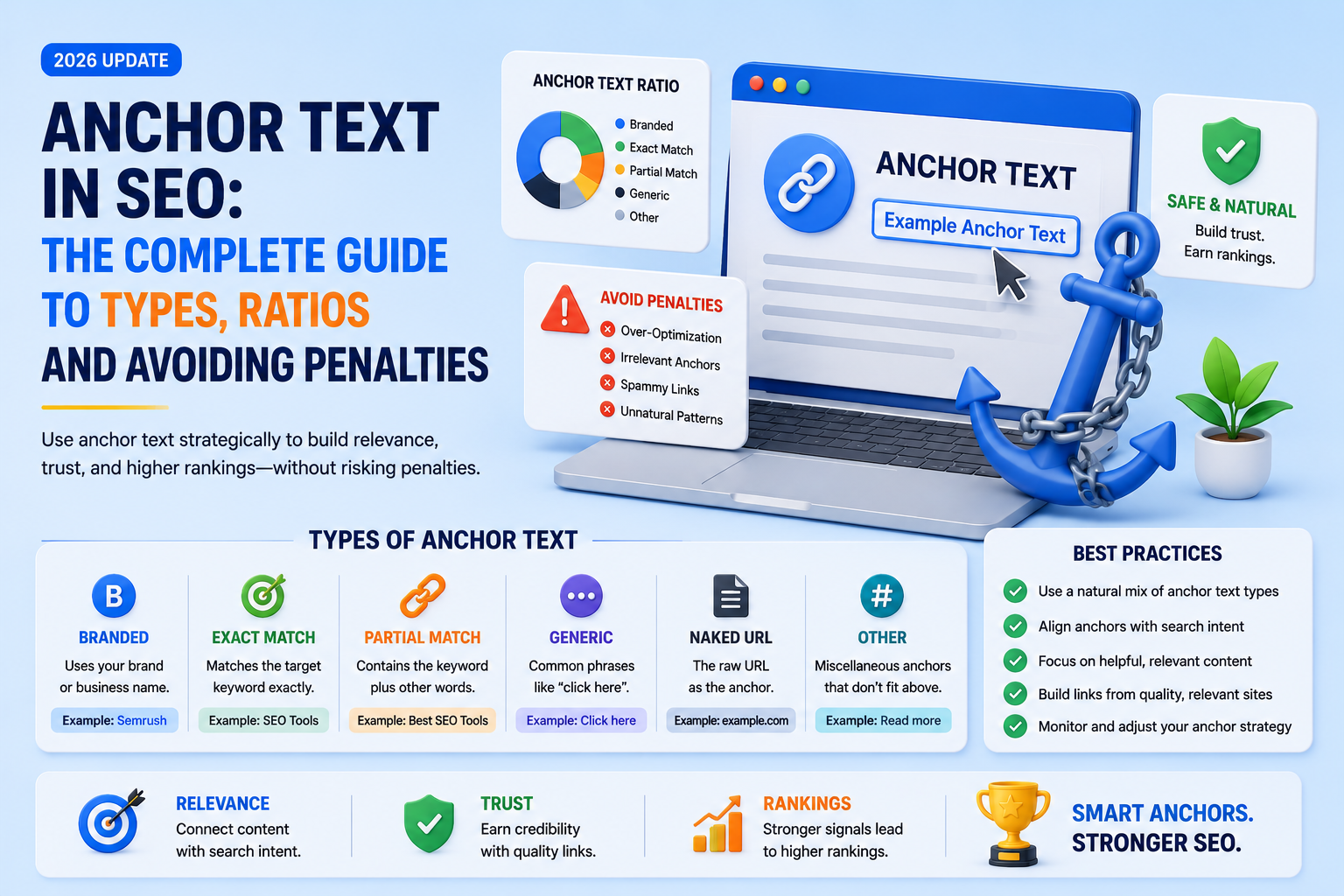
Every backlink you build carries two signals to Google: the authority of the site linking to you, and the anchor text used for the link. Get the authority right and ignore the anchor — your links underperform. Get the anchor text wrong — over-optimised, repetitive, unnatural — and Google’s Penguin algorithm can suppress your rankings or trigger a manual action that removes you from search results entirely.
Understanding anchor text SEO is not optional for any serious link building campaign in 2026. This guide covers everything you need — from the seven types of anchor text and how each signals relevance to the specific distribution ratios that keep your profile safe, to the sections every other guide skips: how to brief anchor text when ordering links, and what to do when your profile is already in trouble.
What Is Anchor Text in SEO?
What is anchor text in SEO? Anchor text is the visible, clickable text within a hyperlink. In HTML, it looks like this:
<a href=”https://monkeygoals.com/guest-posting-services/”>guest posting services</a>
In this example, “guest posting services“ is the anchor text. When another website links to your page using this phrase, Google reads it as a relevance signal: the destination page is about guest posting services. That signal influences how Google ranks your page for related search queries.
Anchor text functions as two things simultaneously: a relevance signal (telling Google what the linked page is about) and a trust signal (naturally earned, descriptive anchor text from credible sites suggests the destination is genuinely authoritative on that topic). The challenge is that exact-match keyword anchors are also the easiest signal to manipulate — which is exactly why Google’s Penguin algorithm monitors anchor text patterns so carefully.
The 2026 update to how anchor text works: Google no longer evaluates anchor text as a standalone keyword string. It evaluates the full context — the anchor, the surrounding sentence, the page the link appears on, and the destination page. All four must align coherently. A misaligned anchor in an irrelevant sentence on an off-topic page passes minimal value, regardless of how perfectly chosen the anchor itself is.
The 7 Types of Anchor Text (and How Each Affects SEO)
Understanding the types of anchor text is the foundation of any safe distribution strategy. Each type sends a different signal — and each carries a different risk profile.
Type | Example | SEO signal | Risk level | Recommended use |
|---|---|---|---|---|
Exact match | link building services | Strong keyword relevance signal | High — triggers Penguin if overused | 3 to 8% of external profile — use sparingly and only where contextually natural |
Partial match | professional link building | Moderate keyword relevance with variety | Low to medium | 15 to 25% of profile — the workhorse of most healthy campaigns |
Branded | MonkeyGoals | Brand authority and entity recognition | Very low — natural and trusted by Google | 30 to 50% of external profile — the largest category for most established sites |
Naked URL | monkeygoals.com | Brand citation, minimal keyword signal | Very low | 10 to 20% of profile — common in citations and directories |
Generic | click here, read more, visit the site | No keyword signal — user navigation only | Very low | 5 to 10% of profile — balances and naturalises an over-optimised profile |
LSI / related | backlink strategy, outreach tactics | Topical relevance through semantic variation | Low | 10 to 15% of profile — builds entity signals without exact match risk |
Image alt text | Alt: MonkeyGoals link building | Anchor signal from image links | Low | Use descriptively — Google reads image alt text as anchor text for image links |
The most important takeaway from this table: branded anchors should be the largest single category in any natural backlink profile. When real websites link to you because they genuinely reference your brand, they use your brand name — not your target keyword. A profile dominated by exact match anchor text looks manufactured, because it is. Real editorial linking is diverse by nature.
Anchor Text Distribution: Safe Ratios for a Healthy Profile
The question every link builder asks: What is the right anchor text ratio? The honest answer is that there is no single universal ratio — but there are safe ranges that consistently avoid Penguin risk. Here is the baseline distribution that works across most niches.
Anchor type | Safe external ratio | Safe internal ratio | Notes |
|---|---|---|---|
Branded | 30 to 50% | 10 to 20% | Your largest external category. Let this grow organically through brand mentions and PR. |
Naked URL | 10 to 20% | 5 to 10% | Common in citations, directories, and forum references. Very natural pattern. |
Partial match | 15 to 25% | 20 to 35% | Solid keyword signal without exact match risk. Most versatile anchor type. |
LSI / related | 10 to 15% | 15 to 25% | Semantic variations strengthen topical authority without creating exact match patterns. |
Generic | 5 to 10% | 5 to 15% | Useful for offsetting an over-optimised profile. Also natural from non-SEO linking. |
Exact match | 3 to 8% | 5 to 15% | Danger zone above 10% externally. Internal exact match is safer but still needs variety. |
Image alt text | 1 to 5% | 5 to 10% | Count these in your audit — they contribute to your overall profile distribution. |
Important: These ratios are guidelines, not rigid rules. The most accurate anchor text targets for your specific site come from analysing what the top 3 ranking pages for your target keyword are already using. If every page-one competitor has 5% exact match, pushing yours to 12% will stand out as anomalous — even if 12% is within the ‘safe’ range. Mirror the competitive norm, then calibrate from there.
Anchor Text Ratios by Niche — Different Industries Need Different Distributions
The safe anchor text distribution varies significantly by niche. Google’s Penguin algorithm calibrates its assessment of ‘natural’ against what real linking behaviour looks like in each vertical. Here is the niche-by-niche breakdown.
Niche | Max safe exact match | Branded target | Why it differs |
|---|---|---|---|
SaaS / B2B Tech | 5 to 8% | 35 to 50% | High-DR publishers in SaaS use descriptive but varied anchors. Exact match above 8% looks like a link buying campaign in this niche. |
Ecommerce | 6 to 10% | 25 to 40% | Product category anchors (‘running shoes’) are more natural in retail. Slightly higher exact match threshold than B2B. |
Legal | 3 to 5% | 40 to 55% | YMYL scrutiny is highest here. Legal sites are expected to be cited by brand or reputation — keyword-heavy anchors look manipulative. |
Health / Wellness | 3 to 6% | 35 to 50% | Also YMYL. Editorial health links use condition names or branded terms — rarely exact-match service keywords. |
Affiliate / Review sites | 8 to 15% | 15 to 30% | Product review anchors are more naturally keyword-specific. Slightly higher exact match threshold but still needs strong branded base. |
Local SEO | 8 to 12% | 30 to 45% | City plus service anchors are natural in local link building (‘plumber in Manchester’). Higher keyword anchor tolerance in local SERPs. |
Finance | 3 to 5% | 40 to 55% | Similar to legal — YMYL enforcement. Finance editorial links lean heavily branded or publication-cited. |
For MonkeyGoals clients: When briefing a campaign, always specify your niche so anchor text guidance can be calibrated correctly. A legal client and an ecommerce client running the same anchor distribution will produce very different risk profiles — even if the raw numbers look identical.
The Contextual Surroundings Rule — What Sits Around the Anchor Matters as Much as the Anchor Itself
In 2026, Google does not evaluate anchor text in isolation. It reads the full sentence surrounding the link — the 15 to 25 words on either side of the anchor — and uses that context to determine how much relevance the link actually passes. A perfectly chosen anchor in a poorly written, irrelevant surrounding sentence is partially devalued. A contextually rich surrounding sentence can amplify even a generic anchor.
Here is the practical difference:
Weak anchor context — link is partially devalued
“For more information, check out this link building service that many businesses use.”
Why it fails: the surrounding sentence says nothing about link building. It gives Google no context to amplify the anchor’s relevance signal.
Strong anchor context — link passes full value
“Agencies looking to scale their client campaigns without hiring in-house outreach specialists often rely on a professional guest posting service to secure editorially placed links on high-DR, topically relevant publications.”
When briefing guest post placements or link insertions, always specify the anchor text and provide a brief description of the surrounding context you want. Tell your link builder: ‘Use partial match anchor X, in a sentence discussing Y topic, placed within a paragraph about Z.’ This doubles the relevance signal your link passes compared to briefing anchor text alone.
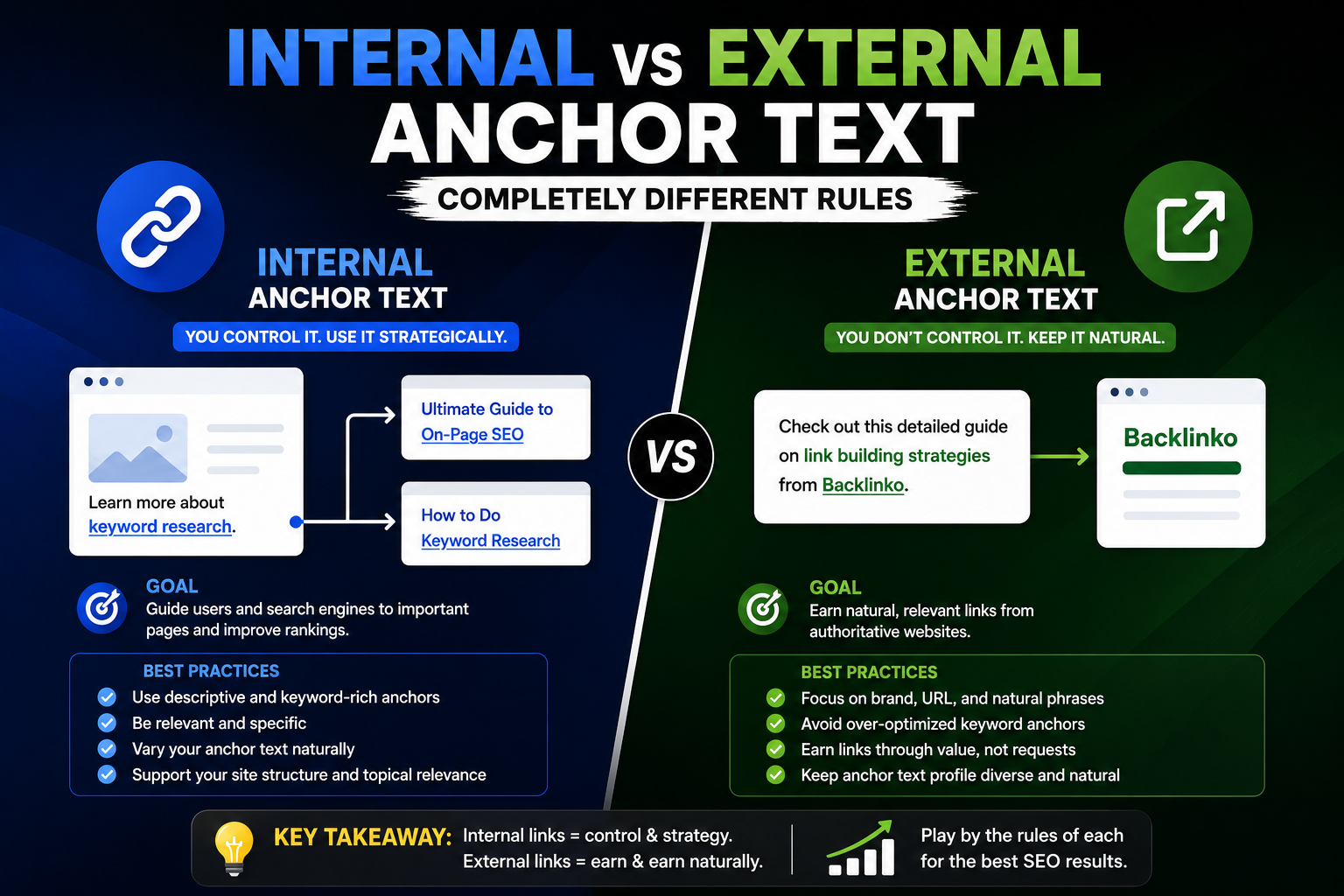
Internal vs External Anchor Text — Completely Different Rules
Internal and external anchor text serve different purposes and operate under different risk profiles. Treating them the same way is one of the most common mistakes in anchor text optimization.
External anchor text — what links from other sites use
External anchor text is what you cannot fully control. You can brief it, request it, and guide it — but editorial decisions ultimately rest with the host site. This is exactly what makes a natural-looking external profile: genuine variety that reflects genuine editorial choices.
- Keep exact match below 8% externally. Every exact match anchor you build is a deliberate footprint. Google knows real websites do not all choose to link to you using your target keyword. Even 10% exact match can look manipulative in competitive niches.
- Let branded anchors dominate naturally. As you build genuine brand authority — through PR, quality content, and editorial mentions — branded anchors grow automatically. Never suppress them by over-briefing keyword anchors.
- Use partial match as your primary acquisition target. Partial match anchors pass keyword relevance without the Penguin risk of exact match. They are the safest active anchor to brief when ordering new links.
- Vary anchor text across multiple links to the same page. If you build 10 links to your pillar page, no two external anchors should be identical. Rotate through branded, partial match, LSI, naked URL, and occasional exact match within your safe ratio threshold.
Internal anchor text — what your own site uses
Internal anchor text is entirely under your control — and the risk profile is significantly lower than external. You can use more keyword-rich anchors internally because Google understands you are describing your own content for navigation purposes. But this does not mean anything goes.
- Use keyword-rich anchors internally — but read naturally. ‘Our comprehensive guide to white label link building’ is better than ‘click here’ and also better than the forced exact match ‘white label link building agency.’ Descriptive is always the goal.
- Use consistent but varied internal anchors to the same page. If five blog posts all link to your guest posting service page, vary the anchor across those five links. This helps the page rank for a broader set of related queries rather than a single keyword.
- Align internal anchors with your target keyword hierarchy. The page’s primary keyword should appear in at least one internal anchor linking to it. Supporting keywords can appear in others. This builds a clear topical signal through internal structure.
- Internal anchor text for images matters too. Every linked image on your site needs a descriptive alt text. Google reads this as the anchor text for that link. ‘img_001.jpg’ tells Google nothing. ‘MonkeyGoals white label link building dashboard’ tells Google exactly what the destination page is about.
How to Brief Anchor Text When Ordering Links — The Agency Template
The most common anchor text mistake among buyers ordering anchor text for link building campaigns is specifying only the anchor — without context, without variation guidance, and without a profile-level strategy. Here is the complete briefing template to use when ordering any link placement.
ANCHOR TEXT BRIEF TEMPLATE
- Target URL: The exact page you want the link to point to (not just the homepage)
- Primary anchor: Your preferred anchor text (e.g., ‘guest posting services’)
- Anchor type: Exact match / Partial match / Branded / LSI — whichever applies
- Anchor variations: 2 to 3 acceptable alternatives if primary is not natural in context (e.g., ‘guest post service,’ ‘professional blogger outreach,’ ‘MonkeyGoals’)
- Surrounding context: Brief description of the topic the surrounding paragraph should address (e.g., ‘place in a paragraph about scaling link building for SEO agencies’)
- Do not use: Any anchors that should be avoided (e.g., ‘click here’, exact match if you are already at threshold, any competitor brand names)
- Profile position: Note where this link sits in your overall distribution — e.g. ‘this will be our 3rd exact match anchor; please use partial match or branded instead.’
MonkeyGoals anchor text guidance is included with every order. When you place a guest post or link insertion with us, we review your current anchor profile in Ahrefs before briefing the placement — ensuring every new link moves your distribution toward the safe zone rather than compounding any existing risk.
How to Audit Your Anchor Text Profile
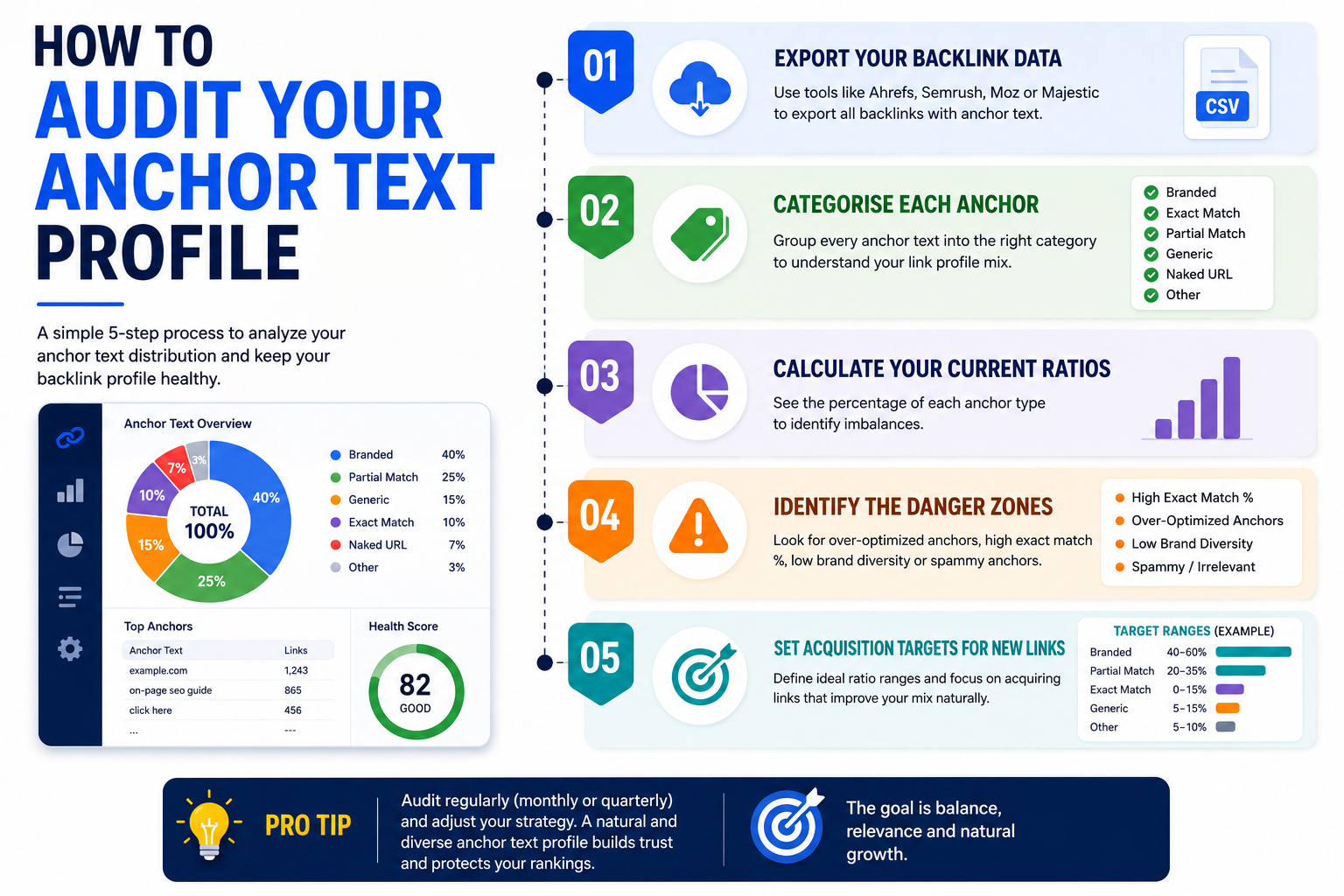
Before building new links, every serious campaign starts with an anchor text checker audit of your existing profile. This tells you exactly where you sit, which anchor types are over or under-represented, and what to brief on new placements to correct the balance.
- Export your backlink data. Open Ahrefs or Semrush, go to Backlinks > Anchors for your target URL. Export the full list including the referring domain count per anchor.
- Categorise each anchor. Sort every anchor into the seven types: exact match, partial match, branded, naked URL, generic, LSI, and image alt text. Use the referring domain count — not raw link count — to avoid double-weighting links from the same domain.
- Calculate your current ratios. Divide each category’s referring domain count by your total referring domains to get percentage ratios. Compare these against the safe ranges for your niche.
- Identify the danger zones. If the exact match is above 10% externally, you are in the risk zone. If the branded is below 20%, your profile looks manufactured. If the generic is at 0%, it looks artificially selective.
- Set acquisition targets for new links. Based on where your ratios sit, brief your next batch of links to move toward the target distribution. If you are over on exact match, your next 5 to 10 links should all be branded, naked URL, or generic.
For clients running white label link building campaigns through Monkey Goals, we run this audit before every campaign launch and include anchor text calibration recommendations as standard. See our SEO audit service for a full backlink profile review, including anchor text health scoring.
How to Recover from an Over-Optimised Anchor Text Profile
If your site has received an anchor text penalty — either an algorithmic suppression from Penguin or a manual action from Google Search Console — the recovery process is specific and methodical. Here is the exact sequence.
Step 1 — Confirm whether it is an anchor text issue
Check Google Search Console for any Manual Action notifications referencing ‘unnatural links.’ If no manual action exists, cross-reference your traffic drop date with known Penguin update dates. If the drop coincides with a Penguin refresh, anchor text over-optimisation is the most likely cause.
Step 2 — Export and categorise your full anchor profile
Follow the audit process above. Identify exactly which anchor types are over-represented. Export the specific links contributing to the over-optimised anchors — you need to know which domains are sending the exact match anchors before you can fix the problem.
Step 3 — Separate low-quality from high-quality exact match links
Not all exact match anchors need to be removed. An exact match anchor from a DR 50, topically relevant, traffic-active site is a genuine editorial link — do not disavow it. An exact match anchor from a DR 5 site with zero traffic and suspicious outbound links is a risk — flag it for disavow.
Step 4 — Build offset links to dilute the ratio
For every exact match link you cannot remove or disavow, build three to five branded, naked URL, or generic links to the same page. This dilutes the exact match percentage without losing the authority those links pass. Offset linking is faster and more reliable than waiting for disavow processing.
Step 5 — Submit a disavow file for low-quality exact match links
For genuinely toxic exact match links — PBNs, link farms, completely irrelevant sites — compile a disavow file and submit it through Google Search Console. Allow 4 to 8 weeks for the disavow to be processed and reflected in your profile assessment.
Step 6 — If it is a manual action, file a reconsideration request
After completing steps 1 to 5, document everything — the links you disavowed, the offset links you built, and the anchor ratio before and after. Submit a reconsideration request through Search Console, explaining the corrective actions taken. Be specific and factual. Manual action reviews typically take 2 to 4 weeks.
Recovery timeline: Algorithmic suppression from Penguin typically takes 2 to 4 months to recover after anchor ratios are corrected — Penguin updates run in real time but domain authority re-evaluation happens gradually. Manual action recovery after a successful reconsideration request typically takes 2 to 6 weeks.
Final Thoughts
Anchor text SEO in 2026 is not about maximising keyword signals — it is about building a profile that looks like it grew through genuine editorial endorsements over time. Branded anchors dominate. Exact match anchors are used sparingly. Partial match does the heavy lifting. Context surrounds every link. Internal anchors are descriptive and hierarchical.
The two most common mistakes are easy to avoid once you understand the rules: over-briefing exact match anchors on new link placements, and treating internal and external anchor text the same way. Brief every new link with the full context template — anchor, type, surrounding sentence guidance, and where it sits in your overall profile distribution. Audit your ratios before every campaign and adjust acquisition targets accordingly.
And if your profile is already over-optimised: Offset first, disavow the genuinely toxic links, and be patient. Recovery takes months — but it is reliable when the process is followed correctly. For a full link building strategy that keeps anchor text healthy from campaign launch, see our guest posting services and link insertion service — every placement is briefed with anchor text calibration built in.
Need a link building partner who understands anchor text strategy?
At Monkey Goals, every placement comes with anchor text guidance built in. We help you build a natural, penalty-proof anchor distribution across your entire backlink profile — guest posts and link insertions from $79 per placement, with bulk pricing for agencies.