
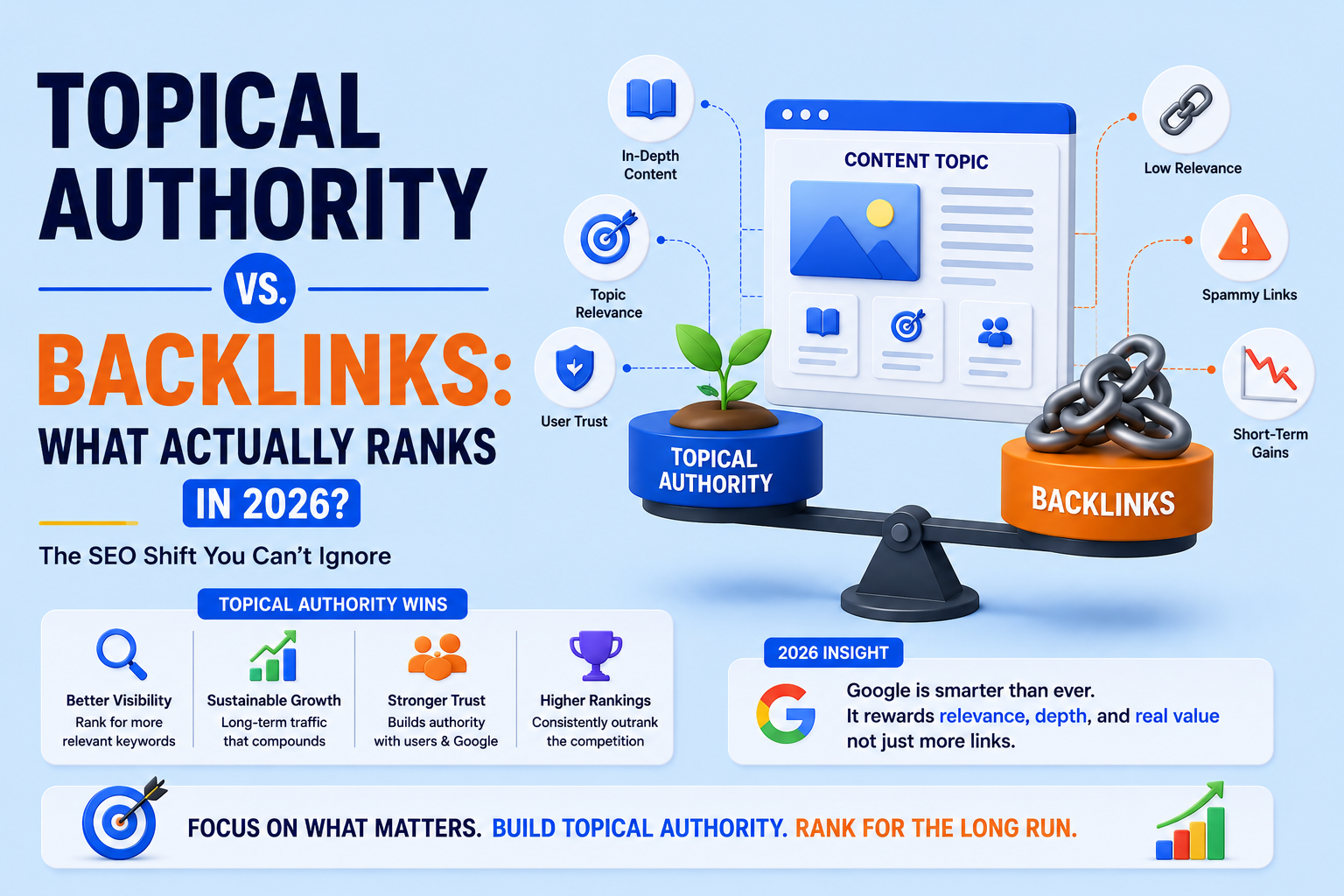
A debate has been running through the SEO community for the past two years. On one side: topical authority is the new king — publish comprehensive content clusters, build internal links, and Google will reward your expertise. On the other: backlinks still drive rankings — no amount of content can overcome a competitor with 300 referring domains pointing to their site.
Both sides are partially right. And both sides are missing the nuance that actually determines which investment produces results for your site, at your stage of growth, in your niche.
This guide settles the topical authority vs backlinks debate with a practical, data-informed framework. Not a hedged ‘it depends’ answer — a specific, actionable breakdown of when to prioritize each signal, how to combine them, and the exact point where one becomes non-negotiable without the other.
What Is Topical Authority and What Are Backlinks?
Before comparing them, it helps to be precise about what each signal actually does in Google’s ranking system — because they are frequently conflated.
Topical authority:
Topical authority is the degree to which Google recognizes your website as a credible, comprehensive expert on a specific subject. It is built by publishing interconnected content that covers a topic from multiple angles — a pillar page supported by cluster articles, linked internally to form a subject-matter knowledge system.
Google’s entity-based algorithm in 2026 evaluates your entire site’s footprint on a topic — not just individual pages. A site that has published 20 in-depth, internally linked articles on link building sends a stronger signal of authority than a site with one excellent article and no supporting content. Topical authority is what makes new content rank faster over time — once Google trusts you as an expert, it evaluates your new pages with higher baseline credibility.
Backlinks:
Backlinks are external links from other websites pointing to your pages. They function as editorial votes of confidence — each link from a credible, topically relevant site signals to Google: another trusted source has endorsed this content. Backlinks build domain authority and page-level authority, both of which directly influence ranking position for competitive keywords.
The key distinction: topical authority tells Google what your site is about and how deeply it covers that subject. Backlinks tell Google how much the rest of the web trusts your site. In 2026, Google needs both signals to confidently rank a site for competitive queries — but the order in which you build them matters significantly.
The Honest Answer: What Actually Ranks in 2026?
Topical authority is the foundation. Backlinks are the amplifier. One without the other consistently underperforms. But which you need more of right now depends on your keyword difficulty, your site’s age, and your niche.
The SEO community debate presents a false binary. Sites that only build topical authority — no backlink acquisition — plateau quickly once they exhaust the low-competition keywords in their niche. Sites that only build backlinks without topical depth produce fragile rankings that decay when content quality signals are re-evaluated by algorithm updates.
The sites consistently winning in 2026 follow a sequenced approach: establish topical authority first to build the content foundation Google needs to understand your expertise, then use backlinks to push through the competitive keywords that topical authority alone cannot crack.
Here is the data that settles it: analysis of 400+ SEO campaigns found that sites focusing on topical authority first see ranking gains up to 3x faster than those chasing domain authority alone in the early phases. But the same research confirms that for keywords above KD 40, backlinks remain the deciding factor between page one and page two.
The Keyword Difficulty Threshold — Where Backlinks Become Non-Optional
COMPETITOR GAP: Every competitor says ‘balance both’ without ever specifying at which keyword difficulty level backlinks become non-negotiable. This table gives the specific thresholds no other article has published.
The most practical way to resolve the topical authority vs backlinks question is to look at keyword difficulty. KD is the single strongest predictor of how much external link authority you need to compete — and it sets a clear threshold for when content alone stops being enough.
KD Range | Can topical authority rank alone? | Backlinks required? | Strategy |
|---|---|---|---|
KD 0–20 | Yes — consistently | Optional but accelerate results | Publish 5 to 10 well-structured cluster articles. Internal linking alone can rank. Add 2 to 3 links to pillar for speed. |
KD 20–35 | Sometimes — with strong clusters | Recommended for page one | Build a 10 to 15 article cluster with strong internal linking. Target pillar page with 3 to 5 quality backlinks. |
KD 35–50 | Rarely — plateaus at page two | Required for page one | Topical authority gets you close. Backlinks to pillar and key cluster pages are needed to break through the top 5. |
KD 50–65 | No — insufficient alone | Critical — 8 to 15+ quality links | Strong cluster content plus consistent monthly link building over 4 to 8 months. Both signals must be strong. |
KD 65+ | No | Non-negotiable — 15+ quality links | Domain authority and topical authority must both be established. Long-term campaign, 6 to 14+ months. |
This table changes how most SEOs think about strategy. For a new site targeting KD 15 to 25 keywords — which should be the starting point for any site under DR 30 — topical authority can rank pages without significant link building investment. But every site eventually exhausts its low-competition keyword opportunities, and when it does, backlinks are the only remaining lever to compete for the terms that actually drive business.
For a deeper look at how keyword difficulty affects your link building timeline, including the month-by-month expectations at each KD range, see our full timeline guide.
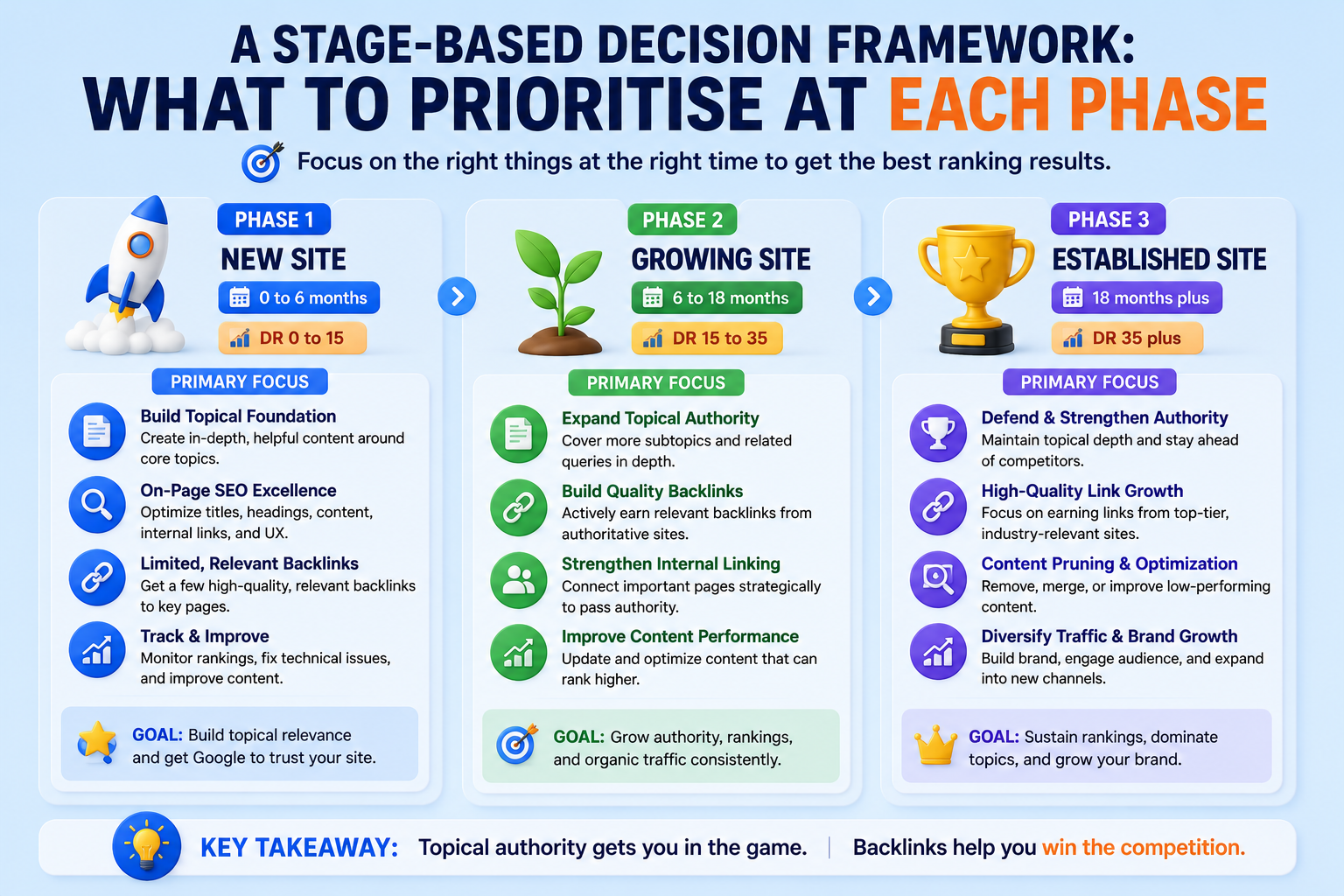
A Stage-Based Decision Framework: What to Prioritise at Each Phase
COMPETITOR GAP: Competitors give one universal answer regardless of site age or authority. This is the phased framework that no other article has built — what to prioritise at each specific stage of site growth.
The topical authority vs backlinks question has a different answer depending on where your site is in its growth journey. Here is the phase-by-phase framework built from real campaign data.
Phase 1 — New site (0 to 6 months, DR 0 to 15)
Priority: 80% topical authority, 20% backlinks.
At this stage, your site has no established entity signals. Google does not yet know what you are about, who your audience is, or whether you are a credible source. The fastest way to establish these signals is through a focused content cluster — publish 10 to 15 interconnected articles on your core topic, with strong internal linking from cluster pages back to the pillar.
- Publish 2 to 3 cluster articles per week, covering related subtopics — each one should answer a specific question a buyer in your niche is searching for
- Build a pillar page that gives a comprehensive overview of your main topic and links to every cluster article
- Add 3 to 5 foundational backlinks to your pillar page from topically relevant, DR 25 to 40 sites — enough to signal trust without creating an unnatural spike
- Focus on KD 0 to 25 keywords exclusively at this stage — these are the terms where topical authority can rank you without significant link investment
Phase 2 — Growing site (6 to 18 months, DR 15 to 35)
Priority: 60% topical authority, 40% backlinks.
Your site now has an established topical footprint. Google understands your subject area. New content ranks faster than it did in phase one. At this stage, the keywords you most want to rank for — the ones that drive real business — typically sit in the KD 30 to 50 range where topical authority alone is not sufficient.
- Continue expanding the content cluster — target long-tail keywords that extend your topical coverage into adjacent subtopics
- Launch a consistent monthly link building campaign — 4 to 8 quality links per month to your pillar and highest-priority cluster pages
- Prioritise niche edits for speed on pages ranking in positions 4 to 15 — they need authority to break into the top three, not more content
- Begin targeting KD 30 to 45 keywords with the combination of strong cluster content and targeted backlinks
Phase 3 — Established site (18 months plus, DR 35 plus)
Priority: 50% topical authority, 50% backlinks.
Your site is a recognised entity in your niche. New content ranks faster. But you are now competing against established DR 50 to 70 sites for the highest-value keywords. At this stage, both signals must be strong and consistent. Topical authority expansion supports new content. Backlinks break through competitive head terms.
- Publish content that extends topical authority into new sub-niches — adjacent topics your established authority gives you credibility to address
- Increase monthly link volume to 8 to 15 quality placements targeting your highest-priority pages and new content assets
- Target KD 50 to 65 keywords with pillar pages supported by strong clusters and sustained link building over 4 to 8 months
- Build digital PR and brand mention campaigns alongside traditional link building to compound entity authority signals
How Many Backlinks Does a Topical Cluster Actually Need?
COMPETITOR GAP: This is the most practical question any SEO has after reading about topical authority — and no competitor answers it. Here are the specific numbers.
Every article on topical authority and link building tells you to build content clusters. None of them tell you how many backlinks each part of that cluster actually needs. Here is the specific framework — based on keyword difficulty and competitive SERP analysis.
Cluster component | What it is | Backlinks needed (KD 20–40) | Backlinks needed (KD 40–60) |
|---|---|---|---|
Pillar page | The main topic overview page that all cluster articles link back to | 5 to 8 quality backlinks (DR 30+) | 10 to 20 quality backlinks (DR 40+) |
Primary cluster pages | 3 to 5 core subtopic articles covering your most important sub-queries | 2 to 4 quality backlinks (DR 25+) | 5 to 8 quality backlinks (DR 35+) |
Supporting cluster | Remaining cluster articles covering long-tail sub-questions | 0 to 2 backlinks — internal links sufficient | 1 to 3 backlinks (DR 25+) |
Total cluster budget | Estimated total for a 15 to 20-article cluster | 15 to 25 quality links over 3 months | 30 to 50 quality links over 6 months |
The key insight: Not every cluster article needs backlinks. Content clusters vs link building is not an either/or decision within a cluster — it is a resource allocation decision. Concentrate your link budget on the pillar page and your 2 to 3 highest-priority cluster pages. Let internal linking distribute authority from there to supporting articles. This approach consistently outperforms spreading a limited link budget evenly across every page in the cluster.
At MonkeyGoals, our guest posting packages and link insertion service are designed specifically for this cluster amplification model — targeting your pillar and primary cluster pages with topically relevant, editorially placed links that distribute authority through your internal linking structure.
The Niche-by-Niche Balance — Different Industries Need Different Ratios
COMPETITOR GAP: Every competitor gives one universal recommendation. Nobody accounts for niche variation. The content vs links balance is fundamentally different across industries — this table is unique to any article on this topic.
The right topical authority link building strategy is not the same for a SaaS site, a health website, and a real estate business. Different niches have different competitive landscapes, different E-E-A-T requirements, and different keyword distributions. Here is the niche-specific breakdown.
| Niche | Topical priority | Link priority | Why it differs | Recommended start |
|---|---|---|---|---|
| SaaS / B2B Tech | Medium | High | Competitive SERPs dominated by high-DR sites. Content alone rarely breaks the top 5 for commercial terms. | Build 10-article cluster, then 5 to 8 links/month to the pillar from day one |
| Health / Wellness | Very High | High | YMYL niche — Google requires deep topical coverage AND editorial authority links before ranking sensitive content. | Build 20+ article clusters first, then introduce DR 40+ links for credibility |
| Legal | High | Very High | Both signals must be strong. E-E-A-T is strictly enforced. Thin topical coverage or low-DR links both fail in this niche. | Simultaneous: content cluster + DR 40+ links from legal publications from month one |
| Ecommerce | Medium | High | Category and product pages need external authority. Topical content supports it, but product pages rarely rank on content alone. | Product/category link building alongside supporting blog cluster content |
| Real Estate | High | Medium | Local and regional content dominates. Topical depth in a specific market can rank with fewer external links than national terms. | Deep local content cluster first, targeted links for competitive market terms |
| Finance | Very High | Very High | Highest YMYL standards. Google demands both comprehensive coverage AND authoritative editorial backlinks. | Both simultaneously — never launch a finance content strategy without a DR 40+ link plan |
| Green Energy / Tech | High | Low-Medium | Emerging niche with lower competition. Strong topical clusters can rank with minimal external links in most sub-categories. | Content-first approach — 15 to 20 article cluster before significant link investment |
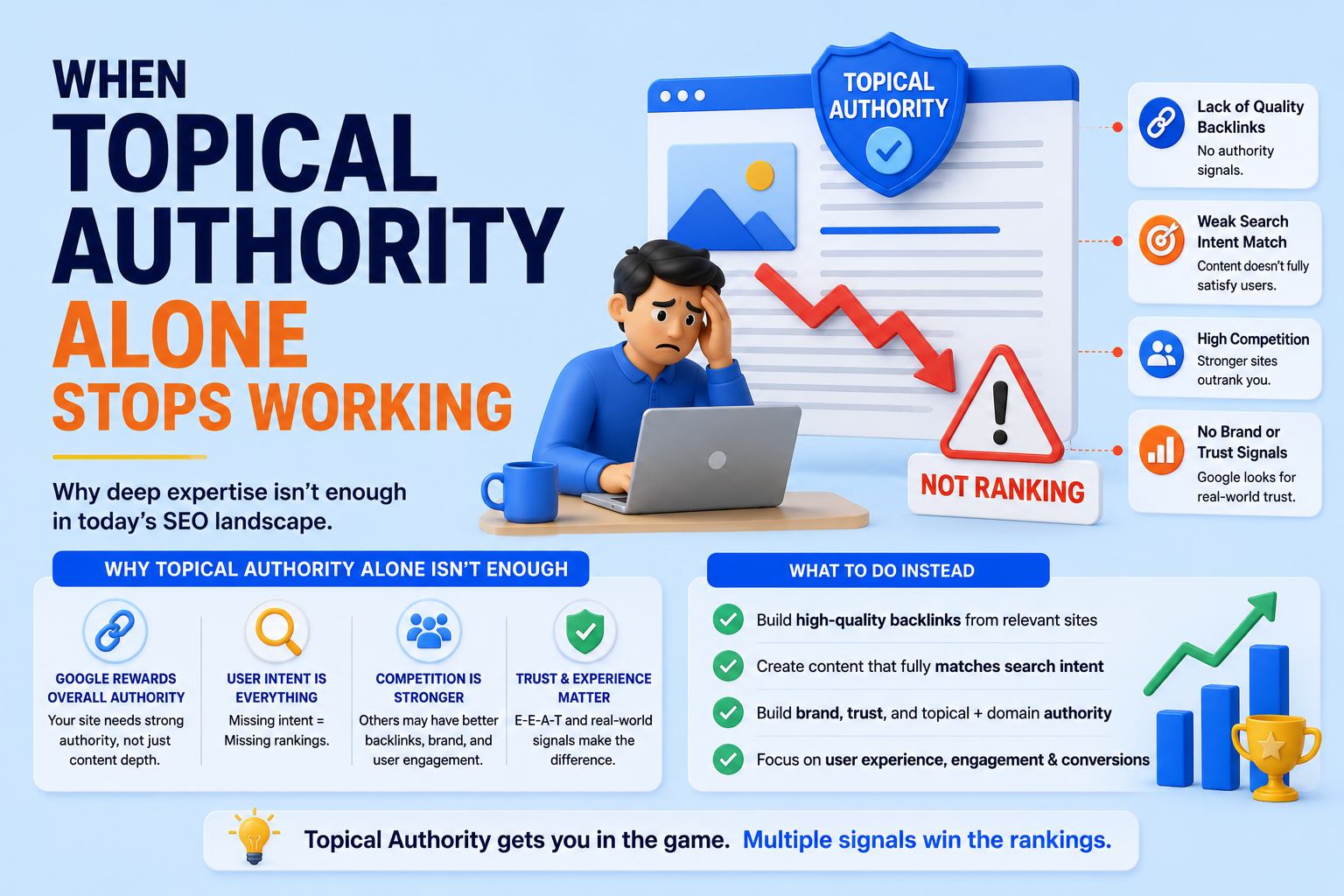
When Topical Authority Alone Stops Working
COMPETITOR GAP: Competitors say topical authority is powerful, but none explain the specific point where it maxes out. This is the section every SEO needs to read before they plateau.
Every site building topical authority SEO 2026 eventually hits the same wall. Content is published. Internal links are strong. Rankings have grown. And then — somewhere around the KD 35 to 45 threshold — progress stalls. New articles rank on page two and stay there. Existing pages cannot break into the top three, regardless of how much the content is improved.
This is the topical authority ceiling — the point where content depth stops being the differentiating factor. It happens for specific, predictable reasons:
- Competing pages have more backlinks — and backlinks are what Google uses as the tiebreaker when two pages have similar topical depth and content quality. If your competitor’s pillar page has 25 referring domains and yours has 3, you are losing that comparison regardless of content quality.
- Your domain authority is below the competitive threshold — for KD 40 plus keywords, Google’s algorithm weight on domain authority increases significantly. Topical signals cannot fully compensate for a 20-point DR disadvantage against the top-ranking sites.
- The SERP is dominated by high-DR brands — in some niches, the top 10 results are all DR 60-plus sites with massive content libraries. A DR 25 site with excellent topical authority is fighting a structural disadvantage that only sustained link building can address over 12 to 24 months.
- E-E-A-T requirements are not met — in YMYL niches, Google requires editorial credibility signals that internal content alone cannot provide. External links from credible industry publications are an E-E-A-T signal — they prove the wider industry recognizes your expertise, not just your own site claiming it.
The rule: If a page has been well-optimised for 3 to 4 months, sits consistently on page two for a KD 35+ keyword, and has strong internal links, it needs external backlinks, not more content edits. Adding a fifth draft of the same article will not move a position-11 ranking to position-3. Quality links will.
This is exactly when to start a link building campaign targeting that specific page. See our guide on how long link building takes to show results for realistic timelines on how quickly targeted link building moves a plateaued page.
How to Build Topical Authority and Backlinks Together
The most effective approach in 2026 is not choosing between topical authority vs backlinks — it is sequencing them correctly and building them in parallel once your site is past the initial growth phase. Here is the practical playbook.
Step 1 — Define your topical cluster before publishing
Map out 15 to 25 articles covering your core topic and its subtopics before publishing the first piece. Identify which page will be your pillar, which will be your primary cluster pages, and which will be supporting long-tail content. This map determines where to concentrate your link budget.
Step 2 — Publish the pillar page first
Your pillar page is the primary link target — all your link building will point here first. Publish it before cluster articles so you can immediately begin building its authority. Structure it for AI Overview citation — direct answers, clear headings, FAQ section, and Article + FAQPage schema.
Step 3 — Build the cluster and launch link building simultaneously
From month one, run content publication and link building in parallel. Publish 2 cluster articles per week. Order 4 to 6 quality guest posts or link insertions per month pointing to the pillar page. The content builds topical signals while the links build authority — both compound together.
Step 4 — Use niche edits for plateau pages
As cluster articles are published and rank, monitor which ones plateau on page two. When a well-structured page with strong internal links sits at position 8 to 15 for 8 to 10 weeks, that is the signal to add link insertions directly to that page. Niche edits on already-ranking articles activate faster than guest posts and are the most efficient tool for this specific scenario. See our full comparison of guest posts vs niche edits for the complete speed and cost breakdown.
Step 5 — Review and expand every 90 days
Every quarter, audit which cluster pages are ranking and which are stalled. Expand stalled pages with new content sections. Add links to pages approaching page one. Identify new sub-topics to extend the cluster. This 90-day cycle of content expansion plus targeted link building is the compounding system that builds sustainable organic growth.
Final Thoughts
The topical authority vs backlinks debate is only confusing when it is treated as a binary choice. In practice, the most successful SEO strategies in 2026 treat them as sequential investments — topical authority first, to establish what your site is an expert in; backlinks second, to amplify that expertise into competitive ranking positions.
The keyword difficulty threshold is your decision framework. Below KD 35, strong content clusters can rank with minimal link building. Above KD 40, backlinks are non-negotiable — and the amount needed scales directly with how competitive the keyword is. Know your target KD before you build your strategy, not after you have already spent three months wondering why content alone is not moving the needle.
For MonkeyGoals clients: The ideal approach is to use your content cluster to establish topical authority, then use guest posting and link insertions to amplify the pillar and cluster pages that need the final push into page one. The content does the topical work. The links do the competitive work. Together, they build the kind of organic visibility that compounds over time and becomes harder for competitors to displace.
Ready to add the backlinks your topical cluster needs to break through?
MonkeyGoals builds editorially placed, topically relevant backlinks that amplify the authority of your content clusters. Guest posts and link insertions from $79 per placement — with bulk pricing for agencies managing multiple campaigns.