
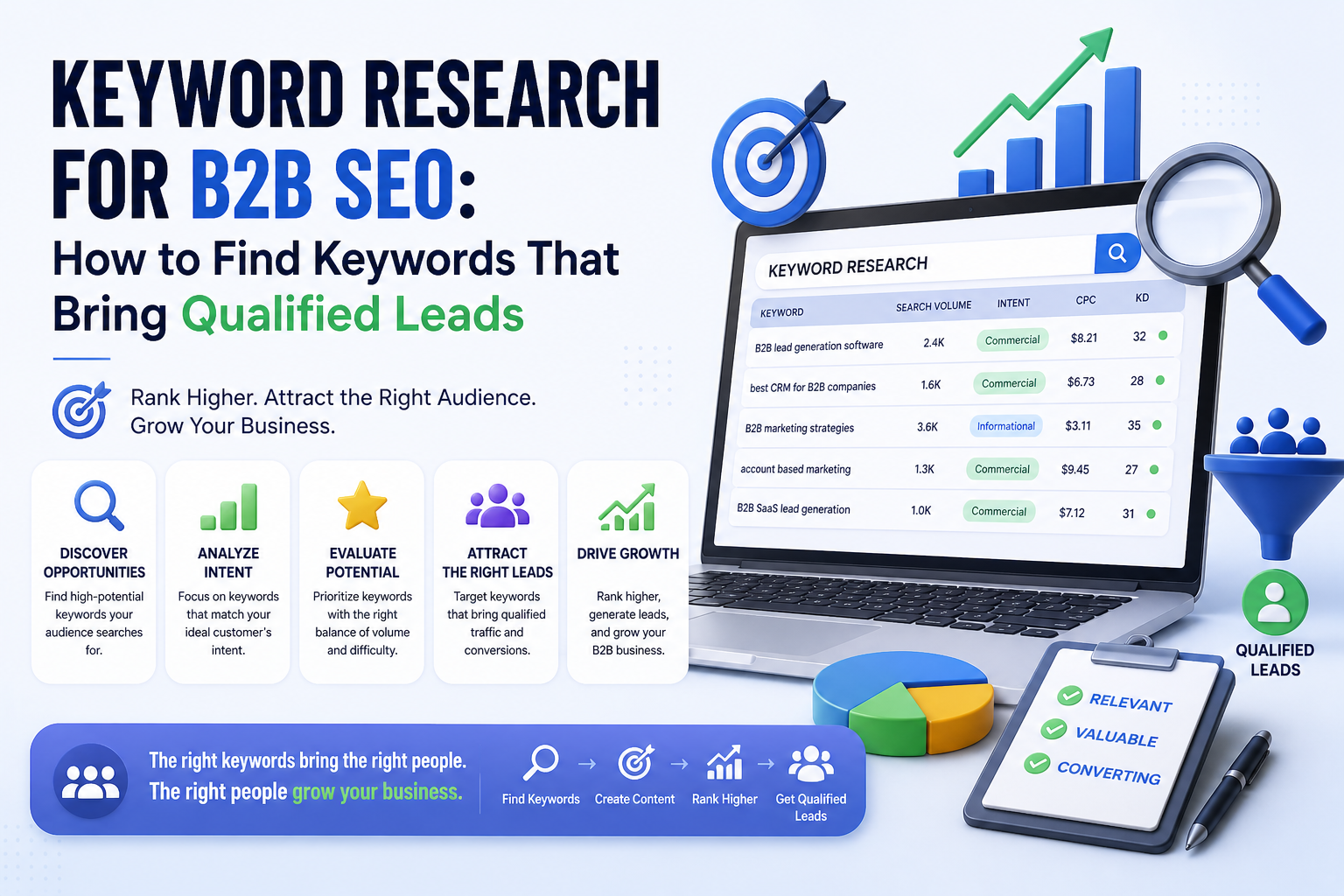
B2B SEO is not about driving as much traffic as possible. It is about driving the right traffic — the decision-makers, procurement managers, and agency owners who are actively evaluating solutions like yours. And it all starts with keyword research for B2B SEO that prioritizes intent over volume.
The challenge is that B2B SEO keywords often look unimpressive in a keyword tool. Low monthly search volume, no obvious commercial signal, sometimes zero data. But behind those quiet keywords sit buyers with five-figure budgets ready to make a decision. If you are optimizing for vanity metrics, you are leaving your best leads on the table.
This guide walks you through a practical, step-by-step approach to finding, evaluating, and mapping keywords that bring qualified B2B leads — not just pageviews.
Why B2B Keyword Research Is Different
Consumer keyword research and B2B keyword strategy follow very different rules. Understanding the difference is the first step to building a strategy that generates a pipeline.
- Longer buying cycles: B2B buyers research for weeks or months before converting. Your keyword strategy needs to cover every stage of that journey — not just the moment of purchase.
- Multiple decision-makers: A single deal might involve an SEO manager, a marketing director, and a CFO. Each searches differently. Your keyword map needs to cover all three.
- Low volume, high value: A keyword with 50 monthly searches might represent 10 potential enterprise clients. Never filter by volume alone in B2B.
- Intent over volume: The searcher behind ‘white label link building for agencies’ is far more valuable than ‘what is link building’ — even if the second gets 10x the searches.
- Longer content required: B2B buyers want depth. Thin content does not build the trust needed to convert a senior decision-maker. Comprehensive, authoritative content wins.
Step 1 — Define Your B2B Buyer and Their Search Behaviour
Before you open a keyword tool, you need to know who you are targeting. How to find B2B keywords starts not with a tool but with a clear picture of your ideal client.
Ask yourself:
- Who is the buyer? Job title, company size, industry, and level of SEO sophistication
- What problem are they trying to solve? Not what your service does — what pain they are experiencing that led them to search
- What stage of awareness are they in? Have they identified the problem, are they evaluating solutions, or are they ready to buy?
- What language do they use? Industry jargon, acronyms, or plain language? This directly affects which keywords they search
For a link building agency like MonkeyGoals, the buyer profile might be an SEO agency owner looking to white label link building, or an in-house SEO manager at a SaaS company looking to scale their backlink acquisition. Each has a different B2B SEO keywords profile — and each needs a different content approach.
Step 2 — Map Keywords to the B2B Buying Funnel
The most effective keyword research for B2B SEO maps keywords to each stage of the buying funnel. This ensures you capture buyers at every point of their research journey — not just the moment they are ready to convert.
Funnel Stage | Search Intent | Keyword Examples | Goal |
|---|---|---|---|
Top of Funnel | Informational | What is B2B SEO? How does link building work? | Build awareness |
Middle of Funnel | Commercial | best link building agency for SaaS, guest post services comparison | Nurture consideration |
Bottom of Funnel | Transactional | Buy guest posts DR 40, white label link building pricing | Drive conversion |
Retention | Navigational | MonkeyGoals login, link building report template | Retain clients |
Pro tip: Bottom-of-funnel keywords have the lowest search volume but the highest conversion rate. Always prioritize them first, then build out the rest of the funnel.
Step 3 — The Keyword Metrics That Actually Matter for B2B
Most SEOs filter by search volume and keyword difficulty. In a B2B keyword strategy, two other metrics matter far more: CPC and search intent. Here is a full breakdown of what to evaluate.
Metric | What It Means | B2B Priority | Why It Matters |
|---|---|---|---|
Search Volume | Monthly searches for the keyword | Medium | B2B keywords often have low volume but high value |
Keyword Difficulty | How hard it is to rank on page one | High | Target KD 0–40 before your domain has authority |
CPC (Cost Per Click) | What advertisers pay per click | Very High | High CPC = high commercial value = qualified buyers |
Search Intent | What the searcher actually wants | Critical | Mismatched intent = traffic that never converts |
Topical Relevance | How closely the keyword fits your niche | Critical | Google rewards depth over breadth in 2026 |
The B2B golden rule: A keyword with a $15 CPC and 100 monthly searches is more valuable than a keyword with a $1 CPC and 10,000 monthly searches. High CPC is a direct proxy for commercial intent and buyer quality.
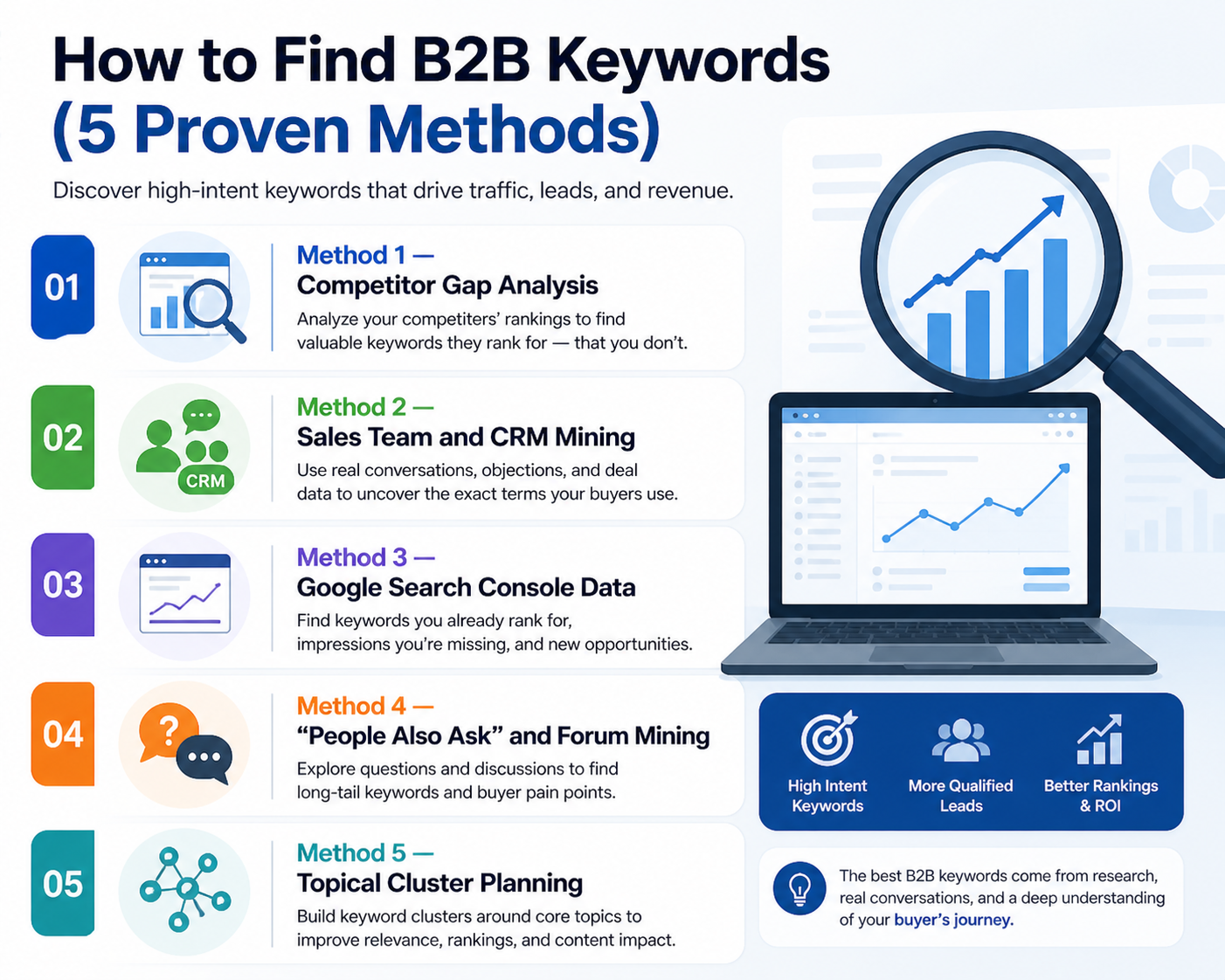
Step 4 — How to Find B2B Keywords (5 Proven Methods)
Here are the five most reliable methods for finding B2B keywords that bring qualified leads rather than general traffic.
Method 1 — Competitor Gap Analysis
This is the fastest way to find proven B2B keywords. Find which keywords your competitors rank for that you do not — these are ready-made opportunities with confirmed search demand.
- Open Ahrefs or Semrush and enter your top 3 competitors’ domains
- Use the Content Gap or Keyword Gap tool to find keywords they rank for that you do not
- Filter by CPC above $3 to surface only commercially valuable keywords
- Sort by keyword difficulty below 40 to find realistic ranking opportunities
Method 2 — Sales Team and CRM Mining
Your sales team and CRM are gold mines for keyword research for lead generation. The exact language prospects use when inquiring is the language they also use when searching.
- Review the last 50 inbound inquiries—what problem did they describe?
- Check the questions asked on discovery calls
- Look at the subject lines of inbound emails
- Mine your live chat transcripts for recurring phrases
Pro Tip: Real language from real buyers almost always uncovers keywords that no tool would suggest — especially in niche B2B verticals where search volume data is sparse.
Method 3 — Google Search Console Data
If your site already gets any organic traffic, Google Search Console contains real keyword data you cannot find anywhere else — the actual queries people typed before landing on your pages.
- Go to Performance > Search Results and set the date range to the last 12 months
- Sort by clicks, then by impressions, to find keywords with high impressions but low clicks — these are ranking gap opportunities
- Filter by pages to see which keywords drive traffic to each service page — then look for related terms you are not yet targeting
Method 4 — “People Also Ask” and Forum Mining
Google’s People Also Ask boxes are a direct window into what B2B lead generation SEO buyers are asking. Search your core topic and collect every PAA question — these become content topics, FAQ sections, and long-tail keyword targets.
- Search your primary keyword in Google and screenshot all PAA questions
- Check LinkedIn posts and comments in your niche for recurring questions
- Search Reddit and industry forums (e.g., r/SEO, Moz community) for threads about your service
- Use AnswerThePublic to generate question-based keyword variations at scale
Method 5 — Topical Cluster Planning
In 2026, Google rewards sites that demonstrate deep expertise in a topic area. Keyword research for B2B SEO should not just find individual keywords — it should build a topical cluster that covers a subject comprehensively.
- Choose a core pillar topic (e.g., “link building for SaaS“) and build one long-form pillar page targeting the head keyword
- Identify 8 to 12 cluster topics that support the pillar (e.g., “guest posting for SaaS,” “SaaS backlink strategy,” and “link building ROI for SaaS”)
- Link every cluster page back to the pillar — this signals topical authority to Google and boosts the entire cluster’s rankings
Best Tools for B2B Keyword Research in 2026
The right tools make B2B keyword strategy significantly faster and more accurate. Here is a practical comparison of the tools that work best for B2B use cases.
Tool | Best For | Pricing | B2B Strength |
|---|---|---|---|
Ahrefs | Competitor gap analysis, backlink data | From $129/mo | Best keyword explorer for intent filtering |
Semrush | Full keyword research suite, topic clusters | From $139/mo | Strong B2B intent data and CPC signals |
Google Search Console | Real search data from your own site | Free | Shows actual queries bringing traffic |
AnswerThePublic | Question-based keyword discovery | From $9/mo | Great for content gap and FAQ keywords |
Keyword Insights | Keyword clustering and intent grouping | From $58/mo | Ideal for mapping keywords to content briefs |
Step 5 — Prioritise Your Keyword List for Maximum ROI
Once you have a list of potential B2B SEO keywords, you need to prioritize them. Not all keywords deserve equal effort. Use this framework to decide where to start.
Tier 1 — High Priority (Build First)
- Bottom-of-funnel transactional keywords with clear buying intent
- Keywords with CPC above $5 indicating strong commercial value
- Keywords where competitors rank but your site does not — proven demand, clear gap
- Keywords directly matching your service pages — these drive the most qualified traffic
Tier 2 — Medium Priority (Build Next)
- Middle-of-funnel comparison and evaluation keywords (e.g., “best X for Y”)
- Long-tail question keywords that map to FAQ or blog content
- Niche vertical keywords (e.g., “link building for e-commerce” and “SEO for SaaS startups”)
Tier 3 — Long-term (Build Over Time)
- Top-of-funnel informational keywords that build brand awareness
- Zero-volume keywords with clear intent but no measurable search data yet
- Trend-based keywords emerging in your niche — capture early before competition rises
The Link Between Keyword Research and Link Building
Here is where most keyword research for B2B SEO guides stops — but this is the most important part for actually ranking.
Finding the right B2B SEO keywords is only step one. Ranking for them requires authority — and authority in 2026 comes primarily from high-quality backlinks pointing to your target pages. This is the direct bridge between keyword strategy and link building.
You can have the best keyword research in your niche. But if the pages you want to rank have no backlinks, your competitors with stronger link profiles will outrank you every time — regardless of how good your content is.
For each Tier 1 keyword you identify, you need to answer these questions:
- What page on my site targets this keyword? If no page exists, create one.
- How many backlinks do the top 3 ranking pages have? This is your benchmark—match or exceed it to compete.
- What DR do the top ranking sites have? If they are DR 50+ and you are DR 20, start building authority in your domain first.
- What anchor text are competitors using? This tells you exactly how to brief your link building campaign.
At MonkeyGoals, we build links directly to your target pages — the ones already mapped to your highest-priority B2B lead generation SEO keywords. Guest posts and niche edits starting at $79 per placement, all manually outreached on traffic-verified, topically relevant sites.
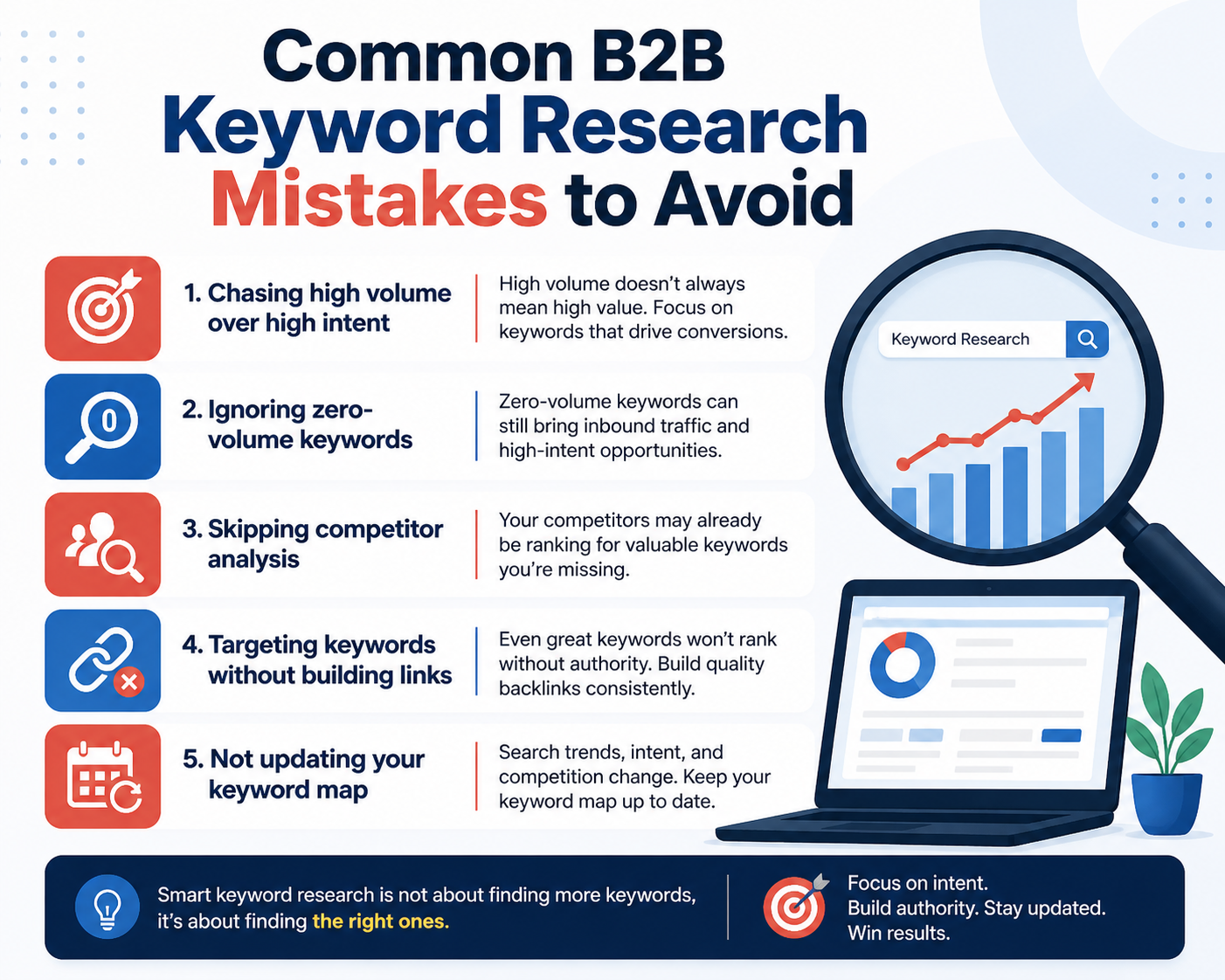
Common B2B Keyword Research Mistakes to Avoid
Even experienced SEOs make these mistakes when building a B2B keyword strategy. Avoid them to protect your time and budget.
- Chasing high volume over high intent: A keyword with 10,000 monthly searches that attracts beginners will never convert as well as a 200-search keyword that attracts buyers.
- Ignoring zero-volume keywords: In B2B, many of the most valuable keywords show zero volume in tools but represent real, high-intent search behaviour.
- Skipping competitor analysis: Your competitors have already done the keyword research for you — their ranking pages prove demand. Always start here.
- Targeting keywords without building links: Great keyword research with no link building is like building a shop in the middle of a desert. The content will not rank without authority.
- Not updating your keyword map: B2B search behaviour shifts with industry trends, new tools, and algorithm updates. Review your keyword strategy every six months at a minimum.
Final Thoughts
Effective keyword research for B2B SEO is not about finding the highest-volume keywords in your niche. It is about finding the keywords your best buyers are searching for at every stage of their decision journey — and building the content and authority to rank for them.
Start with your buyer profile. Map keywords to funnel stages. Prioritise by intent and CPC, not volume. Build topical clusters around your core services. And for every high-priority keyword, run a link building campaign to give your pages the authority they need to compete.
The sites winning B2B SEO in 2026 are not the ones with the most content — they are the ones with the most relevant content backed by the strongest backlink profiles. Get both right and qualified leads to follow.
Ready to rank for the keywords your B2B buyers are actually searching?
At MonkeyGoals, every link building campaign starts with understanding what your ideal clients are searching for. We build backlinks that target the exact keywords driving the B2B pipeline — starting at $79 per placement, with bulk pricing for agencies.