
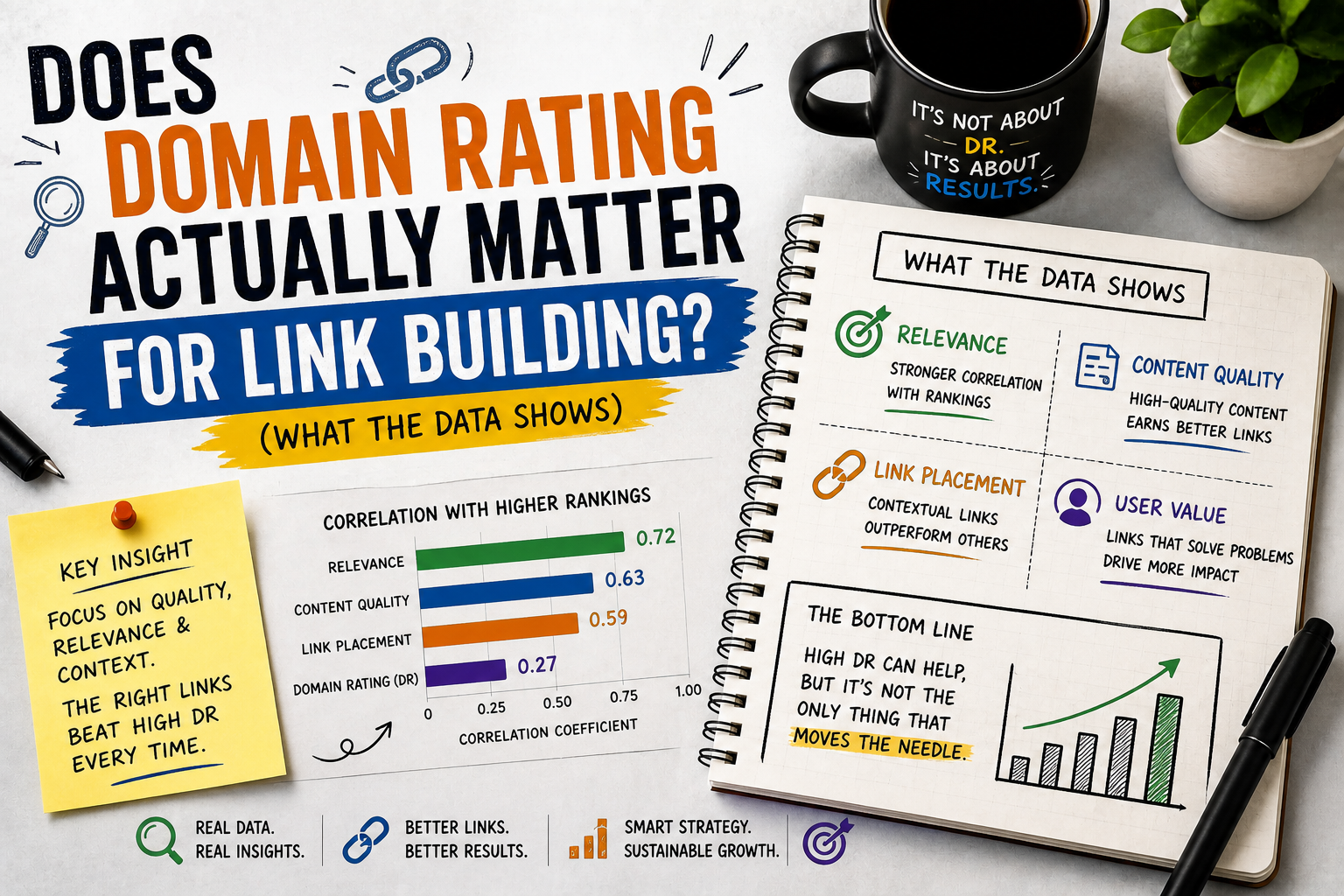
Before every link building purchase, the same question comes up. What DR should the site be? Is DR 20 good enough? Should I pay more for DR 50? The metric is everywhere — in every pricing table, every campaign brief, every client presentation. But most people using it have never stopped to ask whether domain rating matters for SEO in the way they assume it does.
The honest answer is more nuanced than the tools that invented DR want you to believe. DR is useful — but it is frequently misused, overused, and chased as a goal in itself when it should only ever be a diagnostic signal. This article breaks down exactly what DR measures, what it does not measure, when it matters, and how to choose DR for guest posts and link insertions that actually move rankings.
What Is Domain Rating and How Is It Calculated?
Domain Rating (DR) is a metric developed by Ahrefs that measures the strength of a website’s backlink profile on a logarithmic scale from 0 to 100. The higher the score, the stronger the backlink profile — meaning more high-authority sites are linking to that domain.
DR is calculated based on three factors:
- Number of unique referring domains: How many distinct websites link to the domain — not total backlinks, just unique domains
- DR of those referring domains: A link from a DR 80 site contributes far more than a link from a DR 15 site
- Outbound links from the referring domain: If a DR 70 site links to 5,000 other websites, each individual link is worth less than if it only links to 50
The scale is logarithmic — meaning the jump from DR 10 to DR 20 is much easier than the jump from DR 60 to DR 70. This is why domain rating for link building benchmarks looks very different across niches: a DR 35 site in a specialist B2B niche can outrank a DR 60 site in a less competitive market.
Critical distinction: DR is an Ahrefs metric. It is not a Google metric. Google does not see your DR, does not calculate it, and does not use it as a ranking signal. What Google does use are the actual backlinks that DR attempts to approximate. DR is a proxy — useful for quick assessments, but not the thing itself.
Domain Rating vs Domain Authority: What Is the Difference?
Before going further, it is worth clarifying the difference between domain rating vs domain authority — because they are often used interchangeably but measure different things.
Metric | Created by | What it measures | Best used for |
Domain Rating (DR) | Ahrefs | Strength of the backlink profile only | Evaluating link building opportunities and host site quality |
Domain Authority (DA) | Moz | Predicted ranking ability across multiple SEO signals | Comparing overall site strength against competitors |
Authority Score (AS) | Semrush | Backlink quality + organic traffic + spam signals combined | Broader site health check, including traffic verification |
URL Rating (UR) | Ahrefs | Backlink strength of a specific page (not domain) | Evaluating individual page authority before niche edit placement |
For domain rating for link building decisions specifically, DR is the most commonly referenced metric because it focuses purely on backlinks, which is what you are evaluating when choosing where to place a link. But as you will see below, using DR alone without checking organic traffic is one of the most common and costly mistakes in link building.
Does Domain Rating Actually Matter for SEO?
Yes — but not in the way most people think. Does domain rating matter for SEO? The answer is DR matters as a proxy for backlink quality, but it is not a ranking signal; it is not the only thing that determines link value, and chasing a high DR number at the expense of relevance and traffic is one of the most common ways link building campaigns fail.
Here is what the data actually shows:
- DR correlates with rankings — but does not cause them. A 2023 study published in a peer-reviewed SEO research journal found that sites with higher DR and DA scores are more likely to rank — but correlation is not causation. High-DR sites rank because they have strong backlink profiles, good content, and technical SEO. DR is the symptom, not the cure.
- A DR 30 site with real traffic beats a DR 60 site with none. This is the insight that most link buyers miss entirely. Is DR 20 good for backlinks? It can be — if the site has 2,000 monthly organic visitors, is topically relevant, and has a clean outbound link profile. A DR 60 site with zero traffic is a site Google does not trust enough to send users to. Link equity from dead traffic is far weaker than link equity from an active, trusted publication.
- Topical relevance can outperform a 20-point DR advantage. Google’s entity-based algorithm weights relevance heavily in 2026. A DR 30 backlink from a site in your exact niche consistently outperforms a DR 50 backlink from a generic lifestyle blog for keyword-level ranking movement.
- DR is logarithmic — so the gap between tiers matters less than it appears. The difference in link value between DR 30 and DR 40 is meaningful but not enormous. The difference between DR 20 and DR 70 is massive. Do not pay premium prices for a DR 45 when a DR 35 on a more relevant, higher-traffic site is available for less.
The DR Sweet Spot: Where the Best Link Building ROI Sits
COMPETITOR GAP: Ahrefs, Semrush, and Moz will never publish this. They created DR — they cannot tell you that mid-tier DR links often outperform premium DR links on ROI. This is the most valuable section in any article on this topic.
The link building industry has a premium DR obsession. Agencies charge 3x to 5x more for DR 60+ placements. Clients chase high numbers without understanding the return. But the data from real campaigns consistently shows that the best domain rating for link building ROI sits in the DR 30 to 50 range — not DR 60+.
Here is why:
DR Range | Cost per link (approx) | Typical organic traffic | Topical availability | ROI for most campaigns |
DR 10–20 | $40–$80 | Low (100–500/mo) | Wide | Low — often low-quality sites, minimal trust signal |
DR 20–30 | $79–$120 | Medium (300–1k/mo) | Wide | Good — strong ROI when topically matched and traffic-verified |
DR 30–50 | $120–$260 | Strong (1k–10k/mo) | Good | Best ROI — authority + traffic + availability at a reasonable cost |
DR 50–65 | $260–$450 | High (5k–50k/mo) | Limited | Strong — worthwhile for competitive keywords, diminishing returns |
DR 65+ | $450–$1,500+ | Very high (50k+/mo) | Very limited | Premium — reserve for high-KD keywords and YMYL niches |
The DR 30 to 50 tier is the sweet spot for most campaigns because it combines genuine authority with real organic traffic, topical availability across most niches, and a cost-per-link that allows consistent monthly volume. Campaigns built on 6 to 8 DR 35 to 45 placements per month consistently outperform campaigns built on 2 DR 65 placements per month — at the same budget.
At MonkeyGoals, our most popular packages sit precisely in this range. Our guest posting packages and link insertion service both start at DR 20 and scale to DR 70+, with the DR 30 to 50 tier consistently delivering the strongest results per dollar across our client campaigns.
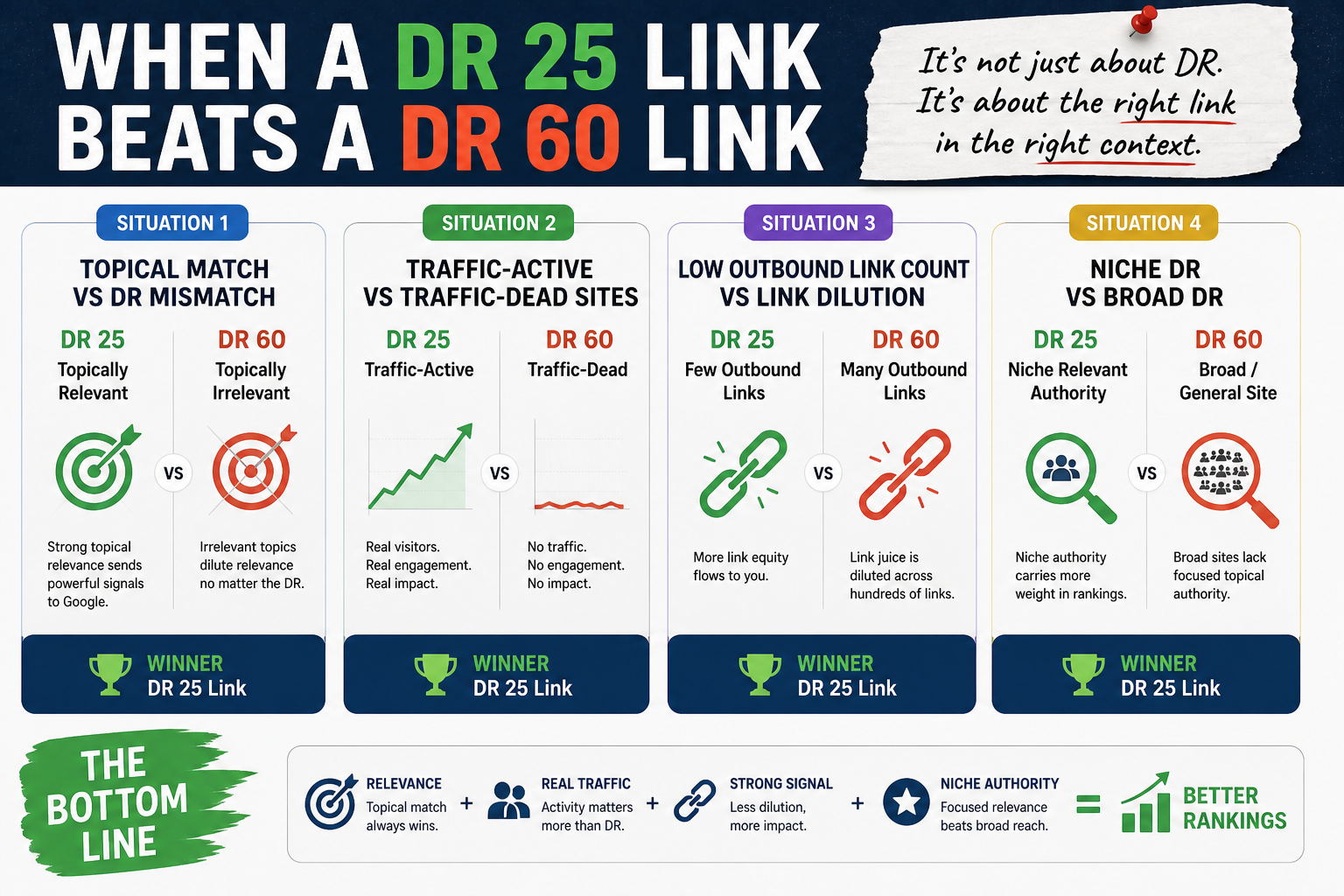
When a DR 25 Link Beats a DR 60 Link
COMPETITOR GAP: No tool company will ever publish this analysis. They have a commercial interest in you valuing high DR. Here is the honest breakdown of when lower DR links outperform.
There are specific, repeatable situations where a lower domain rating placement outperforms a higher DR placement. Understanding these situations is what separates strategic link building from metric-chasing.
Situation 1 — Topical match vs DR mismatch
A DR 25 gardening blog linking to your garden tools ecommerce page passes stronger topical authority than a DR 60 general news site linking to the same page. Does DR affect rankings? Yes — but topical relevance amplifies or diminishes the impact of every link. Never sacrifice relevance for DR.
Situation 2 — Traffic-active vs traffic-dead sites
A DR 28 site with 3,000 monthly organic visitors is a site Google actively crawls, trusts, and sends users to. A DR 55 site with 200 monthly visitors is a site Google has largely deprioritized. The low DR backlinks are worth it. The question is almost always yes when the site has real, verifiable organic traffic. Check traffic in Ahrefs or Semrush before every placement, regardless of the DR.
Situation 3 — Low outbound link count vs link dilution
If a DR 60 site links to 800 other domains from the same page, each link is heavily diluted. If a DR 30 site has only 12 outbound links on the host page, your link receives a far higher share of the page’s authority. Page-level link dilution is a factor most buyers completely ignore when chasing DR scores.
Situation 4 — Niche DR vs broad DR
A DR 35 in the legal, finance, or health niche represents significantly more editorial credibility than a DR 35 in entertainment or general lifestyle. Google’s E-E-A-T framework weighs the authority of the source domain within its specific vertical. What is a good domain rating for link building in your niche is a different number from the average across all niches.
What Is a Good Domain Rating by Niche?
COMPETITOR GAP: Every competitor gives a single universal DR benchmark. Nobody accounts for niche variation. A DR 30 in finance is worth more than a DR 30 in entertainment — here is the breakdown.
The question of what is a good domain rating for link building has no single answer — it depends entirely on the niche you are operating in. Here is a realistic benchmark table by niche, based on what DR levels are typically needed to compete in each vertical.
Niche | Minimum DR to be useful | Target DR for competitive keywords | Why it differs |
Finance / Legal / Medical (YMYL) | DR 40+ | DR 55 to 70+ | Google’s E-E-A-T requirements are strictest here — low-DR links in YMYL carry minimal weight |
SaaS / B2B Tech | DR 25+ | DR 40 to 60 | Competitive but not YMYL — mid-tier DR from specialist publications performs strongly |
Ecommerce | DR 20+ | DR 35 to 55 | Product and category pages respond well to mid-DR links when topically matched to the product niche |
Real Estate | DR 25+ | DR 35 to 55 | Local and national real estate varies — local campaigns can rank with lower DR from local publications |
Health & Wellness | DR 35+ | DR 50 to 65 | Partial YMYL — Google scrutinises health content closely, editorial credibility matters as much as DR |
Lifestyle / General | DR 15+ | DR 25 to 45 | Lower competition means lower DR can rank — volume and relevance matter more than premium DR here |
Green Energy / Sustainability | DR 20+ | DR 30 to 50 | Emerging niche with growing content ecosystem — mid-DR from specialist publications works well |
If you are running a link building campaign in the legal, finance, or health space, see our link building for lawyers guide for a deeper breakdown of E-E-A-T requirements and the DR thresholds that matter in YMYL verticals.
How to Choose the Right DR Tier for Your Campaign
COMPETITOR GAP: No competitor gives a practical DR selection framework. They define DR and move on. This is what buyers actually need before making a purchase decision.
When it comes to how to choose DR for guest posts and link insertions, the right answer is not ‘the highest DR you can afford.’ It is the DR that matches your current domain authority, your target keyword difficulty, and the competitive landscape of the SERP you are trying to rank in.
Use this three-step process before selecting a DR tier:
Step 1 — Check the DR of your top 3 competitors
Open Ahrefs and check the referring page DR for the pages currently ranking positions 1 to 3 for your target keyword. This tells you the average DR of links that are already working in your specific SERP. Match or slightly exceed this benchmark — do not pay for DR that far exceeds what the top results already have.
Step 2 — Match DR to your own domain’s current authority
Building DR 60 links to a DR 10 site creates an unnatural authority spike that Google’s algorithm can flag. A natural, healthy backlink profile for a DR 15 site includes a majority of links from DR 20 to 40 sites — with occasional DR 50+ links from high-profile mentions. DR 30 vs DR 50 backlinks is not always a clear win for DR 50 when your domain is still in the early building phase.
Step 3 — Factor in your keyword difficulty target
Use this quick reference guide when briefing your link building campaign:
Your target KD | Recommended DR tier | Links per month (approx) | Expected timeline |
KD 0–20 | DR 20 to 35 | 3 to 5 | 2 to 4 months |
KD 20–40 | DR 30 to 50 | 4 to 7 | 3 to 6 months |
KD 40–60 | DR 40 to 60 | 6 to 10 | 5 to 9 months |
KD 60+ | DR 55 to 70+ | 8 to 15+ | 8 to 14+ months |
For a full breakdown of how long link building takes to show results at each DR and KD combination, see our dedicated timeline guide.
How to Evaluate a Link Beyond Just DR
COMPETITOR GAP: All competitors stop at DR. None give a full link evaluation checklist. This section turns DR from a single number into a complete vetting framework.
Using DR as your only quality filter is like judging a restaurant by its Michelin star count without checking if it is open, serves the food you want, or is in the right city. Here is the complete checklist to evaluate any placement beyond its domain rating:
Quality signal | What to check | Minimum threshold | Tool to use |
Domain Rating (DR) | Overall backlink profile strength | DR 20+ for most niches, DR 40+ for YMYL | Ahrefs |
Organic traffic | Monthly visitors from Google search | 500+ monthly visitors minimum | Ahrefs / Semrush |
Topical relevance | Is the site in your niche or related niche? | Direct niche match preferred | Manual review |
Outbound link ratio | How many external links on the host page? | Under 8 outbound links per page | Manual check |
Spam score | Percentage of spammy signals on the domain | Under 10% on Moz Spam Score | Moz |
Content quality | Is the site’s content original and editorial? | Real editorial standards, no spun content | Manual review |
Link neighbourhood | What other sites does this domain link to? | No links to gambling, adult, or PBN sites | Ahrefs outgoing links |
Indexing status | Is the host page indexed and ranking? | Page must be indexed in Google | Google site: search |
At MonkeyGoals, every placement is verified against all eight signals above before delivery. We do not accept placements that pass DR but fail on traffic, topical relevance, or link neighborhood quality. This is why our links produce consistent ranking movement rather than just DR inflation.
Want to understand how we source and vet placements? See our full guide on white label link building — which includes the complete red-flag checklist we use to evaluate every host site.
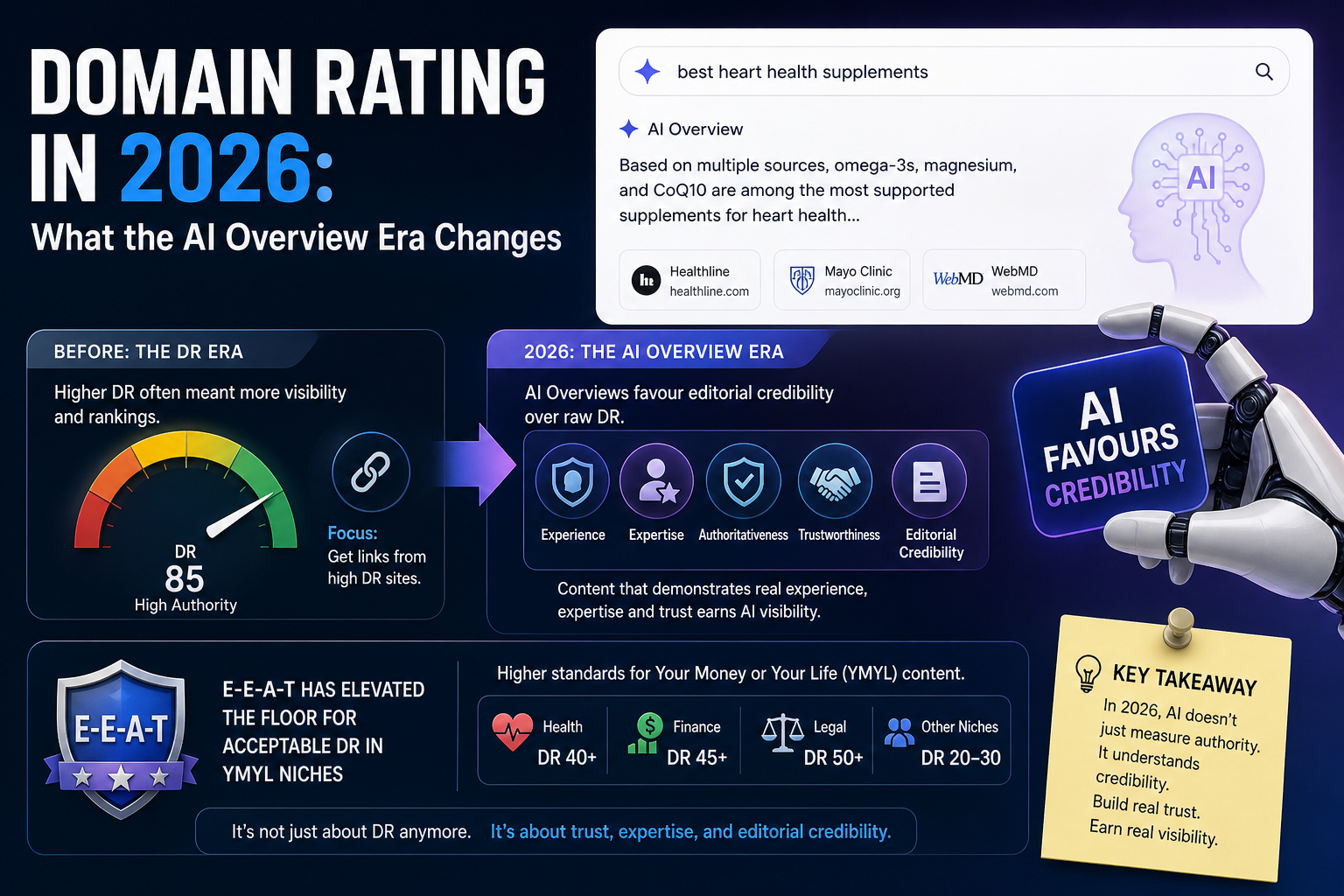
Domain Rating in 2026: What the AI Overview Era Changes
The SEO landscape in 2026 has added a new dimension to the question of how important is DR for SEO. Two algorithm developments are directly relevant to how DR should inform your link building decisions.
AI Overviews favour editorial credibility over raw DR
Google’s AI-generated answer boxes increasingly cite sources based on editorial credibility and topical expertise — not just backlink strength. A DR 35 site that is a genuine, active publication in your niche is more likely to be cited in AI Overviews than a DR 55 site with stale, generic content. When evaluating host sites for guest posts, look for editorial activity — fresh content, real authors, and social engagement — not just DR scores.
E-E-A-T has elevated the floor for acceptable DR in YMYL niches
Google’s E-E-A-T framework (Experience, Expertise, Authoritativeness, and Trustworthiness) has raised the effective minimum domain rating that carries meaningful authority in health, finance, and legal niches. A DR 20 health site that was useful in 2021 carries significantly less weight in 2026 because Google has sharpened its assessment of what constitutes genuine expertise in regulated verticals.
Final Thoughts
Does domain rating matter for SEO? Yes — but it matters less, and in more specific ways, than most link buyers assume. DR is a useful proxy for backlink profile strength. It is not a Google ranking signal. It does not account for organic traffic, topical relevance, or editorial quality — all of which have become more important in 2026, not less.
The sites building the most effective link profiles in 2026 are not the ones chasing the highest DR. They are the ones evaluating every placement against the full quality checklist — DR, traffic, relevance, outbound link ratio, and content standards — and building consistent monthly volume in the DR 30 to 50 sweet spot where authority meets availability meets ROI.
Use DR as a starting filter, not a final decision. Pair it with organic traffic verification and topical relevance. And remember that ten well-chosen DR 35 placements on relevant, active publications will consistently outperform two DR 65 placements on generic, low-traffic sites — at a fraction of the cost. For a deeper look at how guest posts vs niche edits perform across different DR tiers, see our full comparison guide.
Not sure which DR tier is right for your campaign? Get a free backlink audit from MonkeyGoals.
We analyze your current backlink profile, your target keywords, and the DR of competing pages — then recommend the exact DR tier that will move your rankings fastest. Guest posts and link insertions from $79.